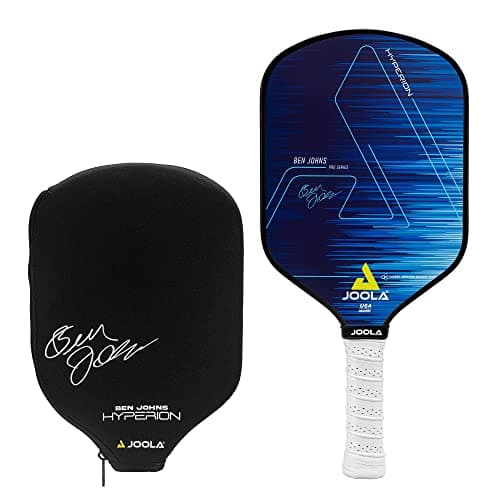
The JOOLA Ben Johns Hyperion is a spin paddle first and everything else second — and if spin is not the thing you are trying to buy, there are better ways to spend the money. It is the paddle that put the elongated shape and the gritty carbon face at the center of competitive pickleball, and it is still the pick on our best paddles for spin list. It is also heavy, sharply shaped, and unforgiving of sloppy contact. All three of those are the same design decision.
What the Hyperion actually is
The Hyperion is JOOLA's signature line for Ben Johns, built around an elongated head and a textured carbon face that JOOLA calls the Carbon Friction Surface, or CFS. The marketing name matters less than the mechanism: the face is deliberately textured rather than smoothed under a finish coat, so the surface grips the ball on contact instead of sliding across it. Grip is what converts a fast swing into topspin, and topspin is what lets you hit a hard third-shot drive that still drops inside the baseline.
The rest of the paddle exists to serve that. The head is elongated — 16.5 inches long by 7.5 inches wide, per JOOLA's published dimensions — which moves mass away from your hand and gives the swing more leverage through the ball. The handle is 5.5 inches, long enough for a genuine two-handed backhand. JOOLA lists a 16mm reactive polymer honeycomb core, a foam edge wall it markets as Hyperfoam, and an average weight of 8.4 ounces, with Pickleball Central publishing a standard production range of 8.2 to 8.6 ounces.
The published specs
Everything below is JOOLA's own figure for the CFS 16, cross-checked against the Pickleball Central spec sheet. We did not measure any of it — we do not have a lab, and our methodology says so in plain language.
| Spec | Published figure |
|---|
| Length x width | 16.5 in x 7.5 in (elongated) |
| Core | 16mm reactive polymer honeycomb |
| Face | Carbon Friction Surface (Carbon-Flex5 texture) |
| Handle length | 5.5 in |
| Grip circumference | 4.25 in (JOOLA notes it may vary) |
| Average weight | 8.4 oz (range 8.2–8.6 oz) |
| Edge guard | 1/4 in overlapping the face |
| Tournament status | JOOLA states USAP approved, PBCoR .43 certified |
That last row is a manufacturer claim, and it is the kind of claim you can check yourself in about thirty seconds: USA Pickleball publishes a searchable approved-paddle database you can query by brand and model before you enter a sanctioned tournament. Do that rather than trusting any review site, including this one.
Which Hyperion you are actually buying
This is the part most reviews skip, and it is the part that will actually cost you money. The Hyperion is a line, not a paddle. JOOLA has published several versions of it, and they do not play the same:
| Version | Core | Avg weight |
|---|
| Hyperion CFS 16 | 16mm | 8.4 oz |
| Hyperion C2 CFS 14 | 14mm | 7.8 oz |
| Hyperion CAS 16 | 16mm | 8.3 oz |
The thickness change is not cosmetic. A 16mm core is softer and more absorbent, which is why JOOLA scores the CFS 16 higher for control than for power on its own product page; the 14mm C2 is thinner, hotter and lighter, and JOOLA reverses those two scores for it. Our 14mm vs 16mm guide covers what that difference feels like in the hand. The CAS is a different face— Carbon Abrasion Surface rather than Carbon Friction Surface — and it sits below the CFS in JOOLA's own line.
Here is the honest problem: the Amazon listing title reads “JOOLA Ben Johns Hyperion Pickleball Paddle — Carbon Surface, High Grit & Spin, Elongated Handle, Polypropylene Honeycomb Core” and does not print the core thickness. The specs on this page are JOOLA's published figures for the 16mm CFS. Before you check out, read the variant you have selected and confirm it is the one you want. We are not going to pretend we can resolve that from a listing title.
Who it is for
A 4.0-and-up player whose points come from pace and shape — heavy topspin drives, dipping third shots, a two-handed backhand that wants the extra handle length. If that describes how you win, the Hyperion is a genuinely good tool and the elongated head gives you reach on the stretch volleys that decide kitchen exchanges. It is the second pick on our best paddles for advanced players list for exactly that reason.
Three honest reasons to skip it
It is heavy.8.4 ounces average is at the upper end of the modern field, and the elongated shape pushes that weight further from your hand, so it swings heavier than the number alone suggests. The Dink's reviewer, who liked the paddle overall, wrote plainly that “if you have problems with heavier paddles, this is not the paddle for you.” Fast hands battles at the net are where you will feel it. Our paddle weight guide explains where the threshold usually sits.
The sweet spot is smaller.Every elongated paddle trades forgiveness for reach and leverage — the same surface area, distributed into a narrower shape. If you are still catching the ball off-center more than occasionally, that trade costs you more than the spin gains you. See elongated vs standard shapes before you commit.
The grit is a consumable.A textured carbon face generates spin because of its surface texture, and surface texture wears. The Dink's reviewer reported no measurable drop-off after a month of play, which is reassuring but is not a two-year answer. Expect an old face to bite less than a new one, and slow it down with proper cleaning.
Is it still the paddle Ben Johns plays?
Not necessarily, and you should not buy it on that basis. JOOLA has continued to build newer generations of the Ben Johns line since the CFS launched, and a signature paddle sold at retail is a production model, not the specific build a sponsored professional has in his bag. Buy the Hyperion because the elongated shape and the gritty face suit how you play, or do not buy it. The name on it will not add spin to your serve.
What the price actually buys
The Hyperion sits in the premium bracket, and a fair reading is that you are paying for two different things at once: a face and shape that genuinely do what they claim, and a brand that funds a professional tour. The construction is real. So is the marketing overhead. Direct-to-consumer brands sell comparable thermoformed carbon builds for meaningfully less because they do not carry that second cost — that is the whole argument of our Vatic Pro Prism review and the Luzz line review. If you want the construction without the sponsorship budget, start there. If you want JOOLA's quality-control and the resale value that comes with a headline brand, that is a legitimate reason to pay the difference — just make it a decision rather than a default.
One note on availability
Checked 2026-09-06: JOOLA's own store shows the CFS 16 out of stock while Amazon still lists it as in stock. That is normal for a mature model in a line that has moved on, and it is the practical reason this page points at the Amazon listing. It is also a reason not to wait: a model the manufacturer has stopped restocking does not usually come back.
Grip size matters more than the model
JOOLA publishes a 4.25 inch grip circumference on the CFS 16 and a slightly slimmer 4.125 inches on the C2 CFS 14, and notes that both may vary. A grip that is too large is the most common cause of self-inflicted elbow trouble in this sport, and you can always build a small grip up with an overgrip — you cannot shrink a large one. Work through our grip size guide before you order, and if elbow pain is already part of your life, read the tennis elbow picks first: a stiff, heavy, head-weighted paddle is the wrong place to start.
What we cannot tell you
We have not hit a ball with this paddle. No swing weight, no measured twist weight, no durability testing, no comparison of face grit over eighteen months of league play. What we did was read every published spec JOOLA and its retailers print, cross-check them against each other, note where they disagree, and score the result against a rubric we publish. That is a different thing from testing, and we are not going to call it testing.