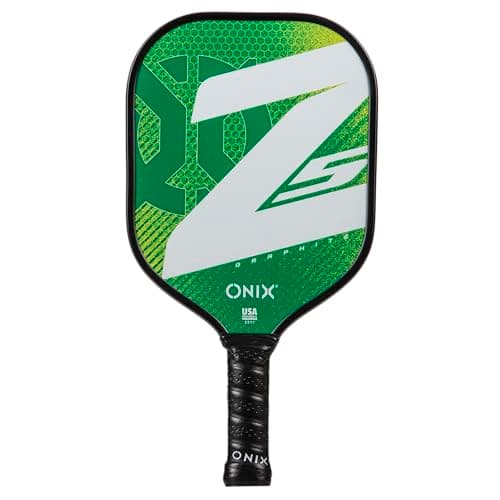
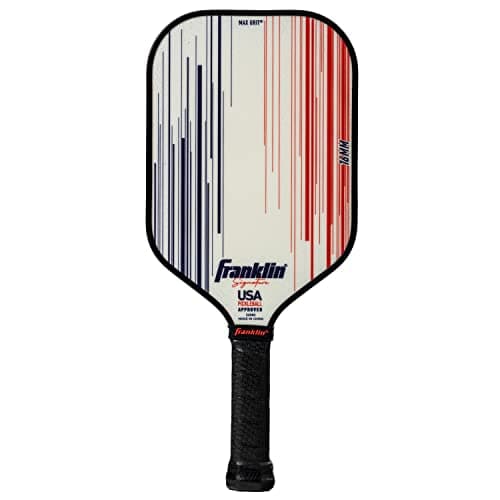
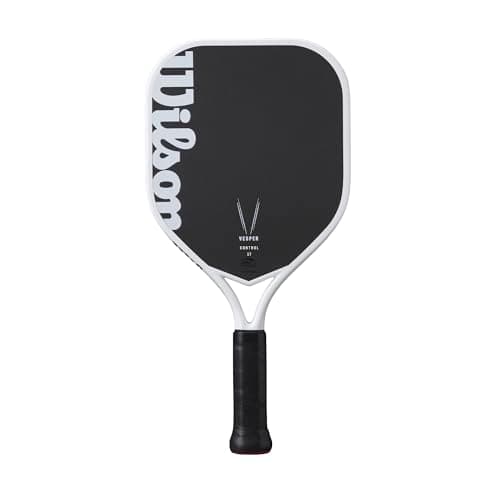
For doubles the Wilson Vesper is our top pick — a control-tuned 17mm paddle built for the soft game where doubles is actually decided. The Onix Z5 is the most forgiving alternative if your hands are still developing, and the Franklin Ben Johns is the best value in the group.
Doubles asks for different things than singles
Almost all recreational pickleball is doubles, and the shape of a doubles point is unlike a singles point. Four players get to the kitchen line within a few shots, and then the game becomes a slow, patient dinking exchange punctuated by two-second bursts of speed-ups and counters at close range. You are rarely covering the whole court alone, and you are rarely hitting a full-swing drive from the baseline.
That changes what a paddle needs to do. Reach and raw power — the things an elongated singles paddle is built for — matter less. What matters is how quickly you can get the face to a ball that arrives from three feet away, how predictably a soft dink comes off the face, and how much the paddle forgives when a fast hand battle catches you off-center. A shorter, more balanced paddle beats a long, head-heavy one at the kitchen almost every time.
What we looked for
Hand speed first. A paddle with less weight out at the tip turns faster in a firefight, and firefights are how doubles points end. Soft-game control second: a thicker core (16mm and up) generally deadens the ball more, which is what you want when the goal is a dink that lands in a seven-foot box rather than a winner. Forgiveness third — a wide face and a broad sweet spot cover the mis-hits that a fast exchange guarantees. Our 14mm vs 16mm core guide explains the thickness trade-off, and the elongated vs standard comparison covers shape.
We deliberately did not rank for power. A doubles paddle that wins you the occasional drive but loses you the hands battle is a bad trade, because the hands battle happens on nearly every point and the drive does not.
How to pick between them
If you already have decent hands and the soft game is where you want to improve, take the Vesper — the thicker, control-tuned build rewards touch. If you are newer, or you play with people who like to speed the ball up at you, the Onix Z5's wide body is the sensible choice; a bigger sweet spot is worth more than a slightly better dink when you are still learning where the middle of the face is. If money is the deciding factor, the Franklin Ben Johns does most of what the Vesper does for meaningfully less, and the GAMMA Conqueror is the cheapest paddle here that still feels like a real paddle rather than a starter.
Whatever you choose, check the grip before you check anything else. A handle that is too big slows your hands down at exactly the moment doubles is decided, and grip circumference is the single most commonly ignored spec on a paddle — our grip size guide walks through measuring it, and sizing down is almost always the right call for doubles.
Should your partner and you use the same paddle?
No, and it is a surprisingly common question. You are covering different sides, you likely have different hand sizes, and if one of you is left-handed your formation matters far more than your equipment — see stacking for how lefty-righty pairs keep two forehands in the middle. Buy for your own hand and your own game.
Weight: lighter than you would pick for singles
A midweight paddle around the middle of the range is the safe doubles default. Heavier paddles add put-away power you will use a handful of times a game and cost you speed in every hands exchange. If you are choosing between two weights and play mostly doubles, take the lighter one. The paddle weight guide covers what you give up in each direction.
Make sure it is approved
If you might ever play in a league or a tournament, buy a USA Pickleball approved paddle. Every pick on this page is a mainstream model from an established brand, but approval status is worth confirming on the listing before you buy — the equipment standards are published, and an unapproved paddle is unusable in organized play no matter how well it plays.
Where doubles paddles and control paddles overlap
There is real overlap between this list and our best control paddles roundup, and that is honest rather than accidental: doubles rewards control. The difference is emphasis. The control list ranks purely on how dead the ball comes off the face; this one balances that against hand speed and forgiveness, because a doubles paddle also has to survive a firefight.