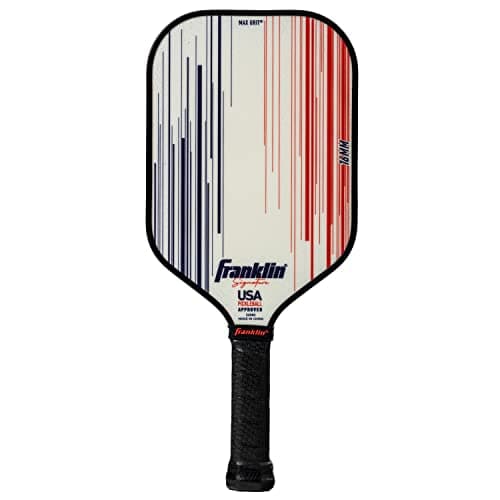
The Franklin Signature Series Pro is the paddle we rank first on our flagship paddle list, and this page is where we show the work behind that call — including the parts that argue against it. It pairs a fiberglass face with a textured coating Franklin calls MaxGrit, a polypropylene honeycomb core in a choice of 13mm or 16mm, and a long 16.5-inch outline, at a price well below the premium bracket. It suits the improving player who has outgrown a first paddle and wants spin without paying for a pro-tour brand. It is a worse fit for a player in their first weeks, for small hands, and for anyone who expects a gritty face to stay gritty forever.
What the Signature Series Pro actually is
Franklin builds this paddle around three decisions, and each one shapes who it suits.
The face is fiberglass, not carbon. Our carbon vs fiberglass guidedescribes fiberglass as the softer, poppier, more forgiving face material — and also the one that grips the ball less, so it generates less spin. Franklin's answer to that weakness is to coat the fiberglass in a texture. Its own listing copy says MaxGrit is “designed for improved traction on the ball to increase spin and dampen vibration.” That combination, a forgiving face material with spin added on top, is the whole idea of the paddle, and it is why it sits between our beginner and intermediate picks rather than squarely in either.
The core is polypropylene honeycomb, in two thicknesses. Franklin sells a 13mm and a 16mm version under the same name. They differ in more than thickness, which we cover below.
The shape is elongated. Franklin lists the paddle at 16.5 inches long by 7.5 inches wide with a 5.6-inch handle. That long, narrow footprint is what our elongated vs standard guide defines as elongated, and Pickleball Central lists the shape the same way. It is worth saying plainly, because an earlier version of our own product card did not.
The published specs (16mm)
Everything below is a published figure: Franklin's own feature bullets on the Amazon listing, cross-checked against the Pickleball Central and Pickleball Warehouse spec sheets. Where the sources disagree, the table says so. We did not measure any of it — we do not have a lab, and our methodology says so in plain language.
| Spec | Published figure |
|---|
| Length x width | 16.5 in x 7.5 in (Warehouse: 7.3 in) |
| Core | 16mm polypropylene honeycomb |
| Face | Fiberglass with MaxGrit coating |
| Handle length | 5.6 in |
| Grip circumference | 4.5 in (Warehouse: 4.75 in) |
| Weight | 7.9–8.3 oz, 8.1 oz average |
| Edge guard | 1/4 in, overlapping the face |
| Swing / twist weight | Not published for the 16mm |
| Tournament status | Listed as USA Pickleball approved |
The width disagreement is small. The grip disagreement is not: Pickleball Central classes a 4.5-inch grip as large and notes that actual grip sizes can vary by up to an eighth of an inch, and the Warehouse figure sits beyond even that. Either way, treat the 16mm's grip as a large one.
The tournament line is a manufacturer and retailer claim, and it is the kind you can check yourself in about thirty seconds: USA Pickleball publishes a searchable approved-paddle database you can query by brand and model before a sanctioned event. Do that rather than trusting any review site, including this one.
13mm or 16mm: which one you are buying
One thing Franklin gets right that some brands do not: the core thickness is printed in the Amazon listing title, so you can see which version you have selected. The buy link on this page goes to the 16mm. The two are not the same paddle in a different thickness — the weight and the grip change too:
| Version | Weight | Grip |
|---|
| 16mm | 7.9–8.3 oz (8.1 avg) | 4.5 in |
| 13mm | 7.5–8.0 oz (7.75 avg) | 4.25 in |
The thickness trade is the one our 14mm vs 16mm guideexplains: a thicker core is softer and more control-oriented, a thinner one poppier. Do not look to Franklin's listing copy to settle it — both versions carry the identical line that the core is “built for durability and increased power,” which tells you nothing about how they differ.
The grip is the difference most buyers miss. The 13mm is the smaller-handled version, and if your hand is small, that alone may decide it for you before core feel ever comes into it. Our grip size guide walks through how to measure.
Franklin publishes a swing weight of 116 and a twist weight of 6.95 for the 13mm, and Pickleball Central repeats both. It publishes neither for the 16mm, so we cannot tell you how the two versions compare on balance or stability, and we are not going to estimate it. For rough context only, Luzz publishes 119.5 and 6.25 across its paddles on our Luzz line review; brands do not all measure these numbers the same way, so treat a cross-brand comparison as a hint rather than a verdict.
One more buying note: each colorway is its own Amazon listing, and they do not always carry the same price. Check the color you actually want against the one linked here before you check out.
Who it is for
The player who has played enough to know they are staying. That might be a beginner a few months in who is starting to want spin on a serve, or an intermediate player who wants a textured face without a premium-bracket price. It is the number-two pick on our best intermediate paddles list and the number-one pick on our best paddles under $100 list for exactly that reason: it is a paddle an improving player is unlikely to outgrow quickly, at a price well below the premium bracket.
It also makes sense for tennis converts. The 5.6-inch handle leaves room for a two-handed backhand, and Pickleball Daily's review makes the same point about the long outline, calling the reach “especially helpful for taller players or those with a tennis background.”
Four honest reasons to skip it
It is elongated, and elongated shapes are less forgiving.Our own shape guide says it directly: a narrower face has a smaller sweet spot, and off-center hits are punished more. Franklin says the fiberglass layer gives the paddle “a large sweet spot,” and Pickleball Daily describes “a generous sweet spot.” Both can be true relative to other elongated paddles; neither changes the geometry. If you are in your first few weeks and still missing the center often, the cheaper niupipo fiberglass paddle is the better place to start, which is exactly how our beginner list ranks the two.
The grit is a coating, and coatings wear.MaxGrit is a texture applied to a fiberglass face. The Pickleball Gang warns that intensive play in hot environments can lead to what it calls grit fading, and writes: “Many competitive players in the US reported that after 10-15 hours of play, the central ‘sweet spot’ becomes smoother.” Pickleball Daily lists “mixed reviews on long-term durability” as a reason to hesitate. Neither is a controlled test, and we have not tested it either — but if spin is the main thing you are buying, expect it to fade well before the paddle itself wears out. Cleaning the face properly helps it last.
The 16mm grip runs large. At a published 4.5 inches, it is a large grip, and a grip that is too big is the harder problem to fix: you can build a small handle up with an overgrip, but you cannot shrink a big one. Small hands should start with the 13mm version or a different paddle.
It is not a precision control paddle.Pickleball Daily describes “a nice blend of softness and feedback, but it's not as precise as a carbon control paddle.” That matches what the face material predicts. If your game is built on soft, exact placement at the kitchen line, our best control paddles list is the better shortlist.
Why it still tops our flagship list
None of those four reasons is hidden, and the paddle still earns the top spot on our paddle ranking for most players because of what it puts together at its price: USA Pickleball approval, a textured face, a real choice of core thickness, and a soft face and thick core that make it forgiving for its shape. The score on the card above combines control, power, spin, forgiveness and value, per our published rubric. Its forgiveness sub-score reflects the fiberglass face and the 16mm core; the elongated shape pulls the other way, and this page is where we say that out loud.
How it compares with the JOOLA Hyperion
The comparison is closer than the price gap suggests. JOOLA publishes the Hyperion CFS 16 at 16.5 by 7.5 inches — the same outline Franklin lists — with a 5.5-inch handle to Franklin's 5.6. The differences are the face and the weight. The Hyperion uses JOOLA's textured Carbon Friction Surface and averages 8.4 ounces; the Franklin is MaxGrit-coated fiberglass at an 8.1-ounce average. Carbon is the stiffer, higher-spin face; fiberglass the softer, more forgiving one. The Hyperion sits in the premium bracket, and the Franklin costs a fraction of that.
Put simply: if you want to find out whether a long, spin-oriented paddle suits your game before paying premium money for a carbon one, the Franklin is the inexpensive way to find out. If you already know it does, our JOOLA Hyperion review covers what the extra money buys, and what it does not.
If you want a different trade
If forgiveness matters more to you than reach, the Onix Z5 on the same flagship list is the wide-body alternative, spending its size on width rather than length. If you want a carbon face without a premium price, our Vatic Pro Prism review covers the direct-to-player route. Both carry live prices on the under-$100 list.
A correction to our own product card
While researching this review we found that our product card for this paddle listed “this is a standard shape” as a con. The published 16.5 by 7.5-inch outline makes it an elongated paddle by our own definition, and Pickleball Central lists it as elongated. We corrected the card on September 15, 2026, and replaced that line with the grip-size con above, which the published specs do support. The correction did not change the paddle's position on any of our lists.
What we cannot tell you
We have not hit a ball with this paddle. No measured swing weight for the 16mm, no durability testing of the grit, no side-by-side against the 13mm. What we did was read every spec Franklin and two specialty retailers publish, note where they disagree, read two independent reviews and attribute what they say to them, and score the result against a rubric we publish. That is a different thing from testing, and we are not going to call it testing.