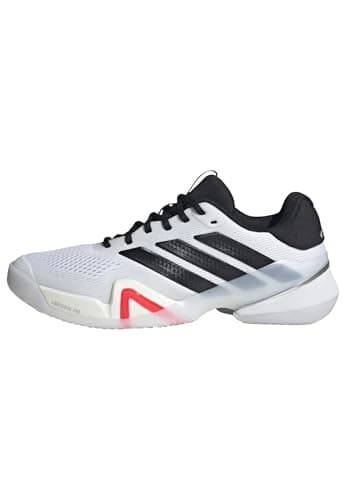
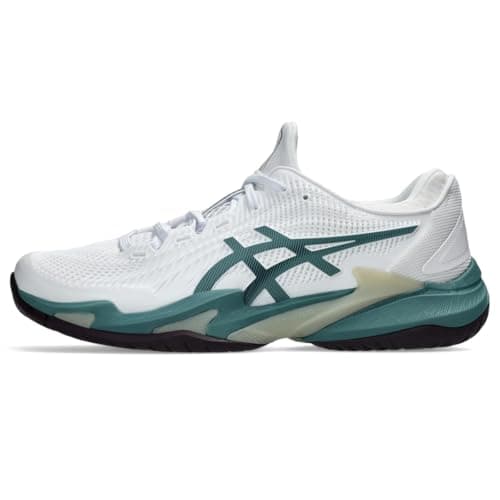
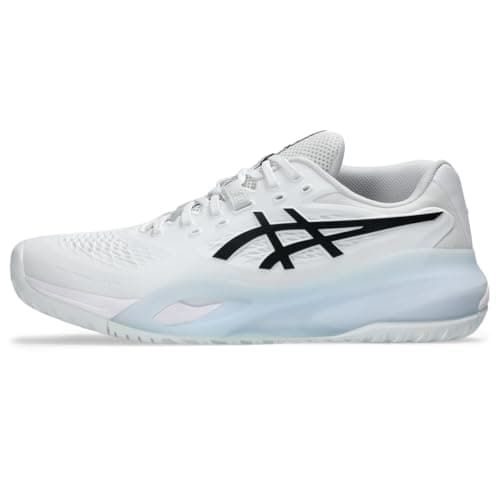
The best men's tennis shoe is the ASICS Gel-Resolution X — maximum lateral containment from the re-engineered DYNAWALL, on a full-length AHAR Plus outsole. If you drag your toe on serve, buy the adidas Barricade instead: its Adituff medial reinforcement is the best answer on the market to the specific way men wear shoes out.
The toe-drag problem
Watch a men's club match and count how many players finish the serve with the back toe scraping the court. It is most of them. The kick and slice serve both encourage it, and the result is a hole worn through the medial forefoot of the shoe while the rest of it is barely broken in.
This is why toe protection is a real spec rather than a marketing line. adidas Adituff is a reinforced panel bonded over the medial toe and forefoot specifically for this. K-Swiss DragGuard and Babolat's toe wrap do similar jobs. If you have ever worn a hole in a shoe in one spot, this is the feature to buy for, and it will save you more money than any other decision on this page.
Heavier players need more shoe
A spec table does not capture this, but it matters. Lateral force scales with body mass, and a 200 lb player loads a midsole far harder than a 150 lb one. Soft entry-level foams — adidas Cloudfoam on the Gamecourt, for example — compress permanently much faster under a heavier player, and once the foam is packed out the support structure sits too low to do its job.
If you are a larger player, skip the soft budget shoes and go to the Gel-Resolution, Barricade or Propulse end of the range. The extra cost is recovered in the pair you do not have to replace. The same logic applies if your arch is low, because a packed-out midsole removes the support a flat foot most needs — see tennis shoes for flat feet.
And if you are assembling a kit rather than replacing one pair, the buying order and the frame to go with these shoes are at tennis gear for men and best tennis rackets for men.
Light versus supported
The real trade-off in men's tennis shoes, and it is a genuine fork rather than a quality ladder.
Supported shoes — Gel-Resolution, Barricade, Propulse Fury — are heavier, stiffer, take a few sessions to break in, and hold you through anything. They suit baseline grinders, heavier players and anyone with ankle history.
Light shoes — Court FF 3, Jet Mach 4 — are faster off the mark, lower to the ground, and give you far better court feel. They suit attacking players, serve-and-volleyers and lighter, quicker movers. The price is less containment on a hard cut.
Neither is better. Pick the one that matches how you actually move, not how you wish you did.
Men's shoes compared
| Shoe | Outsole | Toe protection | Weight class | Fit |
|---|
| ASICS Gel-Resolution X | Full-length AHAR Plus | Standard | Heavy / supported | Standard, snug |
| adidas Barricade | Adiwear | Adituff — best here | Heavy / supported | Standard |
| ASICS Court FF 3 | AHAR | Standard | Light / fast | Narrow |
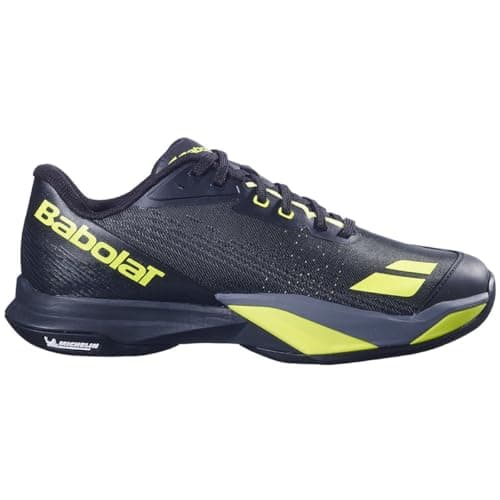
| Babolat Jet Mach 4 | Michelin | Toe wrap | Lightest here | Narrow |
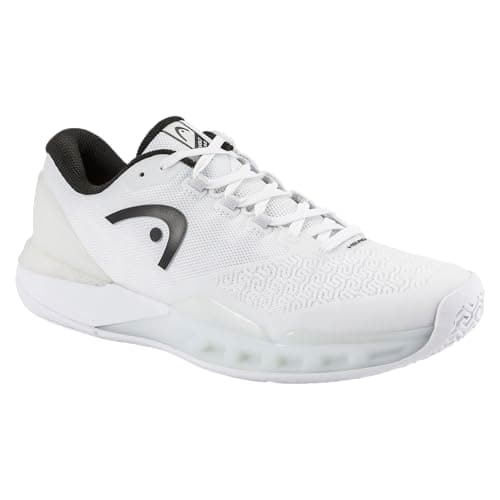
| HEAD Revolt Pro 5.0 | Michelin-tested | Standard | Balanced | Standard |
| adidas Gamecourt 3 | Adiwear | Minimal | Light / entry | Standard |
Sizing by brand
Men's court shoes vary more between brands than between sizes, and this is the single most common ordering mistake.
Babolat is the narrowest major brand — if you are anywhere near a wide fitting, avoid it. ASICS is standard-to-snug, with the Court FF narrower than the Gel-Resolution. adidas is standard. K-Swiss is the roomiest, which is why it leads our wide feet page. New Balance is the only one that sells genuine 2E and 4E widths rather than a single roomy last. Those brand-level differences, and what each maker actually optimizes for, are set out in the tennis shoe brand ranking.
Most men size up a half from their street shoe. Try them late in the day with your playing socks on.
Socks are not a detail
A technical tennis sock with a cushioned sole and a proper cuff does two useful things: it takes up the small amount of slack that causes blisters, and it wicks, which keeps the inside of an expensive shoe from becoming the limiting factor. Cotton socks hold moisture against the foot and are the main cause of blisters in players who otherwise have the right shoe in the right size. Which thickness to buy depends on how your shoes already fit, because a max-cushion sock changes shoe fit by a meaningful amount — the trade-off is worked through in the tennis sock ranking.
One pair or two?
If you play three or more times a week, two pairs rotated outlast two pairs worn consecutively, by a meaningful margin. Midsole foam needs roughly 24 hours to recover its structure after a hard session, and a shoe that never gets that compresses permanently faster. It is the cheapest durability trick available and almost nobody does it.
What about court surface?
Everything here is a hard-court or all-court shoe, which is correct for the large majority of American club tennis. If you play regularly on clay, the outsole is genuinely wrong and you want a clay-specific model — see tennis shoes for clay courts.