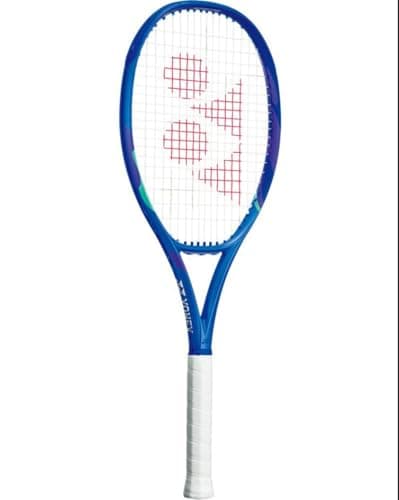
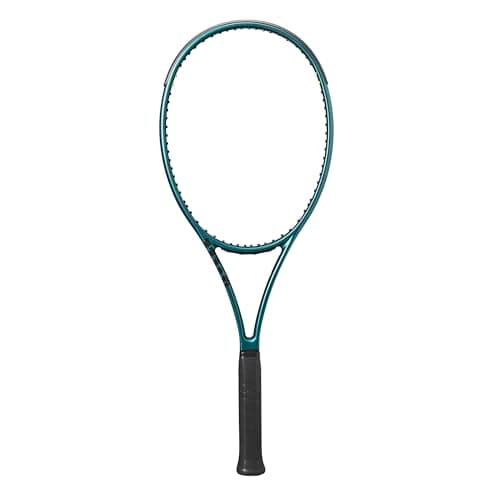
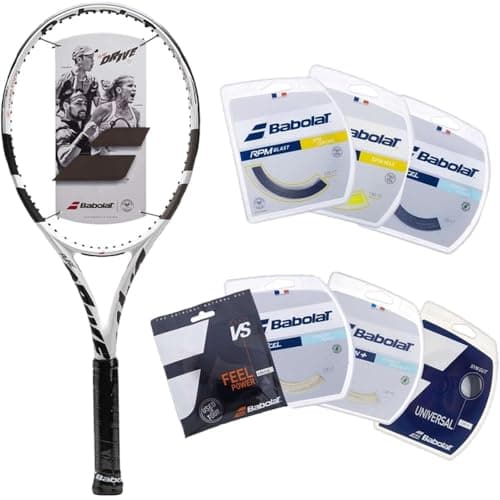
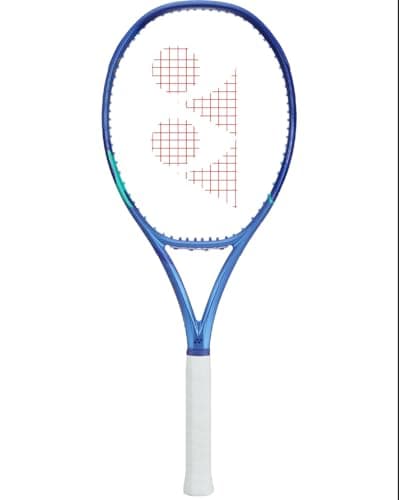
Buy the 100 if you are still developing a consistent swing, play mostly doubles, or miss off-center more than you would like. Buy the 98 if you swing fast, hit flat, and find balls flying long on your biggest shots. The cleanest way to see the difference is the same frame in both sizes: the Yonex EZONE 98 is a published 11.6 oz strung with a 16x19 pattern on a 98 sq in isometric head, and the Yonex EZONE 100 is 11.2 oz on 100 sq in with the same pattern. Same family, same construction, two sizes — and the 98 is the control version while the 100 is the forgiving one. If you want the archetypes rather than one family, the Wilson Blade 98 is the 98 sq in control benchmark and the Babolat Pure Drive is the 100 sq in power benchmark.
Head size is the spec people fixate on because it is the only one you can see. It is genuinely important, but not in the way the shelf-talker implies — the difference between 98 and 100 sq in is not two percent of anything you care about. It is a change in where the sweet spot sits, how high the ball launches, and how much the frame twists when you miss the middle.
What two square inches actually change
Sweet spot size. A bigger hoop has a bigger area where the string bed responds well, so a slightly off-center hit loses less. This is the single biggest practical difference, and it is why a 100 feels "easier" within about three balls.
Launch angle and power. Longer main strings in a larger head stretch more at contact and push the ball back harder and higher. Free power if you need it; balls sailing two feet long if you already generate your own.
Stability on off-center hits. A larger head twists more around its long axis when you catch the ball out toward the edge, all else equal. Makers compensate for this in the layup, and you can compensate further with weight at 3 and 9 o'clock — published customization guidance is explicit that side weighting is what reduces frame twisting.
Spin. A 16x19 pattern in a 100 sq in head has slightly more space between the strings than the same pattern in a 98, so the mains move a little more freely. That reads as marginally more spin potential in the larger head, which is why so many modern spin frames are 100s.
The one question that decides it
Where do your errors go? If your misses are long — you swing hard and the ball lands past the baseline — you do not need more power, you need a frame that launches the ball lower, and that is the 98. If your misses are mis-hits — the ball comes off the frame weakly, in the wrong direction, with that dead sound — you need forgiveness, and that is the 100.
Rating is a decent proxy for the same thing, which is why this site sorts by NTRP level. Below 3.5, take the 100 (or larger: beginner frames run 105–115 sq in for exactly this reason). At 3.5–4.0, either, and most players are happier on a 100. At 4.5 and above, the 98 is the default and a 100 is the deliberate choice of someone who wants help on their forehand. The USTA's own level guidelines are the reference for what each rating means, and NTRP ratings explained translates them.
What about 97, 99 and 105?
The same logic scales. A 97 sq in frame like the Wilson Pro Staff 97 v14 is a step further toward control and away from forgiveness — a published 11.7 oz strung with low power, for a player who supplies everything themselves. Above 100, a 105 or 110 is a genuine beginner and senior tool: enormous sweet spot, free depth, very little precision. The general-case version of this decision, including the big heads, is how to choose tennis racquet size.
Do not change head size and string at the same time
If you move from a 100 to a 98, the frame will launch the ball lower and you will instinctively swing harder to get depth back. Put a softer or lower-tension string in it for the first few weeks rather than fighting both changes at once — the tension guide covers the adjustment, and how to choose strings covers the rest.
As always: the specs quoted here are the manufacturers' published figures and the scores are judgments against the rubric on our methodology page. We have not hit with these frames side by side, and anyone claiming a measured two-square-inch sweet spot difference without a lab is making it up.
The comparison in one line each
98 sq in: smaller sweet spot, lower launch, more control, more demanding. For a fast, flat swing. 100 sq in: bigger sweet spot, higher launch, more free power and spin potential, more forgiving. For everyone still finding the middle of the string bed regularly.
If you play doubles, round up
A stretched volley is an off-center hit by definition, so the format itself argues for the larger head. The doubles-specific shortlist is on best racquets for doubles.
If you have a one-handed backhand, round down
A one-hander drives through the ball and a larger head sends that shot long. The frames that suit the stroke are on best racquets for a one-handed backhand.