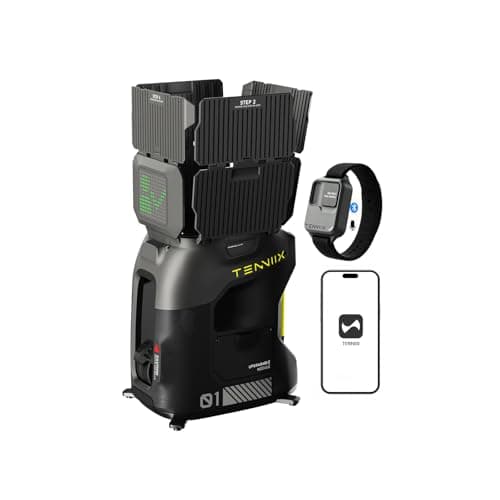
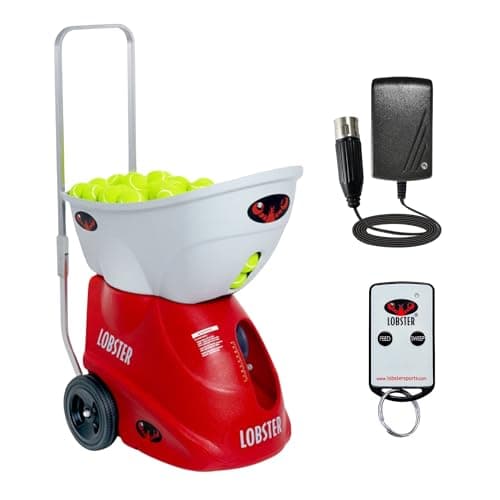
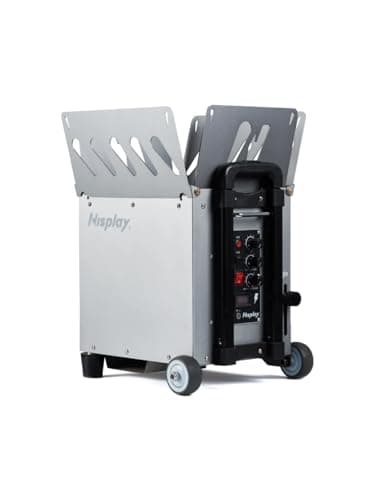
The cheapest tennis ball machine worth owning is the Nisplay Portable: dual motors for genuine topspin, a published 80+ ball capacity and 26 lb to carry, for well under half the price of the established brands. The TENNIIX Basic is the lightest at a published 18.7 lb and adds app control. If you want a machine with a parts and service network behind it, the Lobster Elite Liberty is where that starts, and it costs roughly a third more again.
What “cheapest” should mean here is cheapest machine that still does the job, not cheapest object called a ball machine. The sub-$500 end of this category is full of single-motor feeders that lob a flat ball at a fixed speed, and a flat fixed-speed feed teaches you to hit one shot. We have not ranked any of them.
The one spec that separates a machine from a feeder
Two motors. A single-motor machine throws the ball with one wheel, which means one speed profile and no spin control. Two motors running at different speeds impart rotation — topspin if the lower wheel runs faster, backspin if the upper one does.
That matters because a real rally ball has topspin, and a ball with topspin bounces higher and kicks forward. Practicing against flat balls for a season trains you to meet the ball at a contact point you will never see in a match. The Nisplay publishes dual motors for topspin; this is the main reason it leads the list rather than something cheaper.
What you give up at each price
Under $1,000: top speed, and the service network. The Nisplay publishes a maximum of 68 mph and the TENNIIX 75 mph; the established machines go considerably higher. For a 3.0–4.0 player drilling groundstrokes that ceiling is not the binding constraint — your own recovery between balls is. For a 4.5 wanting match-pace feeds, it is.
Around $1,200–$1,400: you get the brands with a decade of parts availability. That is not a performance feature and it is not nothing: a machine is a motor, a battery and a feed mechanism, and all three are wear items.
Above $1,700: programmable drill sequences, full oscillation in two axes, and remote control. Genuinely useful for a 4.5+ player and genuinely overkill for anyone below. The full range is at the best tennis ball machines.
Weight is the spec that decides whether you use it
The most common fate of a ball machine is sitting in a garage. Not because it does not work — because getting it out of the car, across a car park and onto a court is a job, and after a few months it is a job you stop doing.
So the published weight figure is not a convenience spec, it is a usage spec. At 18.7 lb the TENNIIX is light enough to carry in one hand with a bag over the other shoulder. At 26 lb the Nisplay needs both hands but one trip. Above 40 lb you are making two trips or using a trolley, every single session.
You also need balls, and a lot of them
An 80-ball hopper at a feed every four to five seconds is about six minutes of continuous drilling, after which you are collecting. That arithmetic is the real limit on a machine session, and it is why practice balls are bought by the case and why a wheeled hopper is a genuine accessory rather than an upsell.
Pressureless balls are the usual choice for machine work because they do not go flat in storage, though they feel heavier than a match ball. The accessories to pair with a machine are at the best tennis ball hoppers, and the ball options at best tennis balls for hard courts.
Three of the machines in this price band are reviewed individually, which is worth reading before you commit: the Nisplay review goes through why dual motors matter so much at the bottom of the market, and the Slinger Bag review explains why a published 45 mph top speed makes it a learner's machine rather than a club player's. If the budget tier is where you are because you are not sure you will use a machine at all, start with are ball machines worth it instead.
The four compared on published specs
| Machine | Ball capacity | Weight | Top speed | Runtime |
|---|
| Nisplay Portable | 80+ | 26 lb | 68 mph | 4+ hr (external battery) |
| TENNIIX Basic | 100+ | 18.7 lb | 75 mph | 4 hr |
| Lobster Elite Liberty | See listing | See listing | See listing | See listing |
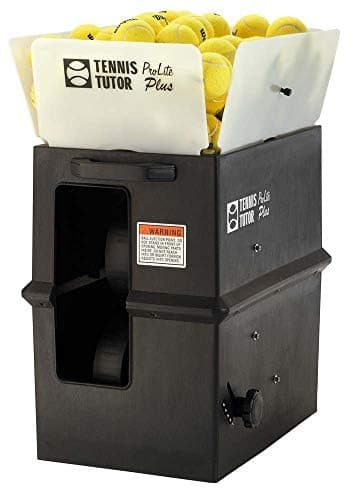
| Tennis Tutor ProLite Plus | See listing | See listing | See listing | See listing |
Two of those rows say “see listing” on purpose. Lobster and Tennis Tutor publish their specifications per configuration, and the figures vary by model variant in a way that a single row here would misrepresent. We would rather point you at the listing than print a number we cannot stand behind — the published figures for the two budget machines come from their own listings, fetched 2026-10-07.
Is a cheap ball machine worth it at all?
For a specific kind of player, it is the best money in tennis. A machine gives you a hundred identical balls to one shot, which is how a stroke actually changes — and no hitting partner on earth will feed you a hundred identical balls.
It is worth it if you have court access, you practice alone, and you have one or two specific strokes you are trying to rebuild. It is not worth it if your limitation is movement, decision-making or match play, because a machine feeds a predictable ball to a predictable place and none of those three improve against predictability.
What to drill, and what not to
Good machine work: groundstroke technique changes, the serve return contact point, volleys at pace, and anything where repetition against a consistent ball is the point.
Bad machine work: long sessions of the same feed with no intent. Twenty minutes of focused repetition beats ninety minutes of hitting balls back, and the machine makes the second one very easy to do by accident.
Oscillation is the feature that pushes a machine toward realistic practice, because it stops you standing in one place. If your budget stretches to a machine that oscillates, that is a better upgrade than top speed.
The hidden costs
Balls. A case, and you will want more than one. A hopper. A wheeled one, unless you enjoy bending over a hundred times. Battery replacement. The wear item that decides the machine's real lifespan, and the reason the established brands' parts networks matter. Court time, if your club charges for it.
None of those are large next to the machine, and all of them are easy to forget when you are comparing a price today against a price next year.