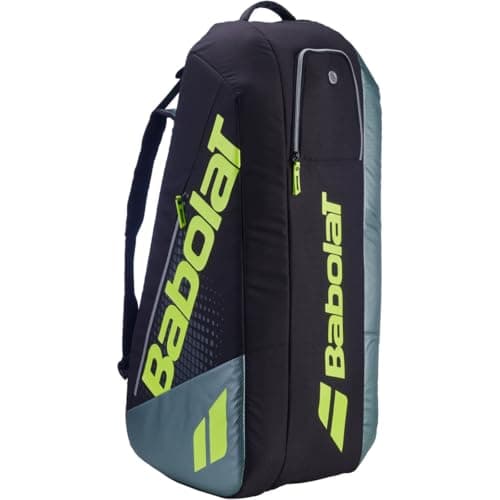
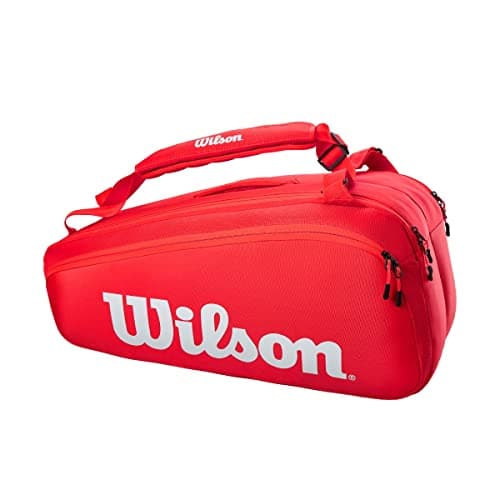
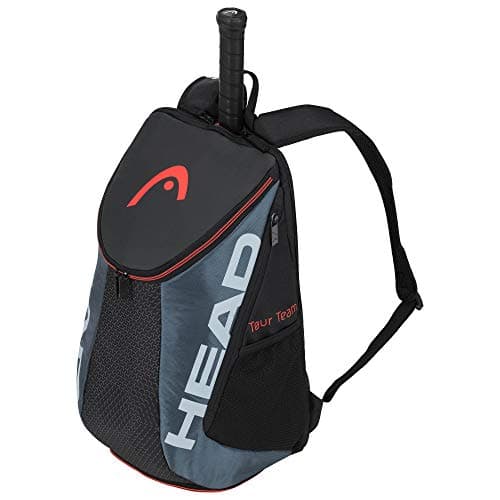
The best tennis bag for most club players is the HEAD Tour Team backpack: two racquets, a dedicated shoe compartment and padded straps — which is exactly what a weekly hit requires and nothing it doesn't. If you play leagues and carry a spare frame, the thermal-lined Babolat Pure Aero RH6. If you are genuinely playing tournaments, the Wilson Super Tour 9-pack.
Buy for what you carry
The most common tennis-bag mistake is capacity inflation. A 9-racquet bag looks like what serious players use, so people buy one, and then carry it two-thirds empty to a Tuesday doubles match where it is a nuisance.
Be honest about the contents of your bag: for the large majority of club players it is one or two racquets, shoes, a towel, a water bottle, a tube of balls and an overgrip. That is a 2-racquet backpack. Capacity above what you carry is weight and bulk you pay for twice.
The thermal lining is the real feature
Here is the one genuinely technical thing a tennis bag does. Heat accelerates string tension loss, and the inside of a car in summer gets far hotter than the air outside. A racquet that lives in a car boot loses tension substantially faster than one that does not.
An isothermal or thermal-lined compartment slows that heat transfer. It does not make the bag a cool box, but it meaningfully reduces the temperature swings your strings experience. If you leave racquets in a car — and most club players do — this is the feature worth paying for. See string tension for why it matters.
Shoe compartments are not a gimmick
A separate, ventilated shoe compartment does two useful things: it keeps court grit and damp off your kit, and it lets shoes dry rather than sealing moisture in with everything else. A damp shoe in a closed bag overnight is how uppers delaminate.
It matters more if you play on clay, where everything you own ends up gritty — see clay court shoes.
Backpack straps versus a shoulder strap
If you walk, cycle or take public transport to the courts, backpack straps are not a preference — they are the whole decision. A loaded 6-pack on one shoulder across a club site is genuinely unpleasant.
Every bag on this page except the Athletico offers both. Check that the straps are padded and that they stow away, because dangling straps on a bag you are carrying by the handle catch on everything.
Bags by what you actually need
| If you… | Buy | Capacity | Thermal |
|---|
| Play once or twice a week, one or two frames | HEAD Tour Team backpack | 2 racquets | No |
| Play leagues, carry a spare frame | Babolat Pure Aero RH6 | 6 racquets | Yes |
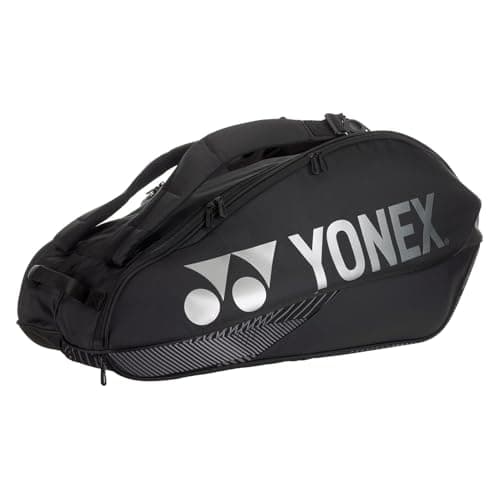
| Want the best-organised 6-pack | Yonex Pro Racquet Bag 6 | 6 racquets | No |
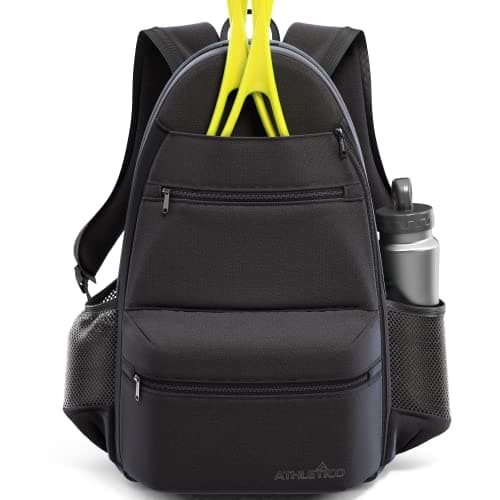
| Want cheap and compact | Athletico Compact City | 2 racquets | No |
| Actually play tournaments or coach | Wilson Super Tour 9-pack | 9 racquets | Yes |
What goes in a club player's bag
A useful checklist, because a bag is only as good as what you remember to put in it. Two racquets if you have them, strung the same. Court shoes, kept separate. A fresh overgrip, which takes ten seconds to fit and is the difference between gripping and squeezing. A tube of balls. A towel. Water. A spare pair of socks, which is the most underrated item on this list.
What does not need to be in there: three racquets you never use, four dead tubes of balls, and the overgrip wrappers from 2024.
Durability: where bags actually fail
Zips first, always. A bag with cheap zips on the main racquet compartment will fail there long before the fabric wears, and a broken main zip ends the bag. Yonex and Wilson both use notably heavier zip hardware than the price suggests.
After that it is the strap anchor points, which take all the load. Look for bar-tacked stitching where the straps meet the body rather than a simple seam.
Do not spend here first
The bag is the lowest-leverage purchase in tennis. A great bag does not improve a single shot; it protects equipment and makes carrying it pleasant. If your money is limited, it goes into shoes, then strings, then the frame, then the bag.
The exception is if you currently carry racquets loose or in a plastic sleeve and leave them in a hot car. In that case even a cheap bag with a padded compartment is a real upgrade, and the Athletico costs less than a restring.
How we picked
We have not physically tested this gear
Everyone in this category says they tested twenty racquets. We have not tested any — and we say so. What we did instead: compiled the manufacturer-published specifications (head size, strung weight, string pattern, stiffness, outsole compound), normalized them, and scored each product against a published rubric weighted for the NTRP tier this page serves. The scores are judgments from documented research, not measurements we took, because we do not have a lab and are not going to pretend we do.