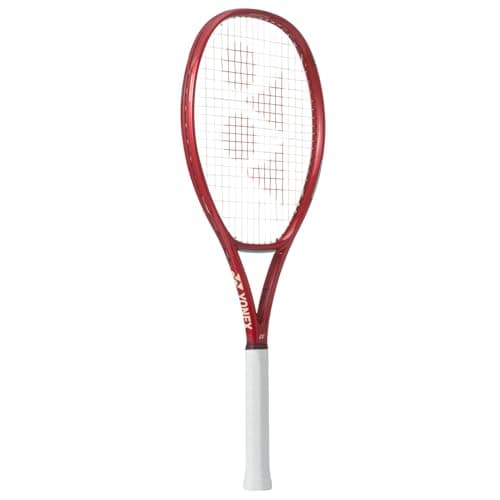
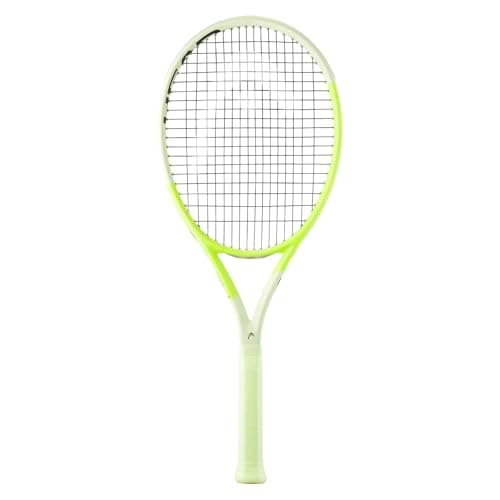
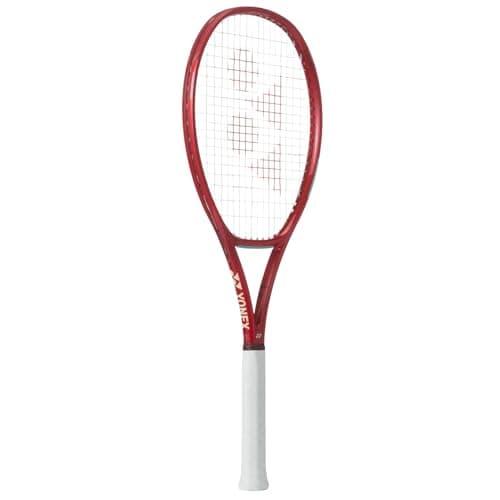
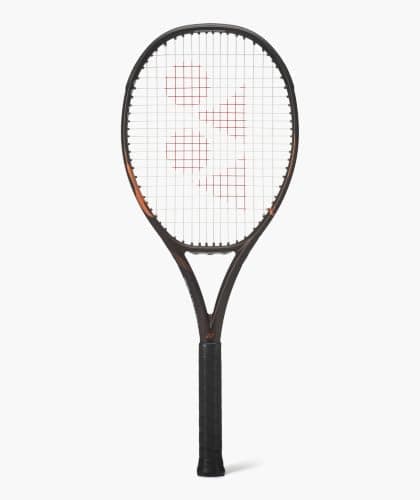
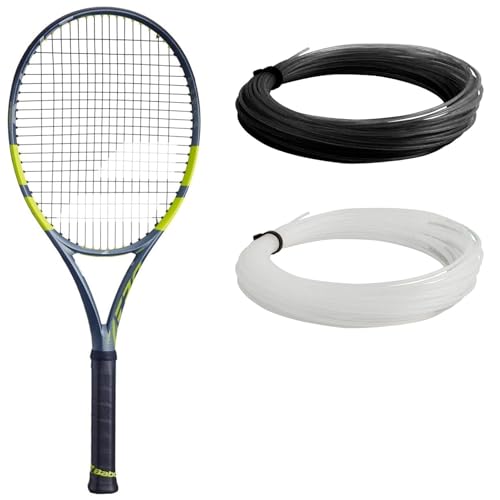
The best tennis racquet for spin is the Babolat Pure Aero, and it is not close on reputation — a 16x19 pattern on a 100 sq in head, a shaft Babolat publishes as “re-engineered… to reduce wind drag”, and spin grommets published as being there “to increase dwell time and string movement”. If you want spin without the Aero's stiffness, the Yonex VCORE 100 is the softer version of the same idea. If you want spin andcontrol rather than spin and launch angle, skip to the VCORE 98. And if the price of a current flagship is the problem, the HEAD Extreme MP is a published 16x19 spin frame at a materially lower bracket — it is the budget pick here and it is not a consolation prize.
Now the part most spin-racquet pages leave out. Your frame is the smallest of the three things that decide how much the ball spins.Technique is first by a distance: a low-to-high brushing path with real racquet-head speed produces topspin on a wooden racquet. Strings are second, and the gap between a slick shaped polyester and a grippy multifilament is bigger than the gap between any two frames on this page — which is why the best strings for spin is the page to read after this one, and arguably before it. The frame is third. It is real, it is worth getting right, and it will not rescue a flat swing.
What the frame actually contributes is published, and it is mechanical rather than magical. Tennis Warehouse's own guide splits patterns into “Open Pattern (16x18 or 16x19)” and “Dense Pattern (18x20)”, and says of the open one that “The advantages of open string patterns are that is is easier to hit with depth, power and spin”, listing “Easier access to spin”, “Livlier (more power)” and a “Higher launch angle (loopier shots)”. Every frame on this page is 16x19. That is the entry requirement, not the differentiator.
The criteria, in the order they matter
- An open pattern, published. All five frames here are 16 mains x 19 crosses. Wider spacing means the mains can displace and return, and the published skip schedules differ in ways you can read: the Pure Aero skips 8T/8H, the Extreme MP skips 8T/7H/9H, both VCOREs skip 7T/9T/8H. That is the geometry of the spin window.
- Published spin hardware, not adjectives.Babolat publishes FSI Spin Technology, “which combines Babolat's time-tested Woofer system with strategically placed Spin Grommets”. HEAD publishes Spin Grommets “which enable greater string movement for increased snapback” plus a Spin Shaft “which increases torsional stability to better complement topspin mechanics”. Yonex publishes the Isometric head shape and its wider contact zone at 10 and 2 o'clock. Those are claims by the people who made the frame — cited, not endorsed by us.
- Swingweight you can actually accelerate. Spin is racquet-head speed in a brushing direction, so a frame you cannot swing fast cannot spin the ball, no matter what the grommets do. Published swingweights here run 315 (EZONE 100) to 325 (VCORE 100), which is a narrow and deliberately club-friendly band.
- Honest comfort.Spin frames are stiff frames more often than not. Two of these publish a stiffness of 66, one 65, one 63 and one 68 — and those numbers change who should buy which far more than any marketing line does.
- Live price, not list price. Flagship racquet pricing moves constantly and the previous generation of a spin frame is often the best value in tennis. Every price on this page is pulled from the retailer daily and expires after 48 hours.
Spin and control: the question behind the query
The most common refinement of this search is not “spin” on its own — it is spin and control, and that pairing sounds contradictory until you see where the two come from. Launch angle and depth control are governed largely by head size and pattern density; spin is governed by string movement and swing speed. A 98 sq in head with a 16x19 pattern sits exactly on that seam: open enough for the mains to move, small enough that the ball does not balloon.
That is the Yonex VCORE 98, and it is the pick for anyone whose shots currently have spin but no ceiling — balls that dip, but dip three feet behind the baseline. Tennis Warehouse publishes it at 98 sq in, 11.4 oz strung, 6 points head-light, swingweight 321 and stiffness 63, and describes it as offering “a more precise and predictable response” than the VCORE 100. You give up some free depth and you get the court back.
If you want the other side of that trade — spin and power, the second clean refinement of this query — the honest answer is the Pure Aero or the EZONE 100, which publish mid-beam sections of 26 mm and 26.5 mm, and both of which will take a short swing and send it long until you commit to brushing up. The frame cannot decide that for you. Your swing path does, and the frame then amplifies whatever you brought.
One more distinction worth making before the picks, because it costs people money: a spin frame is not the same thing as a control frame. None of the five racquets on this page appears on that page, and nothing on that page appears here. If what you want is depth you can trust on a flat drive, you are on the wrong ranking, and the 98 vs 100 head size comparison is the fastest way to work out which side of the line you belong on.
Who should not buy a spin racquet
Three groups, stated plainly, because a spin frame is actively the wrong purchase for each of them.
Flat hitters.If your natural swing drives through the ball rather than up the back of it, an open pattern and a high launch angle give you depth problems and nothing in return. The published trade is explicit: Tennis Warehouse says dense patterns are “great for players who hit flatter shots and don't use spin to control their shots”. Believe that about yourself before you spend.
Anyone with a sore arm. Stiff frame, stiff polyester, high tension is the standard club recipe for spin and it is also the standard pathway into tennis elbow. If your elbow already hurts, start at racquets for tennis elbow instead, and treat the softest frame here (the VCORE 98 at a published 63 RA) as your ceiling rather than your starting point.
Beginners who do not yet rally consistently.Spin access you cannot reproduce is noise. A developing player gets more from a forgiving frame and a cheap string than from spin hardware — the beginner ranking is built for exactly that stage, and the intermediate list is where the frames here start to make sense.
How to get more spin out of the racquet you already own
Before buying anything, there are two changes that cost a fraction of a frame and move the needle more than switching brand.
Change the string, not the racquet. A shaped or slick polyester lets the mains slide and snap back; a sticky synthetic gut does not. This is the single biggest hardware lever on spin and it costs the price of a restring. Start with the strings for spin ranking, and if you want the category-level version, the polyester roundup explains why control-oriented polys dominate this job and what they cost you in comfort.
Drop the tension. Lower tension lets the string bed deform and the mains move, which is the mechanism spin depends on. The published ranges on these frames are worth reading before your next restring: the Pure Aero is listed at 46-55 lb with a 51 lb optimum, both VCOREs at 45-60 lb with 53 lb optimum, the Extreme MP at 48-57 lb. If your stringer has been putting 60 lb of polyester in a spin frame, that alone may be the problem. The tension guide covers how far down is too far.
Reading the specs that actually predict spin
String pattern is the first number to check and the only one on this page that is identical across all five frames. 16x19 is the open standard; 18x20 is the dense alternative and belongs to a different kind of player.
Head size sets your launch angle budget. 100 sq in gives you the bigger spin window and the loopier ball; 98 sq in gives you a flatter, more predictable trajectory with the same pattern. Neither is better. One of them matches how deep your balls currently land.
Beam widthtells you how much free power is coming with the spin. The Pure Aero publishes 23/26/23 mm and the EZONE 100 24.5/26.5/23 mm — thick, powerful, fast-launching. The VCORE 98 publishes 23/23.5/22 mm, which is why it holds a lower trajectory.
Stiffness (RA) is your comfort forecast and the spec club players ignore most. Published figures on this page: Pure Aero 66, Extreme MP 66, VCORE 100 65, VCORE 98 63, EZONE 100 68. A 5-point spread is not cosmetic, especially paired with stiff string.
Swingweight decides whether you can still accelerate in the third set. The EZONE 100 is the lightest-swinging frame here at a published 315; the VCORE 100 the heaviest at 325. If late preparation is your pattern, swingweight explained is worth ten minutes, and adding weight covers the cheap way to move a frame up rather than down.
What we did not measure, and will not claim
No spin figure on this page is ours. We have no high-speed camera, no robot arm and no RPM rig, and no manufacturer publishes a comparable revolutions-per-minute number per frame, so every spin claim here is either a published manufacturer or retailer statement — quoted and attributed — or a judgment from those published specs under our scoring rubric. Where our score and a brand's marketing disagree, the rubric wins and the reasoning is on the page.
One honest consequence: the gap between the first and third frame on this list is smaller than the gap between two string setups in the same frame. If you are choosing between these racquets on spin alone, you are optimizing the wrong variable. Choose on comfort, head size and what you can swing — then buy the right string.
Where this sits in the rest of your kit
A spin game is hard on gear in a specific way: brushing contact shreds strings faster than flat hitting, so plan on restringing more often than a flat hitter would. How often to restring gives the published guidance, and ball choice matters more than most spin players expect — a fuzzed-up ball grips differently than a fresh one. If you are still deciding which level of frame you belong in, the 4.0 ranking is the club-player spine of this site and names the same frames in a different order.