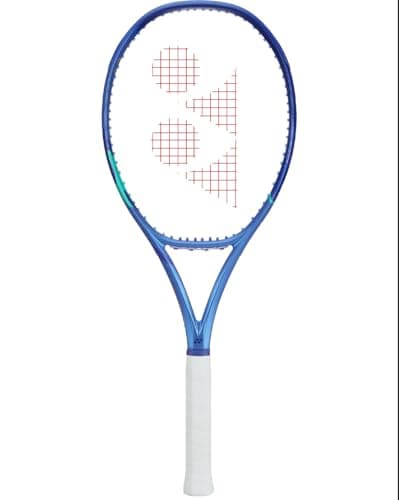
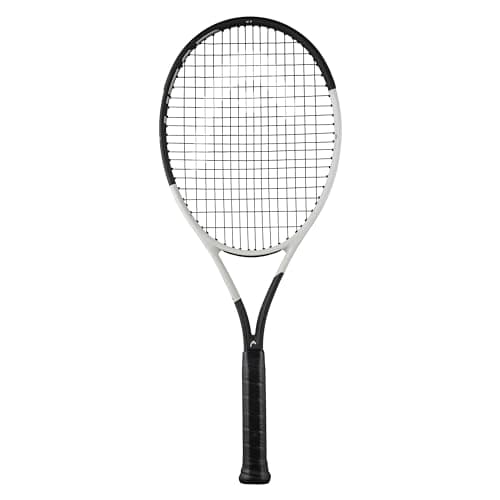
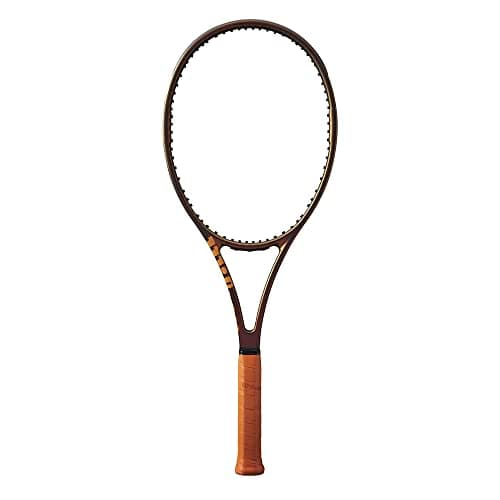
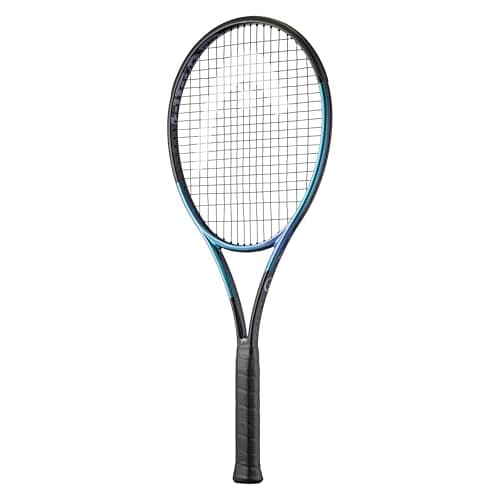
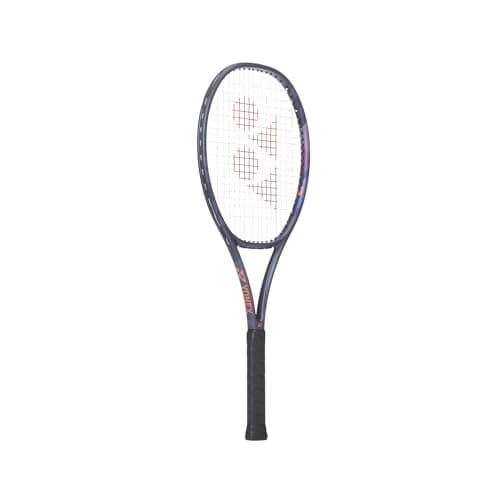
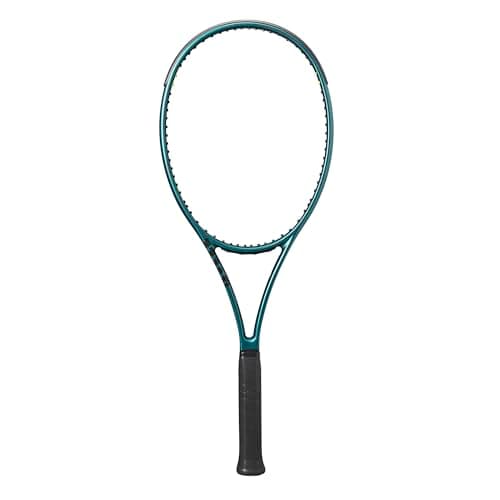
The best racket for an advanced player is the Wilson Blade 98 (16x19) v9 — the most-played frame in competitive club tennis because a 98 with a 16x19 pattern is the precise point where control and spin stop fighting each other. If you want the same control with more power and a softer feel, the Yonex EZONE 98 is the better racket and costs more. If you want maximum precision and do not need help, the Pro Staff 97 is still the purist's answer.
What you are actually buying at this level
Nothing on this page will make you hit the ball harder. That is the point. By 4.5 you generate your own pace, and the job of the frame flips completely: it now has to contain what you produce. Every spec choice here is about removing power and replacing it with information.
That is why the frames get heavier (11.3–11.7 oz strung), the heads get smaller (97–100 sq in), and two of the six use an 18x20 pattern. Mass makes the frame stable against incoming pace instead of being deflected by it. A smaller head shortens the lever between the ball and your hand, which is what “feel” actually is. A denser pattern stops the string bed launching the ball.
The 16x19 versus 18x20 decision
This is the real fork in the road at 4.5, and it is not a quality question — it is a style question.
16x19 leaves the main strings room to slide sideways on contact and snap back, which pulls the ball into rotation. If your game is built on heavy topspin, dipping passing shots and high-bouncing rally balls, you want 16x19 and you should look at the Blade 98, the EZONE 98 or the VCORE 98.
18x20locks the string bed down. The ball leaves flatter, lower and far more predictably, and depth control becomes almost absolute. If you drive through the ball, take it early and redirect pace, you want 18x20 — the HEAD Gravity MP and the Prestige MP L are both here for that.
The 18x20 trade is real: you give up spin, and you will notice it on a short ball you are trying to dip over the net at a sharp angle. The 16x19 trade is also real: you will sometimes swing out and watch it fly.
Comfort still matters at 4.5
There is a myth that arm-friendliness is a beginner's concern. The opposite is true: advanced players hit more balls, hit them harder, and string tighter, so cumulative load is higher. The Gravity MP and the Percept 97 are on this list specifically because they deliver control through flex rather than through stiffness — which is the version of control that does not end with a brace on your forearm. See arm-friendly rackets if this is already a live problem for you.
The six frames, by what they optimise
| Racket | Head | Pattern | Weight | Optimised for |
|---|
| Wilson Blade 98 v9 | 98 sq in | 16x19 | 11.4 oz strung | Control with real spin access |
| Yonex EZONE 98 | 98 sq in isometric | 16x19 | 11.6 oz strung | The four-way balance |
| HEAD Speed MP | 100 sq in | 16x19 | 11.3 oz strung | Fast, crisp, first-strike tennis |
| Wilson Pro Staff 97 v14 | 97 sq in | 16x19 | 11.7 oz strung | Maximum feel, minimum power |
| HEAD Gravity MP | 100 sq in | 18x20 | 11.3 oz strung | Dense pattern, big face, soft |
| Yonex Percept 97 | 97 sq in isometric | 16x19 | 11.6 oz strung | Flex and touch |
The Gravity MP is the quiet recommendation
An 18x20 pattern on a 100 sq in head is an unusual combination and a genuinely clever one. Dense patterns normally live on 95–98 sq in frames, which compounds the unforgiveness: small face and tight strings. Putting the 18x20 on a 100 gives you the depth control of the dense pattern with the off-centre tolerance of the bigger face. If you are a 4.5 who drives the ball and has been frustrated by how little margin a Prestige gives you, this is the frame to demo.
Customisation is where advanced players actually gain
At this level the difference between stock frames is smaller than the difference a few grams of lead tapemakes. Mass at 3 and 9 o'clock widens the effective sweet spot and increases twist stability; mass at 12 o'clock raises swing weight and plough-through. Add 2–4 grams at a time and play with it for a week before adding more — swing weight changes faster than the number on the scale suggests.
String it like an advanced player
A control frame strung with a lively multifilament is a frame fighting itself. Most 4.5+ players want a polyester, and most of them should hybrid it: polyester in the mains for control and spin, a multifilament or gut in the crosses for comfort and feel. That setup gets you most of the control of a full poly bed with meaningfully less shock. The strings hub walks through the options, and poly vs multifilament covers the trade in detail.
Demo before you buy, and we mean it
We score these frames from published specifications. Specs predict a lot — head size, weight and pattern will tell you most of how a racket behaves — but they do not predict feel, and feel is most of what separates these six. Every one of them is a good racket. Which one is your racket is a question a spec sheet cannot answer and neither can we.
How we picked
We have not physically tested this gear
Everyone in this category says they tested twenty racquets. We have not tested any — and we say so. What we did instead: compiled the manufacturer-published specifications (head size, strung weight, string pattern, stiffness, outsole compound), normalized them, and scored each product against a published rubric weighted for the NTRP tier this page serves. The scores are judgments from documented research, not measurements we took, because we do not have a lab and are not going to pretend we do.