Pick a junior racket by your child's height, not their age. Measure them in bare feet, then use this chart, which follows the published retailer sizing: under 35 in → 17" racket; 35–39 in → 19"; 40–44 in → 21"; 45–49 in → 23"; 50–55 in → 25"; 56–61 in → 26"; over 61 in → a 27" adult frame. Then confirm it with the arm test below, which takes ten seconds and catches the cases where a child's proportions do not match their height.
If you want the short version of the shopping: the HEAD Speed Junior 25" is the best value junior frame on this page, and the Wilson Blade Feel Comp Junior 26" is the one to buy for the last step before an adult racket. Both cost less than a single restring on a performance adult frame.
The size chart
Measure your child's height in bare feet against a wall. Then:
| Child's height | Racket length | Roughly |
|---|
| Under 35 in | 17" | Age 3–4 |
| 35–39 in | 19" | Age 4–5 |
| 40–44 in | 21" | Age 5–6 |
| 45–49 in | 23" | Age 6–8 |
| 50–55 in | 25" | Age 8–10 |
| 56–61 in | 26" | Age 10–12 |
| Over 61 in | 27" (adult) | Age 12+ |
The height bands are the published Merchant of Tennis sizing chart. The age column is indicative only, and it is why the chart is organized by height: two children of the same age can differ by a head. Age is a proxy for height, and height is the thing that actually determines whether a racket is the right length. If you only have the age, use the chart as a starting guess and then do the arm test.
The arm test: ten seconds, and it settles it
This is the check that matters, and it works in a shop, at home, or with a friend's racket.
Have your child hold the racket in their playing hand, gripping firmly at the base of the grip, with that arm hanging straight down by their side. Then look at where the tip of the racket is:
Correct: the tip falls an inch or two above the ground. Merchant of Tennis, whose published guide this follows, allows the racket to "gently touch the ground" if you want a little growing room.
Too long: "the tip of the racquet easily touches the ground." Go down a length.
Too short: it "falls above your child's ankle bone." Go up a length.
Why you should not buy a size up
This is the single most common mistake, and it is entirely understandable: a junior racket is outgrown in a year or two, so buying one size up looks like economy.
It is not, for a mechanical reason. A longer racket is a longer lever, and a longer lever at the same weight is harder to hold level through contact — it is also usually genuinely heavier. A child swinging a frame they cannot control does two things: they drop the racket head, so the ball goes into the net, and they compensate by using their whole arm and shoulder to muscle it around, which is how a bad swing path gets learned.
It is better to keep a child on a slightly small racket for a few extra weeks than to move them up early. A frame that is slightly short just means they stand a little closer. A frame that is too long changes their technique, and technique is much harder to unlearn than it is to learn.
What about weight, head size and grip?
Short answer: ignore all three on a junior frame, because nobody publishes them.
This is a genuine difference between junior and adult racket shopping, and it is worth being upfront about. For an adult frame we can give you head size, strung weight, balance, swingweight, stiffness and string pattern, because manufacturers publish all of it — see how to choose a tennis racquet for how those trade off. For junior frames, manufacturers publish the length and almost nothing else. We are not going to invent the rest.
What that means practically is that length is the spec. Within a length, junior frames from the real racket companies are broadly similar: light, forgiving, pre-strung, aluminum-class construction at the recreational end and composite at the performance end. Grip size follows the length — junior frames come with a junior grip and you do not choose it.
One thing you can control: all six frames here arrive strung. Do not restring a junior racket. The factory string is fine for the one or two seasons the frame will last, and a restring costs about as much as the racket.
The red, orange and green ball progression
Worth knowing because it explains why the lengths exist and what your child's coach is doing. Junior tennis is played with slower, lower-pressure balls that step up as the child does, and the racket lengths map onto them:
Red ball — the slowest, on a small court. Typically 19" and 21" rackets.
Orange ball — faster, bigger court. Typically 23" and 25".
Green ball — close to a standard ball, full court. Typically 25" and 26".
Yellow (standard) ball — full court, 26" or a 27" adult frame.
If your child is in a program, ask which ball their group plays with. It will tell you which length band the coaching is built around, which is worth more than the chart.
Picks by length
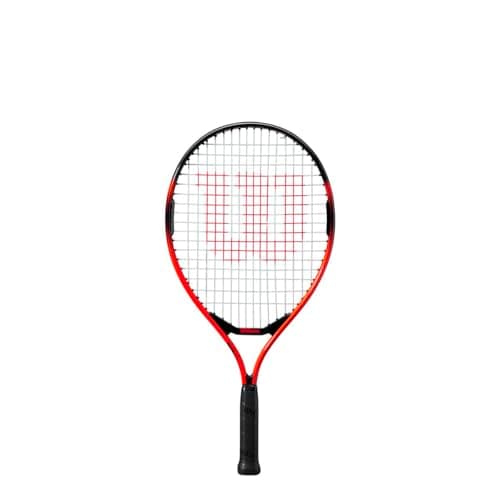
21" (40–44 in tall). The Wilson Pro Staff Precision Junior 21". Short, light and pre-strung, from Wilson's junior line rather than a toy racket from a general sporting-goods brand. Expect about a year out of it.
23" (45–49 in tall). The Wilson Pro Staff Precision Junior 23". The most-used length in group coaching, which means it matches what the coach is teaching with. Same family as the 21 and 25, so the step up feels like the same racket, longer.
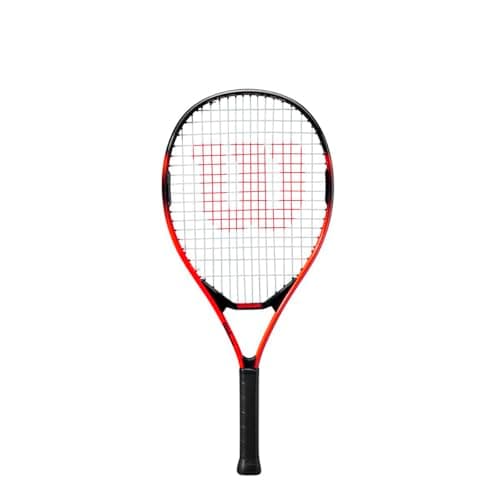
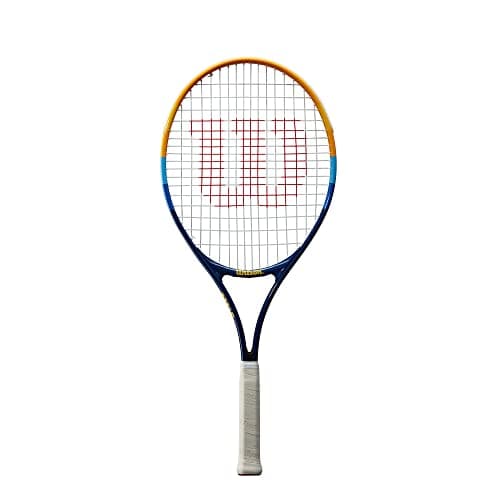
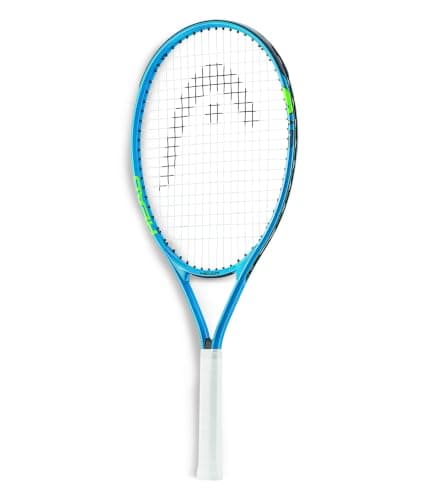
25" (50–55 in tall). Two good answers, and this is the length that lasts longest. The HEAD Speed Junior 25" is our top pick overall: it carries HEAD's performance Speed naming rather than being a generic junior frame, and it is usually the cheapest frame on this page. The Wilson Profile Junior 25" is the recreational alternative — buy it if your child is still deciding whether they like tennis.
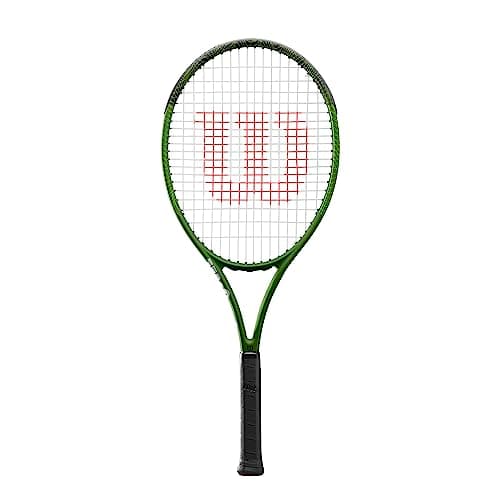
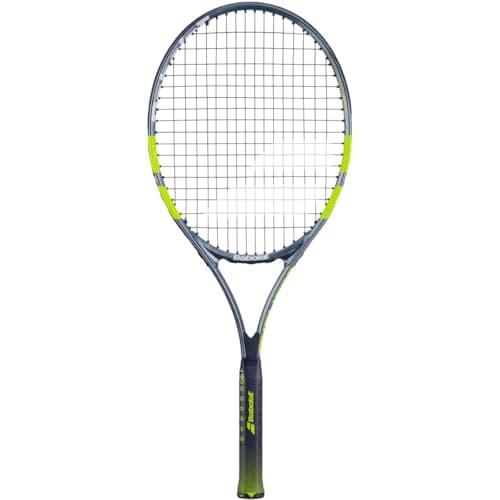
26" (56–61 in tall). The last step before an adult frame, and worth taking rather than skipping. The Wilson Blade Feel Comp Junior 26" is one inch shorter and meaningfully lighter than an adult racket, which is the entire reason the length exists, and the Blade Feel naming puts it in the control-oriented family. The Babolat Carlitos Junior 26" is the direct alternative: the same length band, with a pro signature on it. A cosmetic is not a spec, but it is the thing that gets a ten-year-old to take the racket out of the bag.
When to move to an adult racket
At roughly 61 inches tall, or when the arm test says a 26" is too short. At that point the right answer is a light adult frame rather than a heavy one — a big head, a low weight, forgiving on off-center hits — which is exactly the brief of the beginner racquet ranking.
Two cautions on that step. First, do not buy a heavy adult frame because they will "grow into it" — same lever problem as a too-long junior frame, and a 12-year-old muscling an 11.5 oz player's racket learns a worse swing. Second, this is the first racket where grip size becomes a real decision, so measure it: the grip size chart has the method, and if they are between sizes, buy the smaller frame and build it up with an overgrip.
If the budget is the constraint at that point — and for a growing child it usually is — the cheap racquet ranking covers adult frames under $100 that are still real rackets.