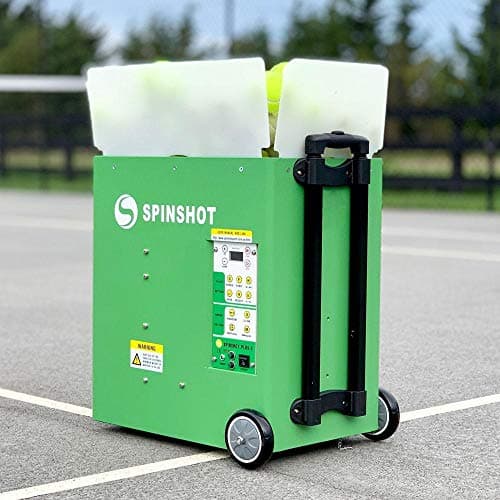
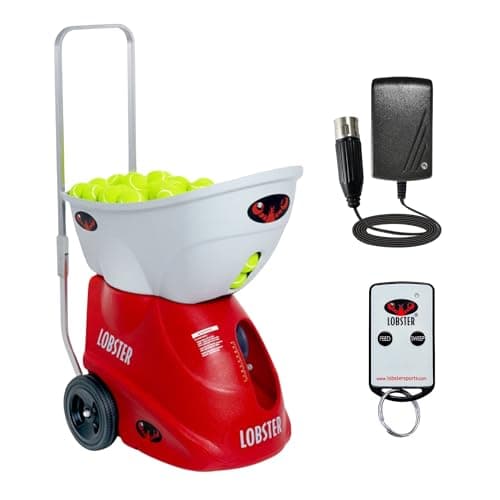
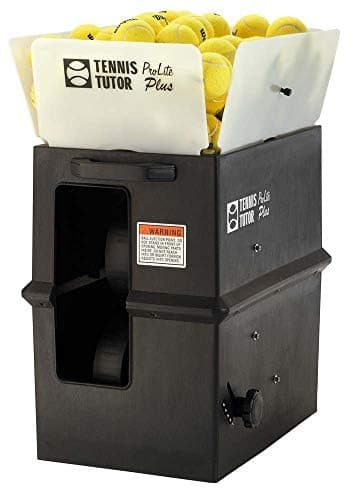
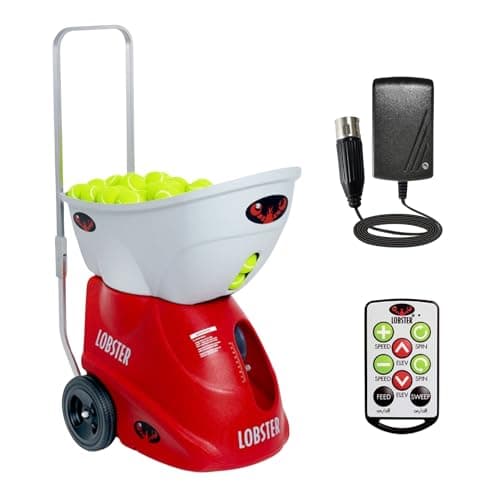
Buy the Lobster Elite Two. Triple oscillation — horizontal, vertical and random — plus a lob switch, a 150-ball hopper and a 10-function remote is the combination that makes a machine feel like an opponent rather than a feeder, and for a 4.5 player that difference is the entire purchase. If you would rather rehearse specific patterns of play than be moved randomly, the Spinshot Plus-2 runs programmable app-controlled drill sequences and is the better tool for pattern work. The Elite Liberty is the one to buy if your practice is groundstroke repetition and you would rather put the difference into lessons.
This page is written for a player at NTRP 4.5 or above, and that changes which specs matter. On the main ball machine page we rank for portability, because for most club players the machine that gets carried is the machine that gets used. At 4.5 you have already decided you will carry it. The question becomes whether the feed is good enough to be worth the trip.
What changes at 4.5
One-spot feeds stop being useful. A 3.0 player gets real value from a hundred identical forehands because the stroke is still being built. A 4.5 player's forehand is built; what is missing is hitting it on the move, off balance, from a position they did not choose. That requires oscillation, and preferably oscillation that is not predictable.
Depth variation starts to matter more than width. Horizontal oscillation moves you side to side, which every machine with an oscillator does. Vertical oscillation changes the depth of the ball, which is the dimension that actually breaks a good player's rhythm: a short ball after three deep ones is the shot most 4.5s hit worst. Triple oscillation — both axes plus random — is the spec worth paying for at this level, and the Elite Two is where it starts.
Pace needs a ceiling you can feel. Machines in the budget tier top out around 68 to 75 mph, which is plenty for a 3.5 rally ball and nothing like a 4.5 first serve or a heavy inside-out forehand. If you want to practice returning real pace, you need the top of a machine's range to be above what you normally face, not level with it.
The remote becomes the most-used feature. This sounds trivial and is not. A serious practice session involves changing the drill eight or ten times. Without a remote, every change is a walk to the far baseline, and the honest outcome is that you stop changing it and do one drill for an hour. The Elite Two's 10-function remote and the Spinshot's phone app both solve the same problem.
Oscillation versus programmability: the real choice
Everything above the entry tier splits into two philosophies, and picking the wrong one is the most common expensive mistake at this level.
Random oscillation (the Lobster approach) makes you move to a ball you cannot predict. It trains recovery, footwork and shot selection under uncertainty. It is the better fit if your weakness is movement and you want a hard physical session.
Programmed sequences (the Spinshot approach) feed a defined pattern — short ball, deep crosscourt, short ball — the same way every time. It trains the pattern itself: the approach, the transition, the finish. It is the better fit if your weakness is a specific phase of play rather than general movement.
A 4.5 player who plays singles and gets passed at the net wants the second. A 4.5 player who plays doubles and loses points late in long rallies wants the first. If you genuinely cannot tell, buy the Lobster: random oscillation is the more general tool and the knobs-and-switches interface has no software dependency to outlive.
What none of them do
No machine on this page serves. They feed from a point near the baseline at an elevation you set, which is a groundstroke or a short-ball feed, not a serve trajectory. If what you want is return-of-serve practice, a machine set high and fast is an approximation and nothing more.
None of them disguises anything either. The feed tells you where it is going a half-second before it arrives, every time, so the anticipation component of your game gets no work at all. Train it against people. For the honest wider picture on what machine practice does and does not buy you, see are ball machines worth it.
As everywhere on this site: we have not fed balls out of these machines. Every figure above is the manufacturer's published specification, and the scores are judgments from that documentation against our rubric, weighted here toward feed quality and programmability rather than toward portability or price.
Feed the machine the right balls
A machine at 4.5 settings is hard on balls, and pressurized balls are dead in two weeks whether you hit them or not. Fill it with pressureless practice balls and expect a season out of them. 150 balls in the Elite Two's hopper is roughly two bags.
Buy the oscillator before the speed
If your budget forces a choice between a faster machine and an oscillating one, take the oscillation. A 70 mph ball you have to run to is harder, and more useful, than an 80 mph ball fed to your strike zone. This is the single most common mis-spend in this category.
Where the budget machines genuinely fall short
The sub-thousand tier — covered on the budget page — now gives you dual motors, real topspin and 80-plus hoppers. What it does not give you is vertical oscillation, a programmable sequence, or a top speed above about 75 mph. For a 3.5 those are not real limitations. For a 4.5 they are exactly the three things you were buying.