Skip to content
Four Oh Club

Bags, machines & training · Gear

The Best Tennis Ball Machines

The most expensive thing on this site, and the one that most often sits in a garage. Portability decides whether a ball machine changes your tennis or just your bank balance.

By Stephen V.Updated How we score
#ad

We earn a commission when you buy through our Amazon links, at no extra cost to you. It never changes our rankings, and we say so when the cheaper racquet is the better buy. How this works.

Buy the Lobster Sports Elite Liberty. It is battery powered, has large wheels, runs two to four hours and oscillates randomly — which is the cheapest configuration that one person can actually get onto a public court alone. If you have a home court or storage at your club, the Elite Two adds vertical oscillation and a remote and is the better machine. If you need the lightest full-feature unit, the Tennis Tutor ProLite Plus.

The spec that actually matters is weight

Ball-machine marketing is all about ball speed, spin and drill programming. Those matter. What decides whether you use the machine is whether you can get it from your car to the court without dreading it.

A machine that needs two people, or a flight of steps you cannot manage, or a mains socket that courts do not have, gets used three times. Battery power and large wheels are not convenience features; they are the difference between a training tool and an expensive ornament.

Oscillation is what separates a machine from a feeder

A machine that fires every ball to the same spot teaches you to hit from a stationary position, which is not tennis. Oscillation is what makes you move.

Horizontal oscillation varies the ball side to side. This is the essential one, and the Elite Liberty has it in random mode, which is better than a predictable sweep because you cannot pre-plan your footwork.

Vertical oscillationvaries depth — short ball, deep ball — and is what lets a machine simulate an actual rally. Only the Elite Two and the Spinshot offer it here, and it is the single biggest reason to spend more.

Programmable sequences go further again: the Spinshot can run defined patterns of play so you can rehearse a tactical sequence rather than a shot. Powerful, and dependent on an app, which is a long-term support risk.

What a machine is good for, and what it is not

A machine is unmatched for repetition. Grooving a stroke needs hundreds of balls in a session, which no hitting partner will feed you and no coach can afford to.

It is poor at everything tennis actually consists of: reading an opponent, varying your own shot, point construction, serving under pressure. A machine ball arrives from the same place at the same height with the same spin, and your brain stops working after twenty minutes.

Use it for 20–30 focused minutes on one specific thing, then stop. It is a tool for technical work, not a substitute for playing.

The short answer

Quick picks

#Racquet / gearBest forScorePrice
01
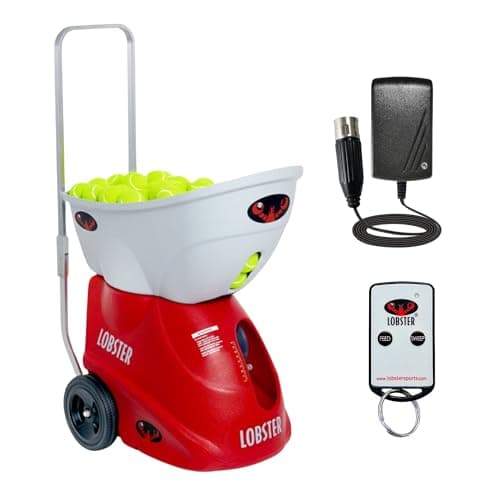
Lobster Sports Lobster Sports Elite Liberty
Lobster Sports Elite Liberty

The ball machine to buy. Battery powered, genuinely portable, with oscillation and spin — the cheapest machine that is not a compromise.

Most club players
8.4
$1,179.00Amazon
02
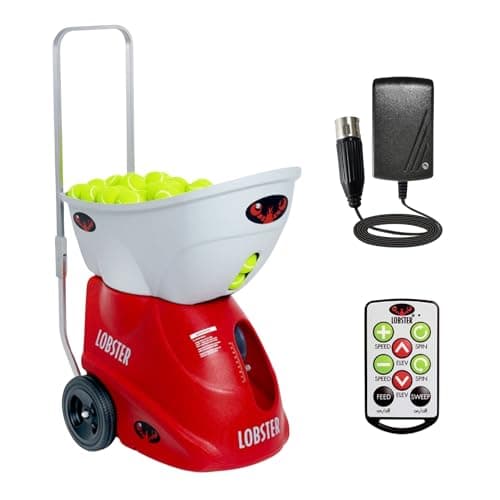
Lobster Sports Lobster Sports Elite Two
Lobster Sports Elite Two

The machine for a serious practice habit: triple oscillation, a lob switch and a remote, so the drill changes without you walking to the baseline.

Serious practice
8.4
$1,699.00Amazon
03
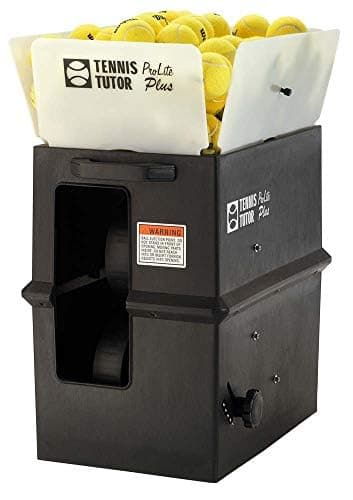
Tennis Tutor Tennis Tutor ProLite Plus
Tennis Tutor ProLite Plus

The light one. Under the weight of the Lobsters with one-touch spin and 75 mph feeds — the machine for someone who has to carry it up steps.

Lightest full machine
8.4
$1,329.00Amazon
04
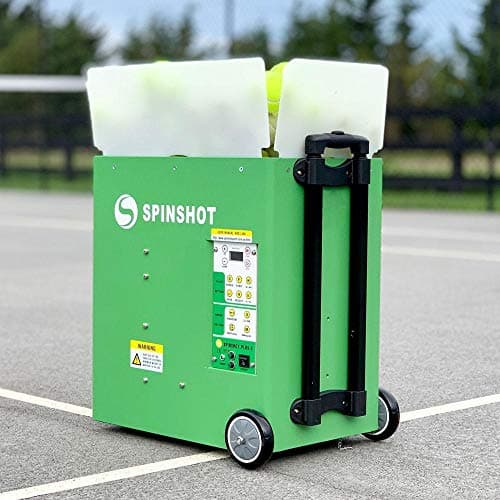
Spinshot Spinshot Plus-2 Ball Machine
Spinshot Plus-2 Ball Machine

The programmable one. Spinshot's machines run app-controlled drill sequences, which is a genuinely different training tool from a feeder.

Programmable drills
7.6
$1,899.00Amazon

#ad · Live prices from the Amazon Product API, as of October 7, 2026. Where we have no verified live price, we show none — we would rather leave a gap than print a number that has rotted.

In detail

The picks, in full

01
Lobster Sports Lobster Sports Elite Liberty

Most club players

Lobster Sports Elite Liberty

Battery, 2-4 hr runtimeRandom horizontal oscillationTopspin/backspin~35 lb
8.4/10

The ball machine to buy. Battery powered, genuinely portable, with oscillation and spin — the cheapest machine that is not a compromise.

Portability
9
Features
7
Build
9
Ease of use
9
Value
8

Pros

  • Battery operation and large wheels mean one person can actually get it onto a public court — the thing that decides whether a machine gets used
  • Random horizontal oscillation makes you move, which is the entire reason to own a machine rather than a basket
  • Adjustable topspin and backspin, not just a feed

Cons

  • Horizontal oscillation only — no vertical, so every ball arrives at the same depth
  • Four figures. This is the most expensive thing on the site

Don't buy this if…

…you want varied depth as well as width. Step up to the Elite Two for vertical oscillation.

$1,179.00View on Amazon

Price as of October 7, 2026. Prices change — Amazon's is the one that counts.

#ad · we may earn a commission from this link to Lobster Sports Elite Liberty

02
Lobster Sports Lobster Sports Elite Two

Serious practice

Lobster Sports Elite Two

150-ball capacityTriple oscillation10-function remoteLob elevation
8.4/10

The machine for a serious practice habit: triple oscillation, a lob switch and a remote, so the drill changes without you walking to the baseline.

Portability
7
Features
10
Build
9
Ease of use
9
Value
7

Pros

  • Triple oscillation (horizontal, vertical and random) is what makes a machine feel like a hitting partner instead of a feeder
  • The 10-function remote means you change drills from where you are standing, which doubles how much you actually practise
  • 150-ball hopper is enough for a genuine session without constant reloading

Cons

  • Substantially more expensive than the Elite Liberty
  • Heavier, so the portability advantage narrows

Don't buy this if…

…you mainly want consistent groundstroke repetition. The Liberty does that for considerably less.

$1,699.00View on Amazon

$1,799.006% off

Price as of October 7, 2026. Prices change — Amazon's is the one that counts.

#ad · we may earn a commission from this link to Lobster Sports Elite Two

03
Tennis Tutor Tennis Tutor ProLite Plus

Lightest full machine

Tennis Tutor ProLite Plus

Up to 75 mphOne-touch topspin/underspinBuilt-in oscillatorMade in USA
8.4/10

The light one. Under the weight of the Lobsters with one-touch spin and 75 mph feeds — the machine for someone who has to carry it up steps.

Portability
10
Features
7
Build
9
Ease of use
9
Value
7

Pros

  • The lightest full-feature machine here, which is the single biggest predictor of whether a machine gets used
  • One-touch spin switching means you change from topspin to slice without a settings menu
  • 75 mph top speed is genuinely enough to practise returns against

Cons

  • Smaller ball capacity than the Lobster Elite Two
  • Fewer drill features for a comparable price

Don't buy this if…

…you leave the machine at a home court. Buy the feature set instead of the light weight.

$1,329.00View on Amazon

Price as of October 7, 2026. Prices change — Amazon's is the one that counts.

#ad · we may earn a commission from this link to Tennis Tutor ProLite Plus

04
Spinshot Spinshot Plus-2 Ball Machine

Programmable drills

Spinshot Plus-2 Ball Machine

App-controlledProgrammable drill sequencesFull oscillationPhone app
7.6/10

The programmable one. Spinshot's machines run app-controlled drill sequences, which is a genuinely different training tool from a feeder.

Portability
7
Features
10
Build
8
Ease of use
7
Value
6

Pros

  • Programmable six-shot drill sequences let you rehearse real patterns of play, not just one repeated ball
  • Phone app control replaces walking back to the machine between settings
  • Combines the Plus and Player feature sets in one unit

Cons

  • The most expensive machine here
  • App-dependence is a long-term risk if support lapses

Don't buy this if…

…you want to buy a machine and never think about software. The Lobsters are knobs and switches.

$1,899.00View on Amazon

Price as of October 7, 2026. Prices change — Amazon's is the one that counts.

#ad · we may earn a commission from this link to Spinshot Plus-2 Ball Machine

The four compared

MachinePowerOscillationControl
Lobster Elite LibertyBattery, 2–4 hrRandom horizontalOn-machine dials
Lobster Elite TwoBatteryTriple — horizontal, vertical, random10-function remote
Tennis Tutor ProLite PlusBatteryBuilt-in oscillatorOne-touch spin
Spinshot Plus-2BatteryFull, plus programmable sequencesPhone app

Hidden costs nobody mentions

Balls.A 150-ball machine needs 150 balls, and machine use destroys them far faster than play does. Budget for a case — see best tennis balls— and expect to replace them regularly.

Pickup. You will spend as long collecting balls as hitting them unless you have a hopper. A wheeled hopper is effectively a required accessory, not an optional one.

Court permission. Many public courts and some clubs restrict ball-machine use, especially at busy times. Check before you buy, not after.

Battery replacement.Batteries degrade over a few years and are a significant fraction of the machine's cost to replace.

Should you buy one at all?

An honest alternative framing. At these prices, a ball machine costs roughly the same as twenty to forty hours of private coaching, depending on where you live.

If your limitation is technique you do not know how to fix, buy the coaching. A machine will help you groove a flawed stroke very efficiently.

If your limitation is repetition on a stroke you already understand, or you simply cannot find people to hit with, the machine is the better purchase and it keeps working for years.

If your budget is a tenth of this, a rebounder or a topspin trainer covers a meaningful share of the same ground.

Spin and speed settings in practice

Most club players set the speed too high. A machine at 50–60 mph with topspin produces a ball closer to a real rally ball than one at 75 mph flat, and gives you time to actually execute the technique you are there to practise.

Topspin feeds are also what you will mostly face on court. Underspin settings are useful for practising approach shots off a short, low ball — a specific drill rather than a default.
How we picked

We have not physically tested this gear

Everyone in this category says they tested twenty racquets. We have not tested any — and we say so. What we did instead: compiled the manufacturer-published specifications (head size, strung weight, string pattern, stiffness, outsole compound), normalized them, and scored each product against a published rubric weighted for the NTRP tier this page serves. The scores are judgments from documented research, not measurements we took, because we do not have a lab and are not going to pretend we do.

Questions

Frequently asked

What is the best tennis ball machine?
The Lobster Sports Elite Liberty for most club players: battery powered, genuinely portable with large wheels, two to four hours of runtime, random horizontal oscillation and adjustable spin. The Elite Two is the better machine if portability is less of a constraint.
Are tennis ball machines worth it?
For repetition on a stroke you already understand, yes — nothing else gives you hundreds of balls in a session. For fixing technique you do not understand, coaching is the better use of the same money.
How many balls do you need for a ball machine?
Enough to fill the hopper — typically 100–150. Buy by the case, and expect machine use to wear balls out considerably faster than normal play does.

Keep reading

Receipts

Sources

We do not run a testing lab, and we do not pretend to. Our specs come from manufacturer listings and spec sheets; our rules and dimensions come from the official rulebook. Where we could not verify something, we say so on the page rather than quietly leaving it out. Read our full method.