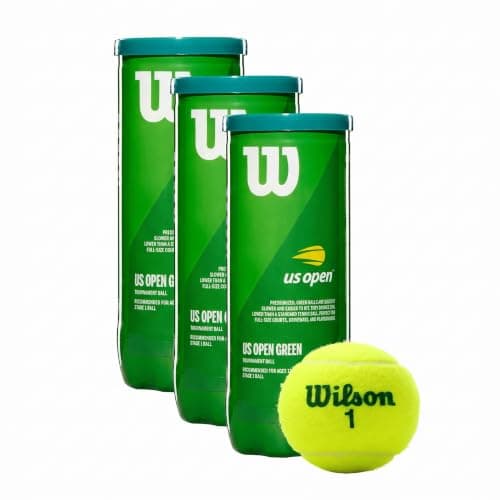
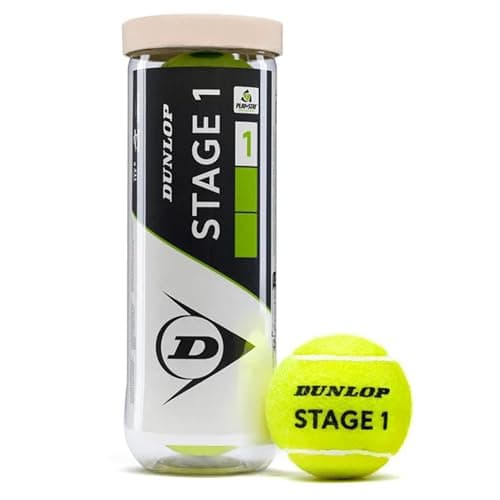
The softest tennis ball you can still play real tennis with is a green dot: full size, full court, at a published 75% of standard compression. Buy the Dunlop Stage 1 green dot 3-pack first — it costs almost nothing and tells you within one session whether softer balls are the answer for your arm. If you need softer than that, an orange dot is 50% of standard compression and a foam Stage 3 ball is softer still, with each step trading away more of how the game plays. If you want the green-dot ball that feels least like a training aid, the Wilson US Open Green comes in sealed pressurized cans.
This page is written for the player whose arm, elbow or shoulder has made tennis uncomfortable — which is most people searching for soft tennis balls. It is also the page to read if you are returning to the game after a layoff, playing into your seventies, or hitting with a child or a beginner and want the rallies to last.
What "soft" means on a tennis ball: compression
A standard yellow ball is built to a compression specification, and the 10-and-under progression exists because that specification is too much ball for a small player. The published figures, per TennisCompanion's ball guide, are a ladder:
Green (Stage 1) — full size, 75% of standard compression. Plays on a full court with a normal net. The ball arrives slower and lower, and nothing else about your tennis has to change.
Orange (Stage 2) — full size, 50% of standard compression. Half the ball coming back at you. Rallies get longer and flatter; a serve-and-volley game stops working.
Red (Stage 3) — 25% of standard compression, and in the felt version 15% larger than standard. The foam version has no rubber core at all and is the softest thing in tennis.
Those numbers are the published figures from a ball guide, cited as theirs, not measurements we took — we do not have a compression rig. But the ladder is the useful part: each step down removes roughly a quarter of the ball's stored energy, and the energy a ball does not store is energy your arm does not absorb.
Why a softer ball helps an arm more than a softer string does
Tennis elbow is a tendon problem, and the American Academy of Orthopaedic Surgeons describes it as overuse causing "microtearing of the tendons that join the forearm muscles on the outside of the elbow." What matters is cumulative load: how hard each impact is, multiplied by how many of them there are.
Every arm-friendly purchase in tennis attacks one of those two terms, and most of them attack the first by a few percent. A softer multifilament string reduces impact shock somewhat. A flexible, arm-friendly frame reduces it somewhat. Dropping a ball to 75% compression reduces the energy of the impact itself, which is a larger and more direct intervention than either — and it costs under ten dollars to test.
That is the honest case for this page. It is also honest to say what a soft ball cannot do: it does not fix technique, it does not treat a tendon, and it is not medical advice. If your elbow hurts, read how to prevent tennis elbow, consider a counterforce brace, and see somebody qualified. Soft balls are a way to keep playing while you do the rest.
What you give up at each step
A green dot ball is a genuine compromise you can live with: a 4.0 can play a competitive set with green balls and it still looks and feels like tennis, just with less pace coming through. This is why it is the top pick rather than the softest option.
An orange ball is a bigger change. Points get longer, the ball sits lower, and anyone with real pace loses the timing of their own strokes. For rehab, for a drilling session that is about repetitions rather than intensity, or for an older player who wants two hours of rallying rather than a match, it is the right ball. For social sets with other adults it is not.
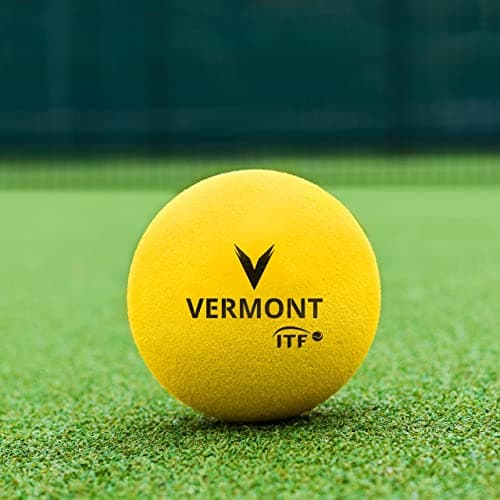
A foam ball is a different sport, and that is fine as long as you know it. There is no rubber core to compress and nothing to sting the arm. Indoors, in a garage, in a hallway, with a child, or with a shoulder two weeks out of a sling, it is the correct tool. Outdoors in any wind it is unusable.
So which should you buy?
Your arm hurts and you want to keep playing real tennis → Dunlop Stage 1 green dot, 3-ball pack. Cheap enough to test the whole idea this week.
Green dot, but you want the fresh-can feel → Wilson US Open Green Tournament, three cans. Sealed and pressurized, from the US Open line, so each can opens fresh rather than coming out of a bag.
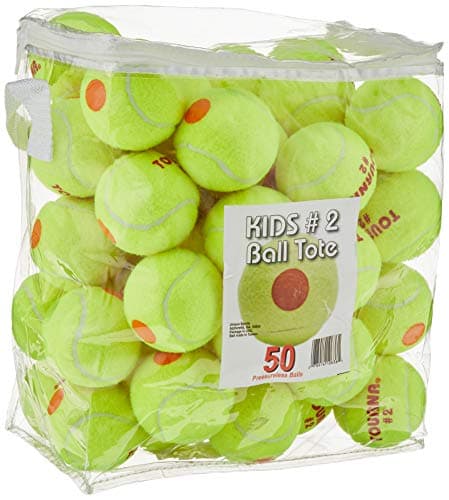
A genuinely sore arm or shoulder, or long low-intensity rallies → Tourna orange dot Stage 2, 50 balls. Half standard compression, and a hopper's worth, which is how softer-ball practice actually gets done.
The softest ball that exists, or practice indoors → FORZA Vermont foam Stage 3, 90 mm, ITF-approved. No rubber core, no sting, no use outdoors in wind.
You want a standard ball that is as gentle as a standard ball gets → a regular duty pressurized ball. Thinner, softer felt and the usual compression — the Penn Championship regular duty on the clay-court page is the cheapest way to get it. It is a small improvement over extra duty rather than a category change.
The same low-compression balls answer a second, completely different question. The best tennis balls for beginners ranks them for learning rather than for arm pain: a slower ball buys a new player the half-second they need to prepare, which is the thing beginners are actually short of.