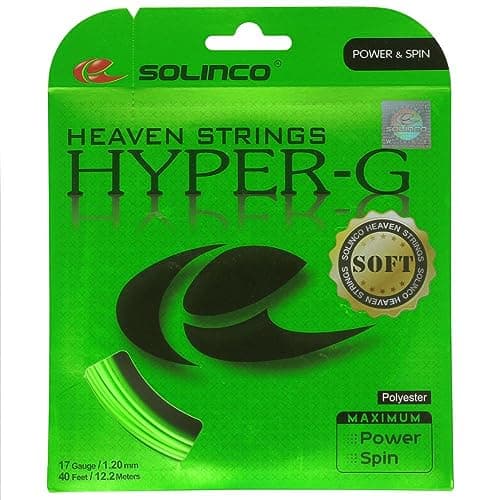
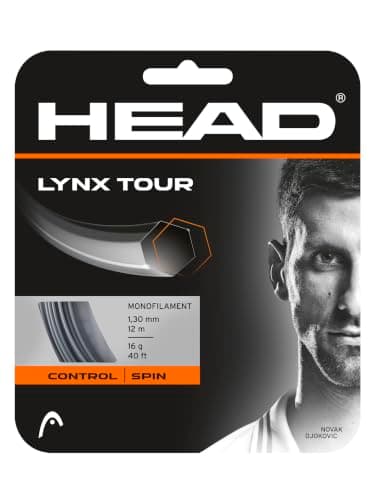
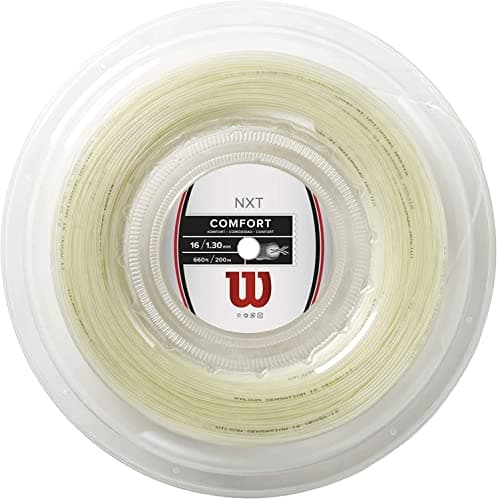
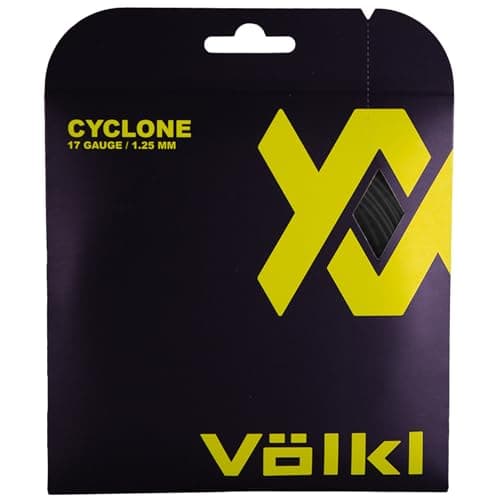
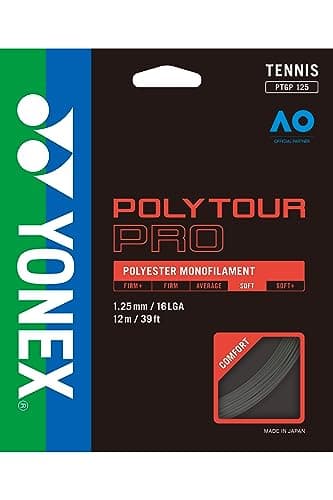
Yonex Poly Tour Pro 125 is the right first polyester for an intermediate player. It is silicone-infused, which genuinely takes the edge off a poly string bed without turning it into a multifilament, and it is the only poly here we would put in the hands of a 3.5 with a slightly grumpy elbow. If you want spin rather than comfort and you want it cheaply, Solinco Hyper-G Soft 17 is the best-value shaped poly sold and the one to buy first. HEAD Lynx Tour 17g is the pick if you hate restringing, because it holds tension unusually well for a poly. Wilson NXT 16 is the answer if your arm vetoes polyester altogether — it is the softest widely-sold synthetic and still has plenty of control for this level. And Volkl Cyclone 17g exists so you can find out whether you even like poly for the price of a sandwich.
An intermediate is the level where strings start mattering, and the reason is swing speed. Polyester works by deforming around the ball and snapping back; that requires racquet-head speed. Below about 3.5 you do not generate enough of it, so poly just feels harsh. From 3.5 upward you do — and the string that used to feel fine now feels loose, because your swing has outgrown it. That specific sensation, "my string bed has gone mushy and I am hitting long", is what brings most players to this page.
The three honest options at 3.5 to 4.0
Stay on a multifilament. Perfectly defensible. If you do not break strings and your priority is comfort, a 16 gauge multifilament in the middle of the tension range is a better string bed for you than a poly you cannot activate. The cost is control on your biggest swings — you will send some balls long.
Go to a full bed of soft poly. The standard move, and what most 4.0s end up doing. You trade some comfort and some free power for control and spin, and you accept restringing more often, because poly goes dead well before it breaks.
Hybrid. The option most club players have never been offered: poly in the mains (the long strings, which do the work and the sliding) and a multifilament or synthetic gut in the crosses. You get most of the control and spin of a poly bed with a noticeably softer feel, at a lower string cost, because one set covers two frames' worth of mains or crosses. If you have any arm history at all, this is where to start rather than a full poly bed.
Shaped or round?
Shaped polys — hexagonal, square, octagonal, seven-sided — have edges on the mains that bite the ball, and the mains then slide and snap back, which is the actual mechanism behind spin. Round polys are smoother on the ball and gentler on the frame's grommets. If you are a topspin baseliner, take a shaped string: Hyper-G Soft, Lynx Tour and Cyclone are all shaped. If you hit flatter and want the poly for control rather than revolutions, Poly Tour Pro's round profile is the better match. The deeper version of this is on strings for spin and strings for control.
Gauge and tension, for this level specifically
Published gauge charts put 17 gauge at roughly 1.16–1.24 mm against 16 gauge at 1.26–1.34 mm. Thinner bites more and breaks sooner. At 3.5–4.0, 17 gauge poly is the sensible default unless you are a string-breaker, in which case go 16. On tension: polyester is strung lowerthan synthetic gut in the same frame — commonly 2 to 4 lb below what you used — because the string itself provides the control a higher tension used to. String a poly at your old synthetic-gut tension and it will feel like a board. See the tension guide.
The thing that actually improves your string bed
Restringing on schedule. A premium poly three months old plays worse than a cheap poly strung last week, because the tension has gone and with it the control you paid for. The old rule — restring as many times a year as you play per week — is more valuable at this level than any brand choice on this page. How often to restring sets out what the tension loss actually does, and if you are playing three or four times a week, the arithmetic in what restringing costs starts to make a stringing machine look reasonable.
One more intermediate-specific note. If you have just moved to a player's frame — a 98 sq in head, 11+ oz strung — change one variable at a time. New frame and new string in the same week leaves you with no idea which one is responsible for how you are playing. The frame side of this level lives on the best intermediate racquets and racquets for 4.0 players.
A hybrid, specified
Poly in the mains, synthetic gut or multifilament in the crosses, crosses strung 2 lb higher than the mains. Ask for it exactly like that. Any stringer will know what you mean, and it costs the same labor as a full job.
If your elbow is the constraint, stop here
Do not solve an arm problem with a string choice alone. The combination that hurts people is a stiff frame plus a stiff full-poly bed at high tension; fixing one of the three is often enough. Strings for tennis elbow and arm-friendly racquets handle that properly, and how to prevent tennis elbow covers the part that is not equipment.
Buy sets, not reels, until you have picked a string
A reel is cheaper per job and a commitment of sixteen jobs. Experiment with 40 ft sets, and buy a reel of the string you keep going back to. Two of the entries here are sold both ways.