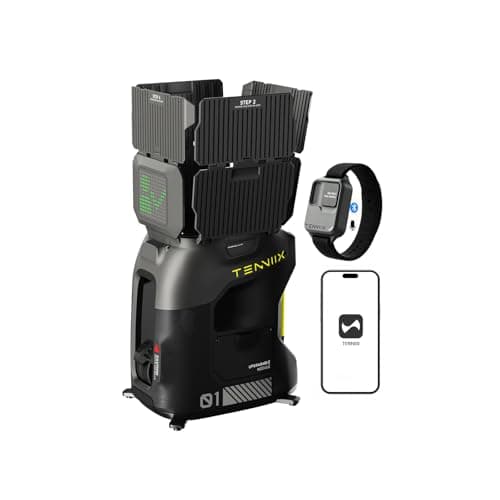
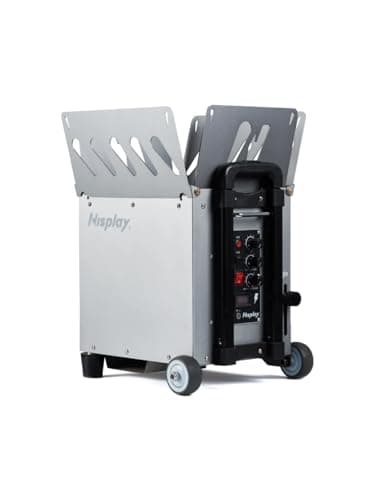
Buy the Nisplay if you want to find out whether you will actually use a ball machine, without spending four figures to answer the question. Its published specs are 80-plus balls, 26 lb, a 68 mph top speed, a 4-plus hour external battery, and — the spec that matters most at this price — dual motors, which is what makes genuine topspin and backspin possible rather than a flat lobbed feed. The closest alternative is the TENNIIX Basic at a published 18.7 lb with a larger hopper and app control; the serious step up is the Lobster Elite Liberty.
As on every review page here: we have not owned or tested this machine. What follows is built from the live Amazon listing and the specifications Nisplay publishes on it, plus what those specs support when set against the other machines we list. We do not have a lab and we do not pretend to.
The published specs, and what each one means
Dual motors. Start here, because it is the reason this machine is on the site at all. Two counter-rotating wheels running at different speeds is how a machine imparts spin: faster top wheel gives backspin, faster bottom wheel gives topspin. A single-motor machine can only throw the ball flat. A flat feed at 60 mph behaves nothing like a topspin rally ball — it arrives lower, skids, and teaches you to hit a shot you will never receive in a match. Dual motors at this price point is unusual and it is the whole value proposition.
80+ ball capacity. Roughly two hoppers. The practical threshold is about 70 balls: below that you spend more of your hour picking up than hitting. 80 clears it with a little margin, though it is below the TENNIIX's published 100+ and well below the 150 of the Lobster Elite Two.
26 lb. A genuine one-person carry. Heavier than the TENNIIX's published 18.7 lb, lighter than the Lobster Elite Liberty's roughly 35 lb. At 26 lb you can get it out of a car trunk and onto a court on your own, which is the single best predictor of whether a machine gets used rather than stored.
68 mph top speed. This is the honest limitation. 68 mph is a solid 3.0 to 4.0 rally ball and it is not match pace for a 4.5. If you are at that level, this is not your machine — read the advanced-player page instead. For everyone below it, 68 mph fed to a corner you have to run to is harder work than most people expect.
4+ hour external battery. Four hours is more than enough for any session, and an external pack is easier to replace than an internal one. It is also the component most likely to degrade: lithium packs lose capacity with cycles regardless of brand, so budget for a replacement in a few years and treat the 4-hour figure as a new-battery number.
Where the money came out
At this price something has to give, and being specific about what is more useful than a score.
Oscillation. The listing's headline specs are capacity, weight, speed and spin — not random horizontal oscillation of the kind the Lobster Elite Liberty makes its central feature. A machine that feeds to one place is a feeder; a machine that moves you is practice. If being moved is what you want from a machine, that is the single best reason to spend more.
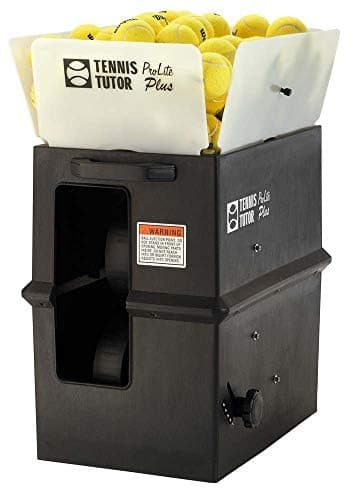
Service and parts. Nisplay is a newer entrant than Lobster or Tennis Tutor. Drive wheels, feed belts and batteries are consumables on any machine, and the established brands have decades-old parts channels. There is no way to know today whether a part will be available for this machine in 2033.
Build finish. Expect molded plastic where the four-figure machines use metal. That is not automatically a problem — plastic is how you get to 26 lb — but it is where the difference is visible.
Who should buy it
A 3.0 to 4.0 player testing the habit. This is the correct use of this machine. Two hundred topspin forehands a week will do more for a 3.5 than any racquet upgrade, and if after six months the machine is still coming out of the car, you have learned something worth four figures for a fraction of it.
A parent feeding a junior. Dual-motor topspin at a slower speed setting is exactly the ball a developing junior needs, and 26 lb means they can carry it themselves within a couple of years. Pair it with low-compression balls rather than standard ones.
Not a 4.5+ player. 68 mph and no random oscillation is a feeder at that level. Spend the money once, properly.
Whichever you buy, fill it with pressureless practice balls. A machine destroys pressurized balls, and pressurized balls die in two weeks anyway. And read are ball machines worth it first if you have not: the arithmetic there applies to this machine more than to any other on the site, because the whole point of the Nisplay is that it lowers the stake.