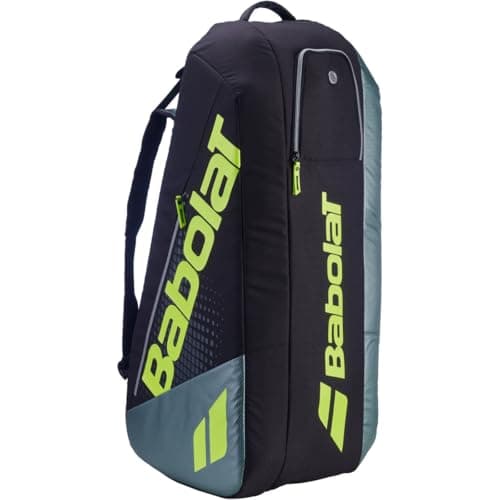
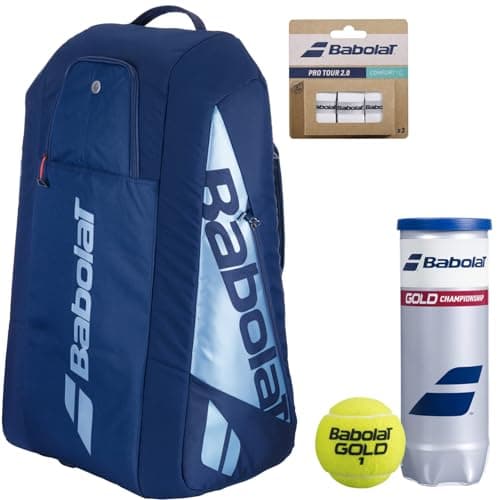
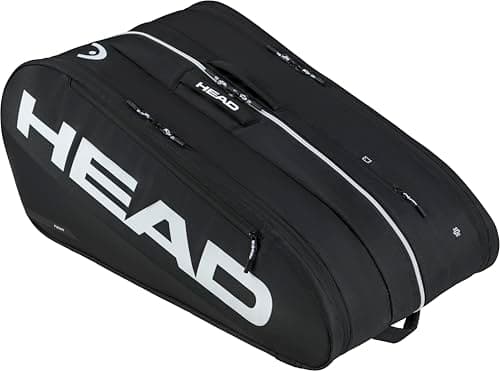
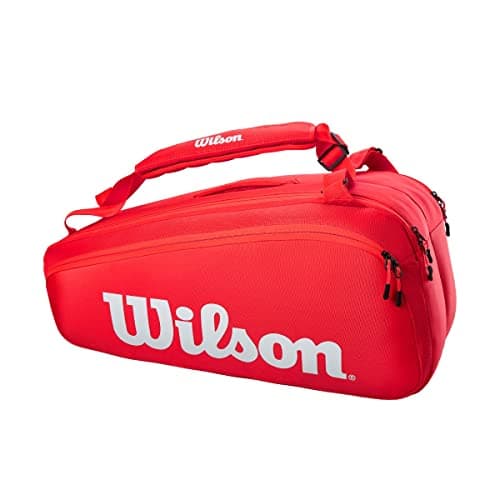
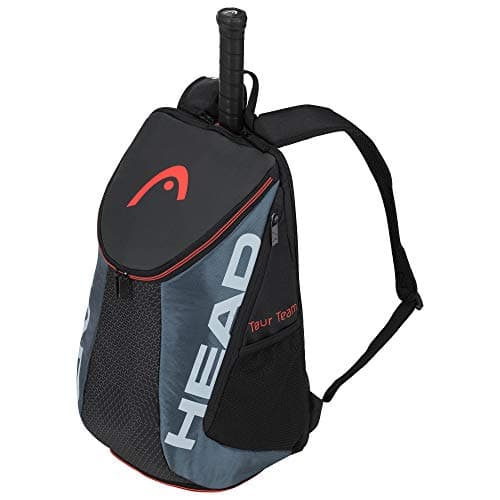
For most club players the HEAD Tour Team Tennis Backpack is the right bag with a shoe compartment: two racquets, a dedicated shoe pocket and padded straps, at backpack money — and a separate shoe pocket at that price is the feature most cheap bags leave out. If you play leagues and carry a spare frame, the Babolat Pure Aero RH6 is the step up, with a thermal main compartment alongside its shoe compartment. For a full kit, two 12-packs publish genuinely good shoe storage: the Babolat Pure Drive RH12 has a seamless, waterproof, outward-vented Clear View shoe pocket and insulates all three of its main compartments, while the HEAD Tour Racquet Bag XL gives you a published 75 liters and a CCT+ climate-controlled compartment for less money. The Wilson Super Tour 9-Pack is here as the honest alternative rather than a shoe-compartment bag: it has three separate thermal main compartments, so one of them becomes your shoe compartment.
This is a page about one feature, so let us be clear about what the feature does and does not do. A shoe compartment is a sealed or semi-sealed pocket, usually at one end of a bag, designed to keep a pair of damp court shoes away from everything else you are carrying. The good ones vent to the outside. The excellent ones are waterproof on the inside face, so that clay dust and sweat cannot migrate.
Why it matters is less about smell than about your racquets. A tennis bag is where your frames live between sessions, and two things in that bag are hostile to them: heat and moisture. A shoe pocket that vents outward moves the moisture out of the bag rather than around it; a thermal or climate-lined racquet compartment next door is what stops a frame in a hot trunk losing string tension. Bags that have both are doing something real for your kit.
What makes a shoe compartment good rather than present
It vents to the outside. A sealed pocket with no airflow keeps the smell in the bag — it just keeps it in a smaller part of the bag. Babolat publishes the RH12 shoe pocket as seamless, waterproof and vented to the outside, which is the full specification you want.
It is big enough for your actual shoes. Shoe pockets are sized optimistically. A size 13 court shoe with a chunky lateral chassis does not go into every "shoe compartment" on the market, and a pocket you have to force the shoe into stops being waterproof the first time the zip strains.
It is separate from the racquet compartment, not a divider inside it. Some bags market a "shoe compartment" that is a fabric sleeve inside the main compartment. That is a pocket, not a compartment, and it does not isolate anything.
The rest of the bag is still the right bag. A shoe pocket is not worth buying the wrong capacity for. If you carry one frame to a weekly hit, a 12-pack with a beautiful shoe pocket is a worse bag for you than a 2-racquet backpack — see small tennis bags and tennis backpacks for those formats.
Which capacity you actually need
Two racquets. A weekly hit, a second frame in case of a break, shoes, balls, a towel. The backpack format, and the HEAD Tour Team is the pick.
Six racquets. League play: two or three frames, a change of shirt, shoes, and room for the stuff a two-hour tie needs. The Pure Aero RH6 is the archetype and its thermal main compartment is the reason to pay for it.
Nine to twelve racquets. Coaches, tournament players and anyone whose bag doubles as a kit locker. This is where the published numbers start to matter: the HEAD Tour XL publishes 75 liters and external dimensions of 31 x 13 x 17 in, which almost no bag brand does, and the Babolat RH12 publishes 35 x 45 x 80 cm. Measure your trunk before you buy an 80 cm bag.
The thermal question, which travels with this one
Thermal or isothermal lining is insulation in the racquet compartment, and it exists for one scenario: your bag spends the summer afternoon in a car. Strings lose tension faster when hot, and a frame left at trunk temperature between sessions arrives at the court softer than it should be. The RH12 insulates all three main compartments; the HEAD Tour XL insulates one of three; the Pure Aero RH6 has a thermal main compartment; the backpacks have none. If your car is where your racquets live, pay for the insulation — and if it is not, do not.
Related: if you are flying rather than driving, a shoe compartment matters less than dimensions and cabin-bin compatibility. That is tennis travel bags, and taking a racquet on a plane covers what the TSA actually publishes about it.
The reason to carry your shoes at all
Worth saying, because it is the whole argument for this feature: court shoes should not be walked to the court. Pavement is more abrasive than any court surface and it wears the tread in a pattern that does you no good, which can cost a third of a pair's life. A bag with a shoe compartment is how you change at the court without putting damp shoes next to your grips. How long tennis shoes last sets out what wears out first and how to tell when a pair is finished.
One note on how this page is built, as everywhere on this site: the capacity figures, compartment counts, linings and dimensions quoted are the manufacturers' own published specifications, cited below. We have not weighed or measured these bags, and we have not filled them with twelve racquets to see what happens. The scores are judgments against the published rubric on our methodology page, weighted here for whether the bag isolates and vents shoes properly rather than for raw capacity.
If you want a bag that does not publish a shoe compartment
Buy one with multiple separate main compartments and dedicate one to shoes. The Wilson Super Tour 9-Pack has three thermal main compartments, which is a better practical outcome than a cramped shoe pocket — and a cheap mesh laundry bag inside it does the isolation for a couple of dollars. That is the honest workaround, and it is why the Super Tour is ranked here rather than excluded.
Never store shoes in the bag between sessions
The compartment is for transport, not storage. Shoes left damp in a sealed pocket degrade from the inside, and the bag keeps the moisture near your frames. Out of the bag, laces loose, at room temperature, every time.
Check the zip, not the marketing
The shoe compartment is the zip you will use twice per session, in a hurry, often with wet hands. YKK-grade hardware and a full-length opening are worth more here than anywhere else on the bag, and a strained zip on an over-tight pocket is the failure that ends bags.