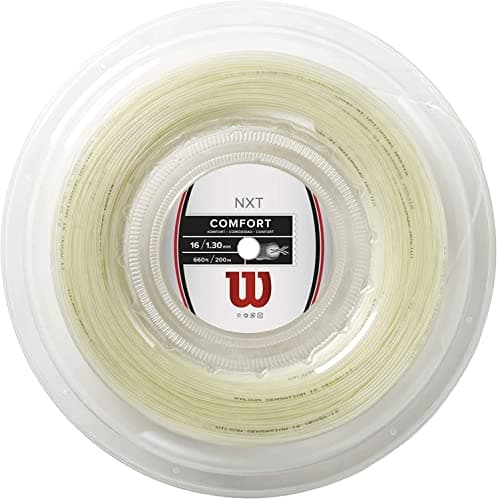
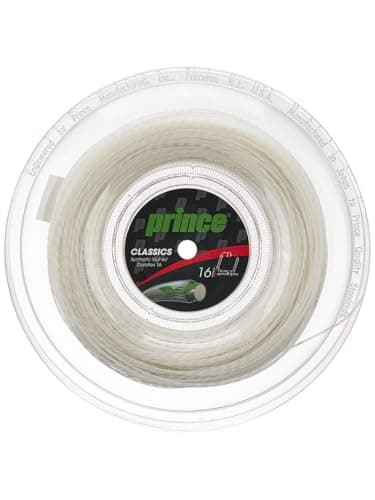
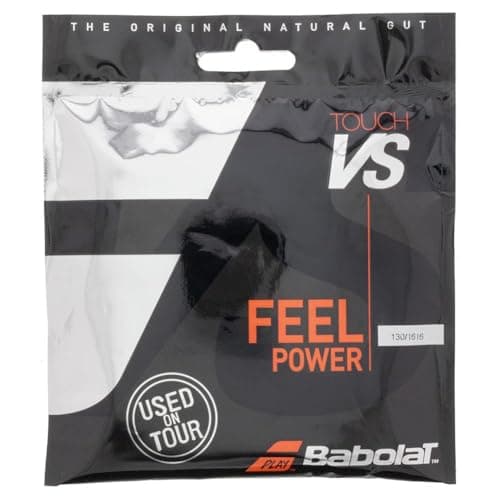
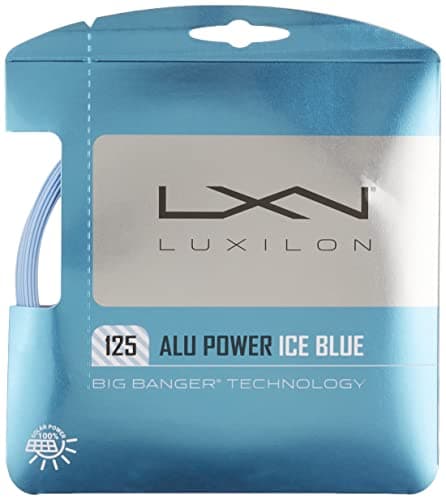
There are four types of tennis string. Polyester is a single stiff monofilament for control and durability; multifilament is hundreds of soft fibers bundled together for comfort and power; synthetic gut is a single nylon core with a wrap, the cheap sensible default; and natural gut is actual cow intestine, the best-playing and most expensive string there is. Almost every club player should be in one of the middle two.
String type matters more than most people expect — more than a racquet upgrade, for a fraction of the price. A frame you like, strung with the wrong material, feels like a frame you do not like. This page explains the four families and what each one is physically made of; the decision process, including gauge and tension, is at how to choose tennis strings.
1. Polyester (“poly”) — control and durability
What it is made of: a single extruded strand of polyester co-polymer, sometimes with additives — Luxilon's ALU Power adds a fluorocarbon resin and aluminum fibers. One strand, no bundle, no wrap. That is why it is called a monofilament.
What it does: it is stiff, so it deforms little on impact and returns little energy. That sounds like a drawback and is the entire point: a low-powered string lets a fast swing go at full commitment and still keep the ball in the court. Poly also holds its shape under shear, so the main strings slide sideways and snap back — which is the mechanism that actually produces topspin.
What it costs you: comfort and lifespan. Poly transmits more shock than any other family, and it goes dead— losing tension and elasticity — long before it breaks, typically in 10–20 playing hours. Playing on old poly is the single most common self-inflicted cause of tennis elbow in club tennis.
Who should use it: players who break strings inside a month, and 4.0+ players whose errors go long. Shaped and softened polys like Solinco's Hyper-G Soft split the difference and are the sensible first poly.
2. Multifilament — comfort and power
What it is made of: hundreds to thousands of microfibres — usually nylon, sometimes with polyurethane or Zyex blended in — bundled and bonded inside an outer coating. The construction deliberately imitates natural gut's bundle of collagen fibrils.
What it does: the bundle stretches and recovers, so the string bed deforms more, returns more energy and absorbs more shock. Depth comes easily, the feel is soft and the ball stays on the strings fractionally longer.
What it costs you: control at high swing speeds, and durability. A multifilament in the hands of a heavy hitter can break in a session, and when the outer coating abrades the inner fibers fray visibly.
Who should use it: anyone with arm trouble, anyone below about 4.0 who does not break strings, and anyone who wants natural gut's feel without natural gut's price. See strings for tennis elbow, where this family dominates the ranking.
3. Synthetic gut — the sensible default
What it is made of: a single solid nylon center core with one or more layers of smaller nylon filaments wrapped around it. Structurally it sits between a monofilament and a multifilament, which is exactly how it plays.
What it does: everything adequately and nothing exceptionally. Decent power, decent control, decent comfort, decent life, at a fraction of the price of either family above. It is the string most pre-strung racquets arrive with and the most-sold string in club tennis by a wide margin.
What it costs you: the top end of every characteristic. It does not control a 4.5 swing like poly and it does not cushion an injured elbow like a premium multifilament.
Who should use it: most 3.0–3.5 players, and anyone who would rather restring three times a year on cheap string than once a year on expensive string. That trade-off is correct more often than club players believe.
4. Natural gut — the best, and the most expensive
What it is made of: serosa, the outer membrane of cow intestine, cut into ribbons, cleaned, twisted into a cord and coated. It is a genuine animal product — one string set uses material from roughly three cows — and it is made essentially the way it was a century ago, which is why it costs what it costs.
What it does: the best power-to-comfort ratio of any string, and by a distance the best tension maintenance. A gut bed plays like a fresh bed for far longer than anything synthetic, which is part of what you are paying for.
What it costs you: money, and weather tolerance. Gut is damaged by moisture and should never be left in a damp bag. It also offers less spin potential than a shaped poly, because it grips the ball rather than sliding and snapping back.
Who should use it: players with persistent arm problems who have the budget, and advanced players in a hybrid — gut mains with poly crosses is the standard tour setup for exactly this reason.
Knowing the four families is the groundwork; picking one is the decision. How to choose tennis strings walks it through in three questions — do you break strings, does your arm hurt, and what do you want more of.
Two of these families account for most club string jobs, and they are easy to confuse because both are nylon. Multifilament vs synthetic gut puts them head to head on construction, comfort, tension maintenance, string life and real cost per restring, with a verdict on which club player should buy which.
Natural gut is the family on this page that raises a cost question rather than a performance one. It is the best-playing string made and the most expensive in tennis, and for most club players the honest answer is to buy a premium multifilament instead. Is natural gut worth it? sets out the three players it genuinely suits, the hybrid that halves the cost, and why moisture decides it for anyone who plays outdoors in the damp.
The four types compared
| Type | Construction | Power | Control | Comfort | Playable life |
|---|
| Polyester | Single stiff monofilament | Low | Highest | Lowest | 10–20 hours |
| Multifilament | Hundreds of bonded microfibres | High | Moderate | High | 20–30 hours |
| Synthetic gut | Solid nylon core plus wraps | Moderate | Moderate | Moderate | 15–25 hours |
| Natural gut | Twisted cow intestine serosa | Highest | High | Highest | Longest, if kept dry |
Playable life is not time-until-breakage. It is the window in which the string still does what you bought it for, and for polyester those two numbers are very far apart — which is the single most useful fact on this page.
The fifth option: hybrid
Not a material but a combination: different strings in the mains and the crosses, chosen so each does what it is best at. Two standard recipes cover almost every case.
Poly mains, multifilament crosses. The affordable one. Mains take most of the wear and do most of the spin work, so putting the durable, control-oriented string there and a soft string across keeps the bed comfortable. This is the setup to use in a stiff, powerful frame.
Gut mains, poly crosses. The tour setup. Gut's comfort and tension maintenance where it matters most, poly's control and durability across. Expensive, and genuinely the best-playing string bed available.
One practical note: hybrids are usually strung with the mains two pounds lower than the crosses, to compensate for poly's greater stiffness. Any competent stringer knows this.
What a string is made of is not the same as its gauge
Gauge is thickness and it is a separate axis from material. Confusingly, the numbering runs backwards: 16 gauge (about 1.30 mm) is thicker than 17 gauge (about 1.25 mm). Thicker lasts longer; thinner bites the ball more and feels livelier.
You can have a 16-gauge poly and a 17-gauge poly, and the difference between those two is far smaller than the difference between poly and multifilament. Decide the family first.
Reels versus sets
A set is one racquet's worth, roughly 40 feet. A reel is 200 meters, enough for sixteen to eighteen jobs, at a substantially lower cost per restring. Three of the picks above are priced as reels and the page says so, because a reel price next to a set price is a misleading comparison.
Buy sets while you are still deciding what you like. Buy a reel once you have settled, and especially if you string your own frames — at that point the reel is most of the saving.
Which family, in one line each
You break strings in under a month → polyester. Your arm hurts at all → multifilament, strung low. You are 3.0–3.5 and neither applies → synthetic gut, and spend the difference on restringing more often. You have arm trouble and a budget → natural gut, or gut mains in a hybrid.
Then rank within the family: the full picks are at the best tennis strings, best for spin and best for control, and the head-to-head is at polyester vs multifilament.