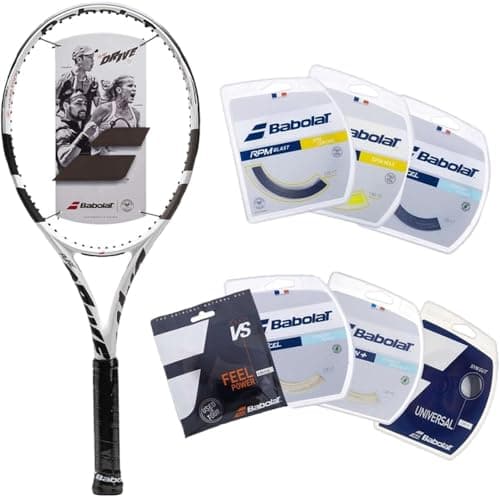
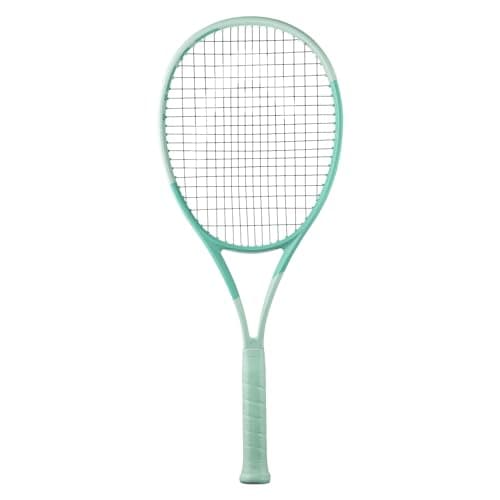
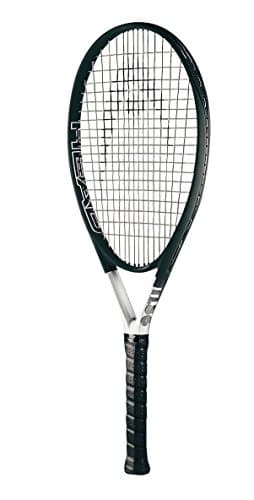
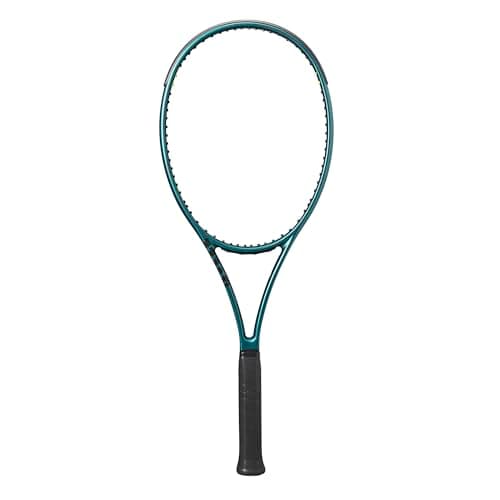
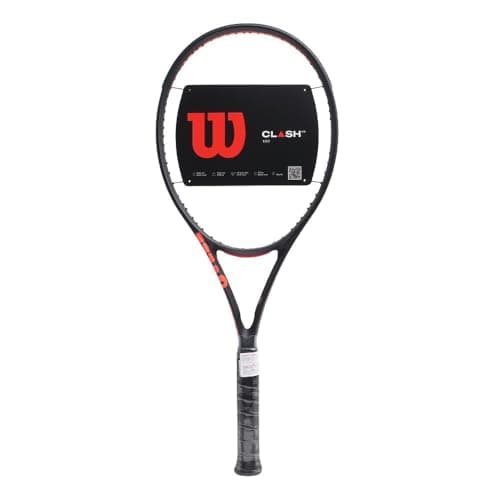
The best tennis racket for most club players is the Wilson Clash 100 v3 — a 100 sq in frame with an unusually low stiffness rating that gives you modern power without the shock that ends seasons. If you want more free depth and your elbow has never complained, the Babolat Pure Drive is the more powerful answer. If you are a genuine beginner, stop reading and buy the HEAD Ti S6: it costs a fraction of either and it is the right tool for where you are.
Why “best racket” is the wrong question
There is no best tennis racket, and any page that gives you one answer for everybody is selling something. A frame is a set of trade-offs between power and control, and the right point on that line is decided almost entirely by how fast and how completely you swing.
A player who takes a short, tentative swing needs the racket to supply power, which means a big head, a light frame and a stiff beam. A player with a full, fast swing needs the racket to removepower, or every ball lands three feet past the baseline — which means a smaller head, more mass and a flexible layup. Give either player the other's frame and they will play worse than they did last week.
That is why this site sorts by NTRP level rather than by brand. Find your level first; the racket follows.
The one number that explains most of this page
Stiffness, published as an RA rating, measures how much a frame deflects under load. It is the single most useful spec nobody looks at. A low RA frame bends around the ball, which gives you feel and absorbs shock; a high RA frame stays rigid and returns that energy as pace.
The gap is not subtle. Tennis Warehouse publishes the Wilson Clash 100 v3 at RA 54 and the Babolat Pure Drive at RA 69. Those two frames have the same head size and the same string pattern, and they are nearly fifteen points apart on the only spec that predicts whether your elbow will hurt. That one number is why the Clash tops this list and the Pure Drive sits second despite being the more popular racket.
How to read the ranking below
The table gives you the short answer; the full write-ups below it give you the reason and the honest reason not to. Every pick carries a “don't buy if” line, because the most useful thing a gear page can tell you is when the thing it is recommending is wrong for you. Prices come from Amazon's API and carry the date we checked them — if our data goes stale, the number disappears rather than lying to you.
The four specs that actually matter
Head size
Measured in square inches, and the biggest single lever on forgiveness. Roughly: 97–98 sq in is a control frame for a consistent striker, 100 sq in is the modern all-court standard and what most club players should buy, and 105–115 sq in is a beginner or senior frame that trades precision for a huge sweet spot. Our head size guide covers the 98-vs-100 decision in detail, because that is where most 4.0 players get stuck.
Strung weight
Heavier frames are more stable against pace and generate a heavier ball; lighter frames are easier to swing late. Under 10 oz is a beginner or senior spec. 10.5–11.3 oz is club-player territory. Over 11.5 ozis a player's frame and will tire you out if your technique is not efficient. Note that a racket sold unstrung weighs about 0.5–0.6 oz less than the same frame strung, which is how two frames can look very different on paper and play the same.
String pattern
16x19 is the open pattern: the mains have room to move and snap back, which is the mechanism behind topspin. 18x20 is the dense pattern: less spin, far more control over depth, and a longer string life. If you are not sure, 16x19 is right for roughly nine club players out of ten.
Balance
Expressed as points head-light (HL). A head-light frame feels quicker at the net and on volleys; a head-heavy frame drives more mass through the ball on a slow swing. Most performance frames sit around 4–8 points head-light. The Clash 100 v3 is published at 7 points HL, the Pure Drive at 4 — which is part of why the Babolat feels more powerful and the Wilson feels more manoeuvrable.
Strung or unstrung?
Several frames here ship strung with a factory multifilament at mid tension, and several ship unstrung. A strung frame is playable the day it arrives; an unstrung frame costs you a stringing job on top of the sticker price, but you choose the string and the tension, which changes how a racket plays more than most people expect. If you do not yet have a view on string, buy strung. If you do, see our strings hub.
What we are not telling you
We have not hit with these rackets. Nobody at this site has. What we have done is compile the published specifications, line them up against the demands of each NTRP band, and score them against a rubric we publish in full. Where a number is a manufacturer or retailer claim rather than something anyone measured, we say so. A page that claims forty hours of court testing across twenty-three frames is a page that is guessing with more confidence than we are.
How we picked
We have not physically tested this gear
Everyone in this category says they tested twenty racquets. We have not tested any — and we say so. What we did instead: compiled the manufacturer-published specifications (head size, strung weight, string pattern, stiffness, outsole compound), normalized them, and scored each product against a published rubric weighted for the NTRP tier this page serves. The scores are judgments from documented research, not measurements we took, because we do not have a lab and are not going to pretend we do.