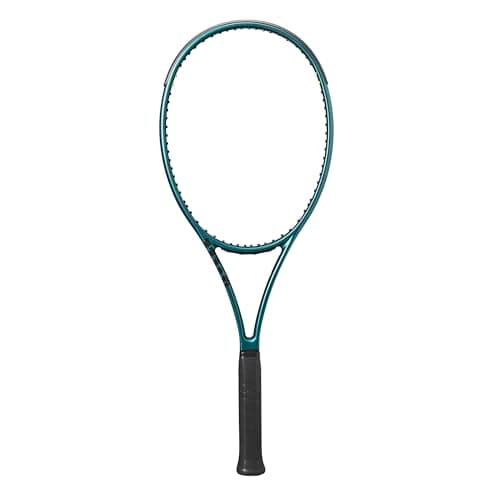
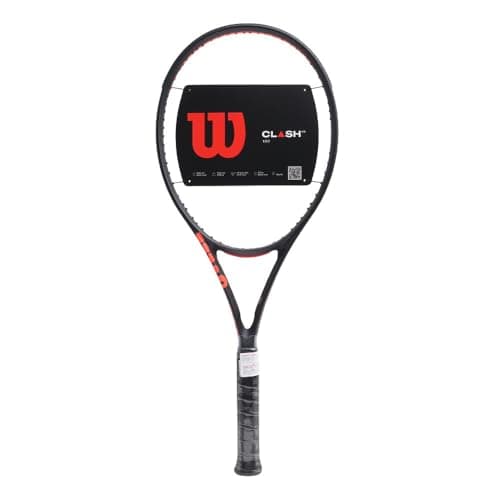
Buy the Clash if your arm is the thing you are protecting. Buy the Blade 98 if your depth control is the thing you are protecting. That is the whole decision, and the published stiffness numbers make it unusually easy to see: the Clash 100 v3 is listed at RA 54, the Blade 98 v9 at 62. Eight points of flex is a large gap between two frames people treat as interchangeable — the Clash is one of the most flexible performance frames in production, and the Blade is a conventionally stiff player's frame that earns its reputation for feel through a thin 21 mm box beam rather than through bending.
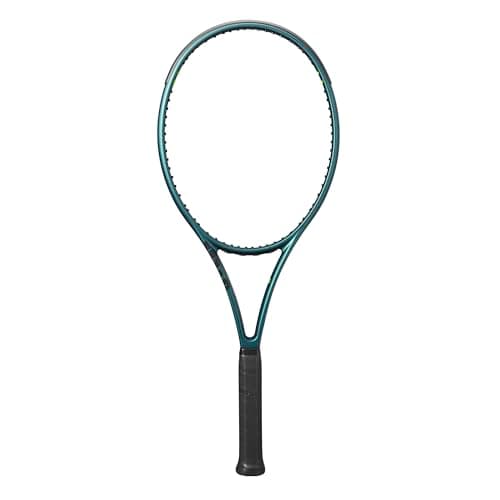
There is a second, less comfortable half to this answer. The Blade 100L v9 is the frame most club players actually end up holding when they go looking for a lighter Blade, and it is not a softer one. Tennis Warehouse publishes it at RA 69 on a 22 mm beam — fifteen points stiffer than the Blade 98 whose name it shares, and the stiffest of the three frames on this page by a wide margin. If you came to the Blade line because someone told you Blades are arm-friendly, the 100L is the one model in it that will not deliver that.
What the published specs actually say
Three frames, one brand, one string pattern between them, and three completely different jobs. The numbers below are the retailer spec sheets, not our measurements.
Wilson Clash 100 v3. 100 square inches, 11.0 oz / 312 g strung, 7 points head-light, swingweight 308, stiffness RA 54, 16x19. The combination that matters is the flex and the head-light balance: a frame that bends through impact and is easy to get around in front of you.
Wilson Blade 98 (16x19) v9. 98 square inches, 11.4 oz / 323 g strung, 4 points head-light, swingweight 324, stiffness 62, a 21/21/21 mm box beam in basalt and braided graphite, and a published power level of LOW. The listed stroke style is medium-full and the listed swing speed is medium-fast. Those three published labels are the page in miniature: this frame is specified for a player who already produces their own pace.
Wilson Blade 100L v9. 100 square inches, 10.6 oz / 301 g strung, only 2 points head-light, swingweight 308, stiffness 69, a 22 mm beam in graphite, power level low-medium. It is the accessible Blade: 0.8 oz / 22 g lighter than the 98 and meaningfully easier to swing for two sets, bought by exactly the player who should think hardest about that 69.
Why the Clash is the arm answer and the Blade is not
Frame stiffness is the one published racquet spec with a direct, well-understood relationship to how much shock reaches your elbow. A flexible frame deforms at impact and gives some of that energy back slowly; a stiff frame barely deforms and returns it fast. RA 54 is low enough that the Clash is the frame we point at most often for a player who has had elbow trouble — it is our pick on best rackets for tennis elbow, and the reason is this number rather than anything we can feel on your behalf.
The Blade 98's 62 is not harsh. It is squarely mid-range, and its thin box beam and 323 g strung weight do real work absorbing impact that a lighter frame would transmit straight into your forearm. But mid-range stiffness in a heavy frame and genuine flexibility are different products, and if you are buying to protect a joint rather than to hit a better ball, that difference is the entire point.
One caveat cuts against the Clash, and it matters: a flexible frame is more sensitive to what you string it with, because the string bed is doing a larger share of the work. Put a full bed of stiff polyester at a high tension in a Clash and you have thrown away a good part of what you paid for. See strings for tennis elbow.
Why the Blade is the control answer and the Clash is not
Wilson publishes the Blade 98's power level as low. Read that as a feature rather than a warning: a low-powered frame is one that does not add depth you did not ask for, which is what makes it possible to swing hard at a short ball and still have it land inside the baseline. The 324 swingweight is the other half — mass moving through the ball holds its line against pace and does not get pushed around on a returned serve.
The Clash is not a low-powered frame, and it is not a precise one in the same way. Flex costs you some of the predictability a stiff box beam gives you, especially on a flat drive where you want the ball to go exactly where you aimed and nowhere deeper. Club players who switch from a Blade to a Clash for their arm very often report the same pair of outcomes: the elbow is better and the balls are landing a foot longer.
If control is specifically what you are shopping for across brands rather than inside Wilson, best control racquets ranks the whole category, and 98 vs 100 head size handles the other half of this decision using the same model in each size.
The mistake: buying the 100L because it says Blade
This is the error worth the whole page. A 3.5 player reads that Blades are the feel-and- control line, finds the 98 too heavy to swing for two sets, and buys the 100L instead because it is the Blade they can handle. What they have actually bought is the stiffest frame in this comparison, with the least head-light balance of the three, two square inches more head than the frame they were told about, and a published power level of low-medium rather than low.
That is not a bad racquet. It is a fast, easy, spin-friendly frame and there is a real player for it: someone with a long, loose swing who wants speed through the air and has no arm trouble. It is simply not a lighter version of the thing the Blade name sold them, and if the reason they wanted a Blade was comfort, the Clash is the frame they were looking for the entire time.
If the honest problem is that the Blade 98 is too much racquet, the better fix is usually a lighter frame from elsewhere in the market rather than a different Blade — best lightweight rackets covers that, and best intermediate racquets is where the Clash wins on our scoring.
They share one thing, and it is the reason to buy either
Both lines are built around feel rather than free power, and both are frames you can keep for years because neither flatters you into a swing you will outgrow. A Pure Drive or an EZONE will give a 3.0 player immediate free depth. Neither of these will — which is exactly why neither becomes useless at 4.0. If you are deciding between these two at all, you are buying for the right reasons, and the worst outcome available to you is a good racquet that suits you slightly less well than the other one would have.
One last note for anyone buying the Clash specifically for an arm. The softest string bed you can put in it is natural gut, and it is also the most expensive thing in tennis — is natural gut worth it? argues that a premium multifilament restrung on time beats gut left in too long, which is the version of this decision most club players should take.
Head to head, on published specs
| Spec | Clash 100 v3 | Blade 98 v9 | Blade 100L v9 |
|---|
| Head size | 100 sq in | 98 sq in | 100 sq in |
| Strung weight | 11.0 oz / 312 g | 11.4 oz / 323 g | 10.6 oz / 301 g |
| Strung balance | 7 pts head-light | 4 pts head-light | 2 pts head-light |
| Swingweight | 308 | 324 | 308 |
| Stiffness (RA) | 54 | 62 | 69 |
| Beam | Flexible layup, no beam figure published | 21/21/21 mm box | 22/22/22 mm |
| Composition | Graphite / carbon layup | Basalt / braided graphite | Graphite |
| String pattern | 16x19 | 16x19 | 16x19 |
| Published power level | Not published | Low | Low-medium |
| Recommended tension | Not published | 50-60 lb (55 optimum) | 50-60 lb (55 optimum) |
| Our score | 8.0 | 7.8 | 7.8 |
Sources for every figure in that table are listed at the foot of this page. Where a cell says “not published” it means the retailer spec sheet we cite does not print that field for that frame — we would rather leave a gap than fill it with a number nobody published.
Which one, by player
Has had tennis elbow, or is worried about it → Clash 100 v3, strung with a multifilament. Hits a big flat ball and keeps going long → Blade 98 v9; the low published power level is the fix. NTRP 3.5 moving to 4.0 with a developing swing → Clash 100 v3, which is our pick at that level. Plays mostly doubles and lives at the net → Blade 98 v9; the 324 swingweight is stability on a punched volley. Long, loose, spin-heavy swing and no arm trouble → Blade 100L v9. Wants a Blade but cannot swing the 98 for two sets → read the stiffness number before you buy the 100L.
If you are not sure which level you are buying for, what a 4.0 player actually is sets out the NTRP definitions this site organizes everything around.
String them differently
These frames want opposite string beds, and getting it backward wastes most of the difference you paid for.
The Clash is already soft, so a full bed of multifilament can feel mushy and short on control for a strong hitter; a soft poly in the mains with a multifilament in the crosses is the usual answer, toward the lower end of the tension range. If your reason for buying it was your elbow, go full multifilament and accept the slightly looser response — you bought comfort, so take the comfort.
The Blades are both published at 50–60 lb with a 55 lb optimum. On the 98, the low power level means you can string toward the bottom of that range without the ball flying. On the 100L, a stiff frame plus a stiff poly at the top of the range is the combination to avoid, because the two stack. Our full walk-through is at how to choose tennis strings, and poly vs multifilament explains the trade in one page.
Price brackets, honestly
All three sit in the performance-frame bracket rather than the budget one, and the Blade 100L is usually the cheapest of the three while the Clash and the Blade 98 trade places depending on the week. None of them is a sensible first racquet — if this is your first frame, best rackets for beginners is the honest page, and best cheap tennis rackets is the one to read if the budget is firm. Live prices for all three are in the table above, checked daily; we do not print a number in prose, because it would be wrong by the time you read it.
What we did not do
We have not hit with these frames side by side, and we are not going to tell you the Clash feels plush as though we had. Everything above is reasoning from published specifications — stiffness, swingweight, balance, beam geometry, power level — and from what those specifications reliably mean on court. Our scoring rubric is written out on methodology, including what it does and does not claim.