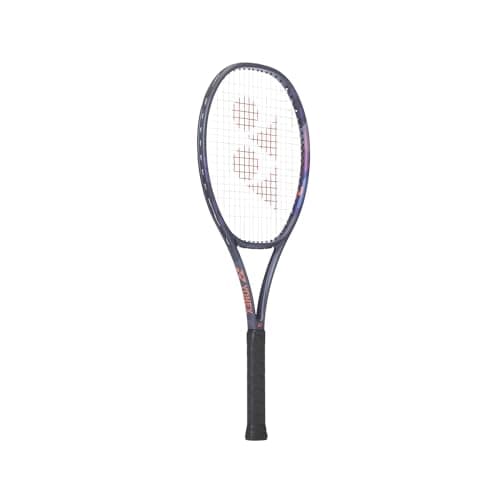
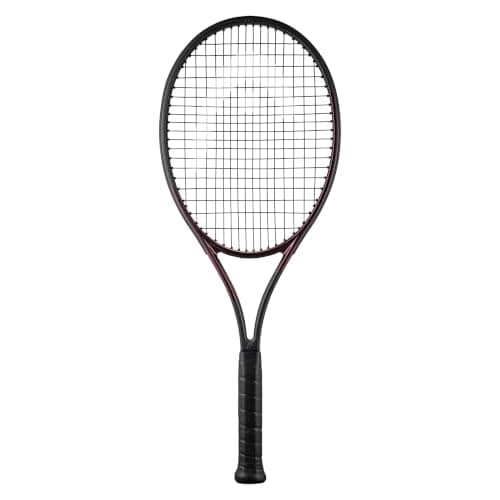
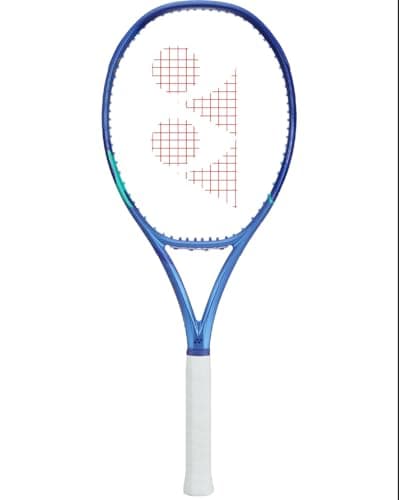
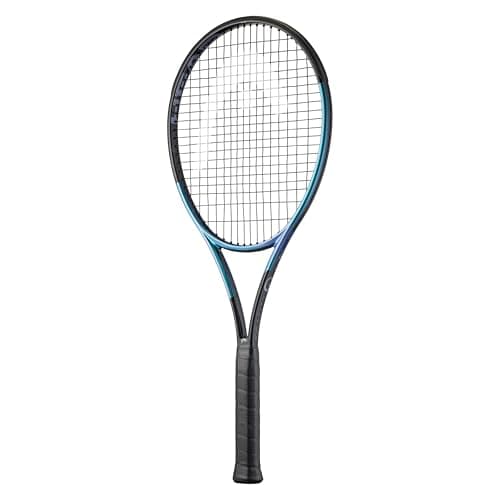
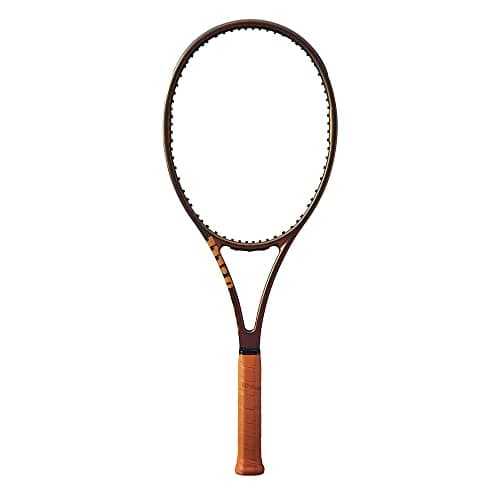
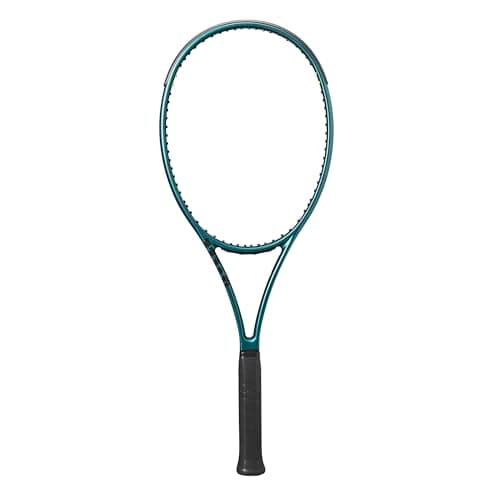
The Wilson Blade 98 (16x19) v9 is the one-hander's racquet. A published 11.4 oz strung on a 98 sq in head with Wilson's FORTYFIVE flex layup gives you exactly the two things a one-handed backhand needs — mass to carry through the ball and a frame that bends rather than jars — which is why it is the most-used frame in competitive club tennis. If you want more feel still, the Yonex Percept 97 is the flexible control frame for a player who hates a stiff, loud string bed. The HEAD Prestige MP L is the choice if your backhand goes long under pressure, because an 18x20 pattern simply does not launch the ball. The Yonex EZONE 98 is the most complete frame here if you want help on the forehand too, the HEAD Gravity MP (2025) is the comfort pick at 100 sq in and 18x20, and the Wilson Pro Staff 97 v14 is the purist's frame: it gives you nothing and lets you do anything.
The one-handed backhand is a single-arm swing with a long acceleration path, and it fails in a specific way with the wrong frame. Too light and the ball pushes the racquet rather than the racquet pushing the ball — you get a short, floating slice you did not ask for. Too stiff and the shot has no feel, which matters enormously on a stroke where the contact point is in front of your body and you are judging it by hand. Too large a head with an open pattern and the ball launches, because a one-hander hits through the ball rather than brushing up it.
So a one-hander's shopping list is the opposite of the industry's best-seller list: heavier rather than lighter, flexible rather than stiff, head-light rather than balanced, 98 sq in rather than 100, and often a denser string pattern.
Mass first: why 11 oz is the floor
With two hands you can muscle a light frame through a ball. With one you cannot, and the ball wins. Every frame ranked here is a published 11.0 oz strung or heavier, and the top of the range — the Pro Staff 97 at 11.7 oz and the Percept 97 at 11.6 oz — is where committed one-handers usually end up once their swing is grooved.
The caveat is honest: mass is only an asset if you can still get the frame around in time. If you are late on fast serves, you do not need a heavier racquet, you need an earlier preparation — and in the meantime a frame at the lighter end of this page. The number that governs how heavy a racquet feels to swing is not the static weight on the spec sheet; swing weight explained sets out the difference and why it matters more than the figure on the box.
Flex: the spec one-handers notice most
A flexible frame bends around the ball, holds it on the string bed a fraction longer, and sends back a clearer signal about what just happened. For a stroke judged almost entirely by feel, that is worth more than free power. Wilson publishes FORTYFIVE flex construction on the Blade line and an RA 54 stiffness on the Clash; Yonex builds the Percept on a deliberately flexible layup; HEAD's Gravity is the softest of its advanced frames. Those are the makers' own claims, quoted as claims — we have not put any of these frames on a stiffness machine.
Pattern: 16x19 for spin, 18x20 for a backhand that goes long
An open 16x19 pattern lets the mains move and bite, which gives spin and a slightly livelier response. A dense 18x20 holds the ball flatter and lower. The practical rule for a one-hander: if your backhand is your weapon and you drive it flat, the dense pattern of the Prestige MP or Gravity MP will keep it in the court. If you slice and want the ball to sit up and die, take the 16x19. Either way, the string you put in it matters as much as the pattern — strings for control is the companion decision, and strings for advanced players covers the gut hybrids that keep a heavy frame comfortable.
The arm question, which is not optional here
A one-handed backhand loads the lateral elbow more than a two-hander does, and the classic bad combination is a stiff frame, a full polyester bed and a late contact point. If you have any elbow history at all, bias toward the flexible end of this page, string softer, and read racquets for tennis elbow and how to prevent tennis elbow before you buy anything. The Gravity MP exists on this page specifically as the frame for a one-hander who needs comfort and will not give up control to get it.
Finally: a one-hander does not require an advanced rating. If you are a 3.5 with a one-handed backhand, you are better served by a lighter frame from the intermediate page with a few grams of tape at the handle than by a 11.7 oz tour frame you cannot swing. Add mass as your swing grows; the frame will still be there.
How to tell if your frame is too light for your backhand
Hit ten backhand drives down the line. If the shot that comes off the frame is consistently shorter and floatier than you intended, and the racquet feels like it got pushed at contact, the frame is losing the argument with the ball. That is a mass problem, not a technique problem, and it is fixable with tape before it is fixable with a purchase.
Add mass at the handle before you add it at the tip
Published customization guidance is specific about this: weight at 3 and 9 o'clock reduces frame twisting, weight at 12 o'clock makes the racquet swing much heavier for a small mass gain, and handle weight counterweights the frame without slowing the head. For a one-hander chasing stability rather than a heavier swing, start at the sides and the handle. How to add weight to a racquet has the recipes.
Demo before you commit, if you can
No spec sheet can tell you how a one-hander will feel in your hand, and these are not cheap frames. Club demo programs exist; use them. What this page can do is narrow six frames out of a hundred and tell you honestly which published specs made the shortlist.