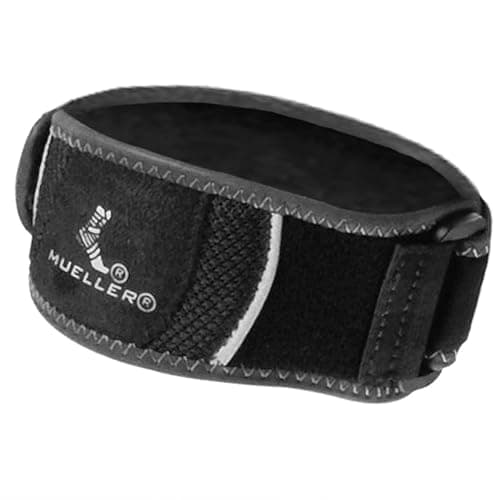
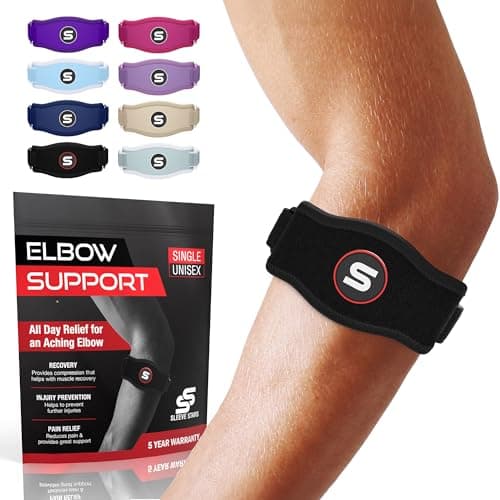
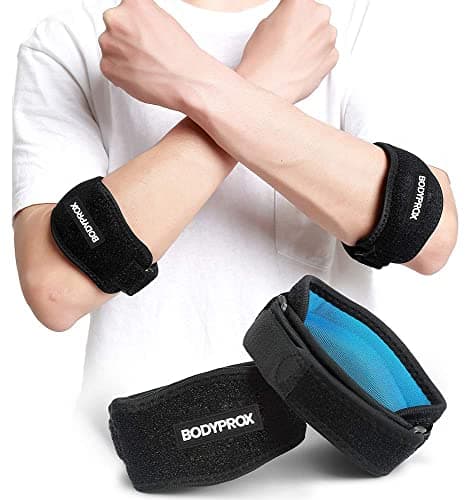
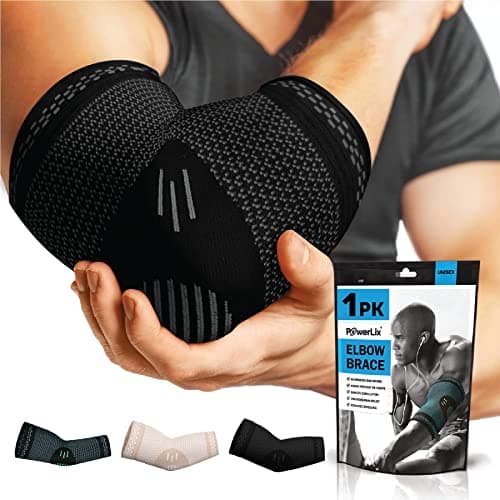
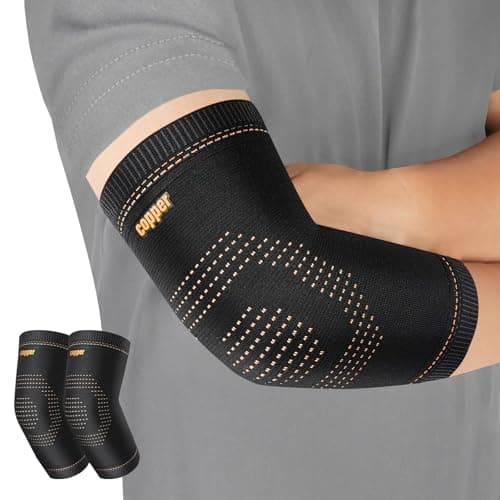
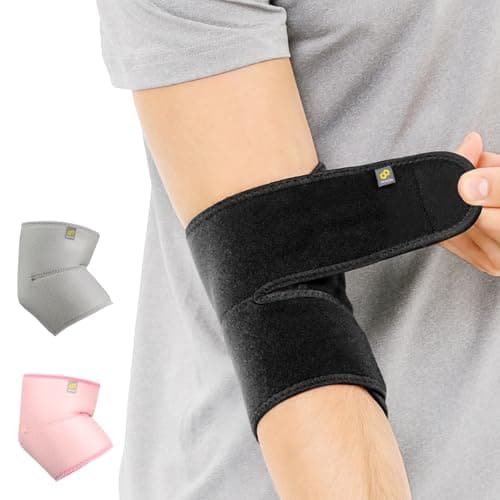
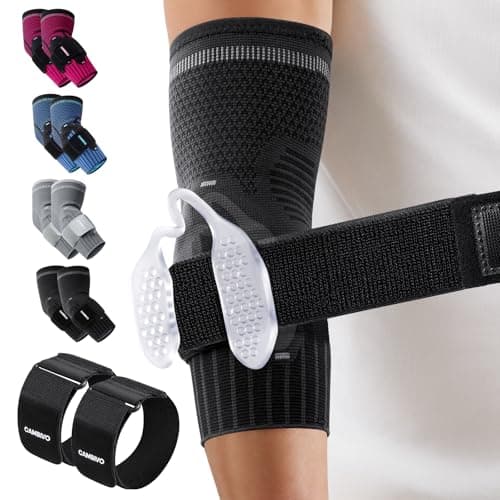
The best tennis elbow brace for playing tennis is a counterforce strap, and the CAMBIVO two-pack is the one to buy: dual gel pads, a wide adjustment range, and two in the box so one lives permanently in the racquet bag. If the cheap one-size straps have never fitted you, buy the Mueller Hg80 instead — it is the only brace here sold in measured sizes. If you want something for weightlifting or for sleeping, you do not want a strap at all: you want a pull-on compression sleeve, and the PowerLix is the pick.
That distinction is the whole page, and almost nothing written about elbow braces makes it clearly, so here it is before anything else.
Strap or sleeve: the only decision that matters
A counterforce strap is a band that goes around the thick part of your forearm, an inch or two below the elbow, with a pad pressing into the muscle. It is not a support and it does not immobilize anything. It works by giving the muscle a second, artificial anchor point, so some of the force generated when you hit a ball is absorbed there instead of pulling on the damaged tendon attachment at the bone. That is a real mechanism, and it is the one that does something while you are actually playing.
A compression sleeve is a tube you pull on over the whole joint. It applies even pressure, retains warmth, and has no point load anywhere. It does not offload the tendon attachment, so it does not do the counterforce job. What it does do is be comfortable for hours, which is why it is the right answer for the two biggest variant searches on this topic:
"For sleeping" — a strap tight enough to work is unwearable for eight hours and restricts circulation. Use a sleeve.
"For weightlifting" — a strap sits exactly where a bar or a sleeve of a shirt wants to be, and it shifts under load. A compression sleeve stays put and keeps the joint warm. Use a sleeve.
For playing tennis — use a strap. This is the case a counterforce brace was designed for.
Most people reading this page need a strap for the court and would benefit from a sleeve for the gym and for overnight. Both together cost under $35, which is a tenth of one physical therapy appointment.
Before you buy any of them: fix the actual cause
We would rather sell you nothing than sell you a brace instead of the fix. Tennis elbow — lateral epicondylitis — is, per OrthoInfo (the patient-education site of the American Academy of Orthopaedic Surgeons), an overuse injury: "microtearing of the tendons that join the forearm muscles on the outside of the elbow," usually involving the extensor carpi radialis brevis. A brace manages the load on that tendon. It does not heal it, and it does not change what is loading it.
What loads it, in club tennis, in the order worth fixing:
1. Your string. A stiff polyester at a high tension is the single most common equipment cause of elbow pain in recreational tennis, and it is also the cheapest thing to change. A soft multifilament at a lower tension is a different racquet for the price of a restring. Start at the arm-friendly strings page.
2. Your grip size. A grip that is too small makes you squeeze harder to stop the frame twisting, and squeezing harder is load on the same tendon. Measure yours with the grip size chart — it takes a ruler and thirty seconds.
3. Your frame. A light, stiff racquet transmits more shock to the arm than a heavier, more flexible one. If you are replacing a frame anyway, see arm-friendly racquets.
4. Rest. OrthoInfo's first listed nonsurgical step is to stop the activities that cause the pain "for several weeks", and it reports that "approximately 80 to 95% of patients have success with nonsurgical treatment." A brace that lets you keep playing through pain is not always doing you a favor. If it hurts at rest, or your grip strength has dropped, see a physician rather than buying a strap.
One last thing worth knowing, because it reframes the whole category: OrthoInfo notes that "athletes are not the only people who get tennis elbow" — painters, plumbers, carpenters and cooks get it at higher rates than the general population, and most sufferers are between 30 and 50. If you got it at work rather than on court, the equipment fixes above will not help and the brace is doing more of the work.
How to position a counterforce strap
Most straps that "do not work" are in the wrong place or the wrong tightness, and both are easy to get right.
Position. Roughly one to two inches below the bony point on the outside of your elbow, over the thickest part of the forearm muscle — not on the joint, not on the bone. OrthoInfo describes a brace "centered over the back of your forearm." If it is sitting on the elbow itself, it is too high to do anything.
Tightness. Snug with the muscle relaxed; you should feel it tighten when you clench your fist. You should not see color change in your hand, feel pins and needles, or have to take it off after twenty minutes. Tighter is not better — a strap worn too tight restricts circulation and makes the situation worse.
When to wear it. During activity that loads the tendon: tennis, lifting, a day of DIY. Take it off afterward. It is not a dressing.
Where to buy a tennis elbow brace
Every brace on this page is an Amazon listing with a live price, which is the honest answer to the "where can I buy one" search: this is a commodity category sold online for between about $13 and $20, and drugstores and sporting-goods chains carry the same kinds of product at higher prices and with less choice of sizing. The one thing worth paying a little more for is measured sizing (the Mueller), and the one thing worth buying twice is a strap, because the brace that is in your other bag is a brace you are not wearing.
Braces for men and for women
There is no men's or women's counterforce strap. Every strap here is a one-size adjustable band, and the adjustment range is what has to fit, not the gender on the listing. Two products on this page are the exception and are sized:
The Mueller Hg80 is sold in real sizes (this listing is Small/Medium), which matters if a one-size strap is loose at full tightness or cuts in before it grips. The Vlela copper sleeve is sized separately for men and women, which on a compression sleeve is a genuine difference — a sleeve only works if it actually compresses.
Ignore the copper. We have seen no published evidence that copper-infused fabric does anything for tendon pain, and we are not going to repeat the claim as if we had. Buy that sleeve for the sizing, which is real.
What a brace will not do
It will not fix a late forehand. It will not make a stiff frame with tight poly in it comfortable. It will not shorten the recovery — the published nonsurgical path is rest, therapy, and time, with the brace as one component. And it will not help golfer's elbow if you put it in the tennis-elbow position: the medial version is on the inside of the arm, and the pad has to move to the inside of the forearm. The Bodyprox listing covers both positions explicitly, which is why it is on this page.
If you came here from an elbow that already hurts, the highest-value five minutes you can spend is how to prevent tennis elbow — the equipment and technique list that stops it recurring once the current flare settles.
One thing to rule out while you are here, because it is the most common wrong purchase for this problem: a vibration dampener does not help tennis elbow. The dampener page explains why — it damps the stringbed's high-frequency ping, not the frame shock that reaches your arm — and ranks them honestly as the sound modification they are.