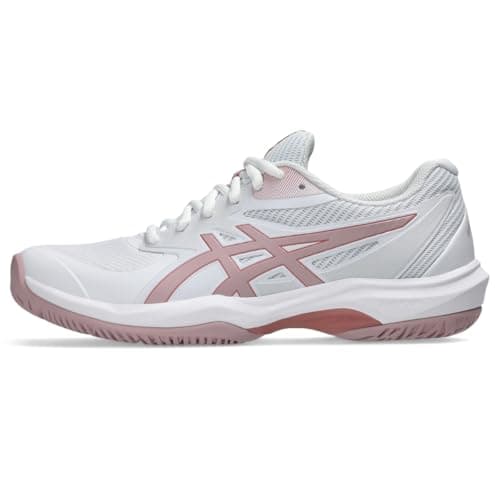
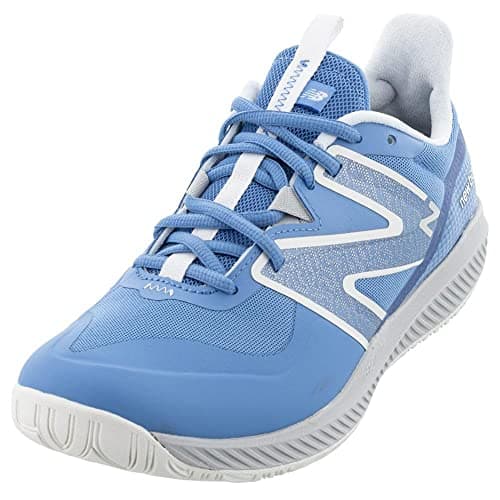
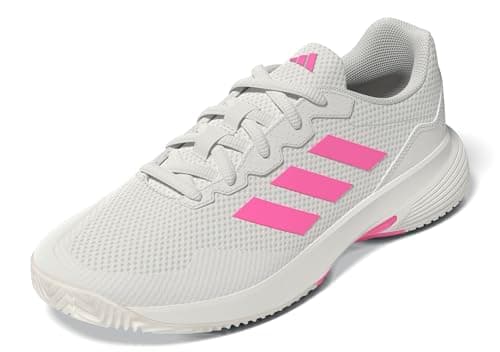
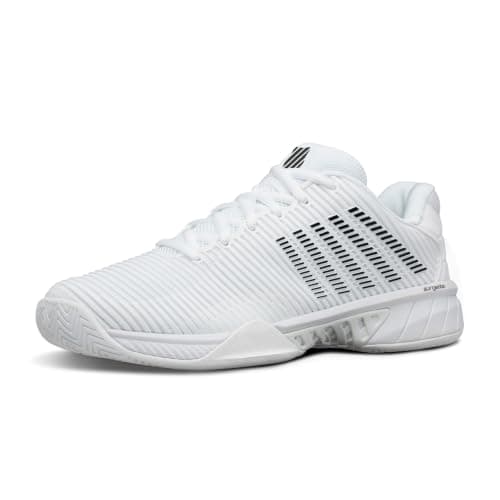
If you have high arches, buy the K-Swiss Hypercourt Express 2 in the women's fit. It is the roomiest women's court shoe we list, it is cushioned, it needs no break-in, and it is neutral — which is the exact combination published guidance on high arches asks for. The ASICS Game FlyteFoam is the pick if you want more responsive cushioning and a standard width works for you; the New Balance 796 v3 is the pick if you need to choose a width (it comes in B and D); and the adidas Gamecourt 2.0 is the softest-feeling budget option. The shoe to be careful with is the one everyone will recommend to you: a maximum-support court shoe with a lateral cage.
A high arch is an under-pronating or supinating foot. Nike's own guidance describes supination as a foot strike where "your feet lean outward" and the weight shifts to the outer edge, and names "having a naturally high arch or an inflexible instep" as a cause. The consequence on a tennis court is specific and it is worth understanding before you buy anything.
What a high arch does to you on a tennis court
It absorbs shock badly. A high, rigid arch does not flatten much under load, so more of each landing travels up the leg instead of being spread through the foot. On a hard court — which is where most club tennis happens, and which is abrasive and unforgiving — that is hundreds of landings an hour.
It loads the outside edge. Weight rolling to the lateral side of the foot is the supination pattern, and on a court the lateral side of the foot is already where the hardest loads land, because every split-step recovery and every wide forehand pushes off it.
It narrows your usable fit. This is the part that surprises people: a high instep means a shoe that fits your forefoot can still be too tight over the top of the foot. Nike names an "inflexible instep" alongside the arch itself, and depth over the instep is as important as width across the ball of the foot.
What published guidance asks for — and what to avoid
Nike's supination guidance is unusually concrete: "The best shoes to fix supination have extra cushioning, good arch support, and a wide toe-box." It adds that midfoot arch support can "counteract the effect of your high arches" and that a narrow forefoot "will restrict your feet and further enhance the damage caused by supination." It also warns that "wearing shoes with no arch support can actually cause supination."
That translates into three things to look for in a court shoe and one thing to avoid.
Look for: cushioning. Your arch is not doing the shock absorption, so the midsole has to. FLYTEFOAM, Cloudfoam, FuelCell — the specific name matters less than the fact that there is real foam under the heel and forefoot.
Look for: a roomy forefoot and instep. Not a sloppy shoe — a shoe with depth. The K-Swiss Hypercourt Express 2 has the widest women's toe box on this site and the New Balance 796 v3 is the only women's court shoe here sold in more than one width.
Look for: a neutral platform. A supinating foot is already rolling outward. You do not want a shoe designed to push it further that way.
Avoid: motion control and heavy medial posting. Those features exist to stop a foot collapsing inward, which is the opposite problem. In tennis-shoe terms that means being careful with the maximum-support models — a rigid lateral cage plus a stiff platform is a lot of shoe for a foot that needs cushioning and room. The ASICS Gel-Resolution X women's is still on this page, last, because if you have rolled an ankle, containment wins that argument. Just do not start there.
How to tell what your arch actually is
The wet-footprint test is the one everybody repeats, and it is a reasonable first indication: step on a dark surface with a wet foot and look at the print. A high arch leaves a narrow band or nothing at all connecting the heel to the ball of the foot; a flat foot leaves a full outline. It tells you about arch height while standing, which is useful, and nothing about arch flexibility under load, which is what actually matters.
The other home indication is your old shoes. Turn a worn pair over: wear concentrated along the outer edge, from the heel through to the little-toe side of the forefoot, is the supination pattern. Wear on the inside edge is the opposite. On a tennis shoe, read the heel and midfoot rather than the toe — the toe wears from dragging on serves regardless of your arch, which is why court shoes have a toe drag guard in the first place.
An insole is the cheapest thing you can change
A cushioned, neutral, roomy court shoe plus a supportive aftermarket insole is a better combination for a high arch than a stiff support shoe is — and it costs a fraction of a second pair of shoes to try. This is also the reason the roomy shoes outrank the narrow ones here: a shoe with depth can take an insole, and a tight shoe cannot.
If your arches ache specifically in the heel and first thing in the morning, that is a different page: best tennis shoes for plantar fasciitis. If your problem is width across the ball of the foot rather than arch height, go to best tennis shoes for wide feet. And if your arch collapses rather than holds, you are on the wrong page entirely — flat feet is the mirror image of this one.
The honest limits of this page: we have not fitted anyone's foot, we are not clinicians, and arch height is one variable in a fit that also involves your instep, your gait and any orthotic you already use. The guidance quoted above is published and attributed; the shoe picks are judgments from the manufacturers' published construction against our rubric, weighted here toward cushioning and forefoot room. A podiatrist can assess things we cannot.