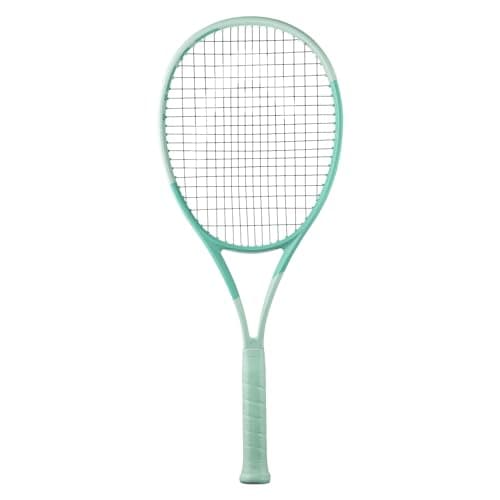
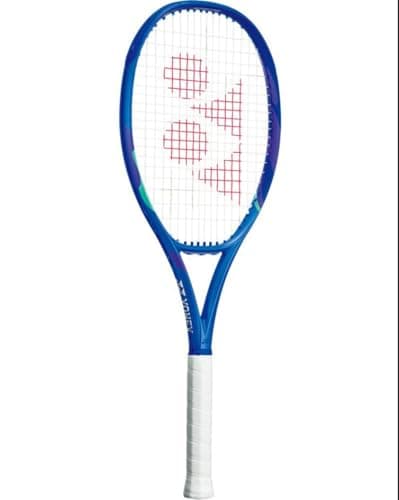
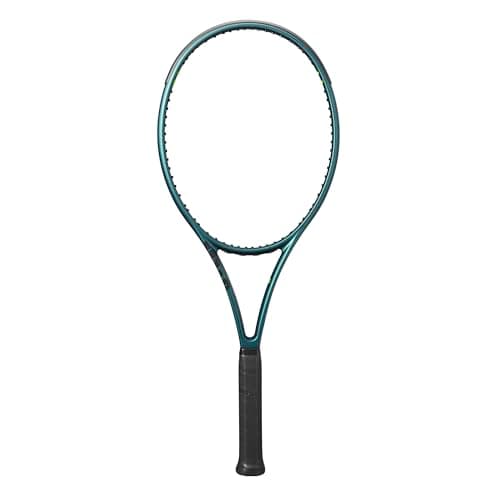
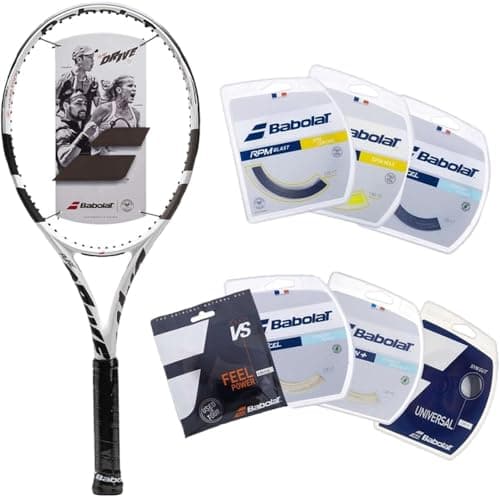
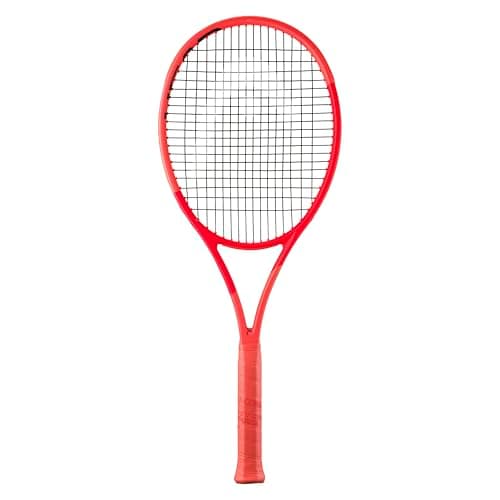
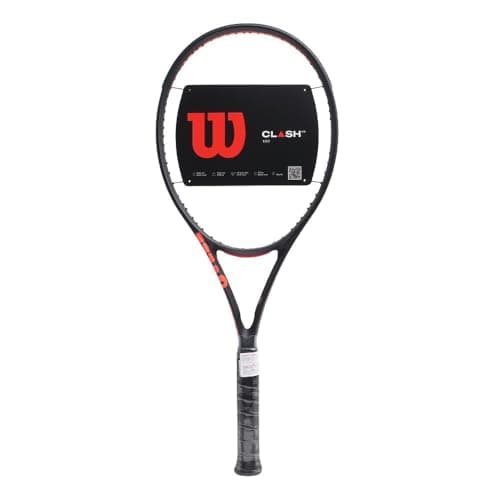
The best racquet for an intermediate player is the Wilson Clash 100 v3: it is the only frame on this list that gives you modern spin and depth at an RA 54 stiffness, which means you can string it with a polyester and still have an elbow in March. If you want more free power and your arm is bombproof, take the Babolat Pure Drive instead. If you want the same idea as the Clash but delivered strung and cheaper, the HEAD Boom MP is the value pick.
What changes at 3.5
This is the level where the equipment conversation becomes real. Below 3.5, the racket mostly needs to stay out of your way. At 3.5 and above, three things become true at once:
You now generate enough racket-head speed that a beginner frame sends balls long. You hit the middle of the string bed often enough that a smaller, more precise head stops being a liability. And you have started to shape shots — topspin to bring a ball down inside the baseline, slice to change the pace — which means the string pattern and the frame's aerodynamics start to matter.
Put together, that is the definition of the four-oh club: the level where gear decisions pay off, and also the level where the wrong gear decision quietly costs you a season.
The comfort problem nobody warns you about
Here is what actually happens to intermediate players. You improve. You start swinging faster. Someone tells you that a polyester string gives you more control, which is true. You string your stiff, powerful frame with a full bed of stiff polyester. Six weeks later your elbow hurts and you cannot play.
That combination — a high-RA frame plus a stiff poly — is the single most common injury pathway in club tennis. The published numbers make the risk legible: Tennis Warehouse lists the Pure Drive at RA 69 and the Clash 100 v3 at RA 54. Both are 100 sq in, both are 16x19. One of them has fifteen points more frame stiffness going into your arm on every ball.
This is not an argument against the Pure Drive, which is on this list and is a superb racket. It is an argument for knowing which one you bought, and stringing it accordingly — see strings for tennis elbow.
Spin is bought with swing speed, not money
Every frame on this page is marketed on spin. The ones that genuinely deliver it — the Pure Drive, the EZONE 100 — do so by being fast through the air and letting the main strings slide and snap back. That mechanism only works if you are already brushing up on the ball. If your swing is still flat and driving, a spin frame gives you nothing but a thinner feel. Fix the swing path first; our training aids page covers the one tool that genuinely helps with that.
The six frames compared
| Racquet | Head | Weight | Pattern | Leans |
|---|
| Wilson Clash 100 v3 | 100 sq in | 11.0 oz strung | 16x19 | Comfort (RA 54) |
| HEAD Boom MP | 100 sq in | 10.9 oz strung | 16x19 | Balanced, ships strung |
| Yonex EZONE 100 | 100 sq in isometric | 11.2 oz strung | 16x19 | Power + comfort |
| Wilson Blade 100L v9 | 100 sq in | 10.4 oz strung | 16x19 | Control, light |
| Babolat Pure Drive | 100 sq in | 11.2 oz strung | 16x19 | Power (RA 69) |
| HEAD Radical MP | 98 sq in | 11.1 oz strung | 16x19 | All-court generalist |
Notice how similar the headline specs are. Five of the six are 100 sq in, 16x19, and within 0.8 oz of each other. The differences that matter at this level are the ones that do not fit in a spec table — stiffness, beam shape and how the frame is laid up — which is exactly why demoing beats reading, ours included.
Which one, in one line each
Your elbow has ever twinged → Clash 100 v3. You want it playable out of the box and cheap → HEAD Boom MP. You want power without harshness and budget is not the issue→ Yonex EZONE 100. You want feel and you are not strong → Blade 100L. You want maximum free depth → Pure Drive. You genuinely play all-court and want no weaknesses→ Radical MP.
The upgrade that is not a racquet
If you are at 3.5 and playing on a frame you like, the honest advice is that a string changewill change your tennis more per dollar than a new racquet will. Going from a dead factory multifilament to a fresh string bed at the right tension is a transformation that costs roughly a tenth of a new frame. Most intermediate players restring far too rarely — see string tension explained.
A note on weight, and getting stronger
There is a persistent idea that intermediate players should buy light and “grow into” a heavier frame. It is mostly wrong. A frame that is slightly too heavy is correctable — you build up to it, and in the meantime it is stable. A frame that is too light cannot be fixed by getting stronger; it will always get pushed around by pace. If you are between two weights and you play weekly, take the heavier one. If you want to fine-tune after the fact, lead tape lets you add mass exactly where you want it.
How we picked
We have not physically tested this gear
Everyone in this category says they tested twenty racquets. We have not tested any — and we say so. What we did instead: compiled the manufacturer-published specifications (head size, strung weight, string pattern, stiffness, outsole compound), normalized them, and scored each product against a published rubric weighted for the NTRP tier this page serves. The scores are judgments from documented research, not measurements we took, because we do not have a lab and are not going to pretend we do.