Skip to content
Four Oh Club

Bags, machines & training · Gear

The Best Tennis Balls for Hard Courts

One spec decides this entirely: extra duty felt. Everything else is price per can — and buying by the case is where the real money is.

By Stephen V.Updated How we score
#ad

We earn a commission when you buy through our Amazon links, at no extra cost to you. It never changes our rankings, and we say so when the cheaper racquet is the better buy. How this works.

The best tennis ball for hard courts is Penn Championship Extra Duty, bought by the 12-can case: extra duty felt, USTA approved, the default club ball in the US, and the lowest cost per can here. The Dunlop ATP Championship 24-can case is the cheapest way to get 72 balls, and the Wilson US Open case is the actual US Open specification.

This is a simpler question than most gear questions, and the answer is almost entirely one spec. If you take one thing from this page: outdoors on a hard court, buy extra duty felt. Regular duty on a hard court fluffs up and dies inside a set.

Why felt type is the whole decision

A tennis ball is a pressurized rubber core with a woven wool-nylon felt bonded over it, and the felt is what wears. Manufacturers weave it in two densities.

Extra duty felt is woven thicker and more densely, specifically for abrasive hard courts. A hard court is acrylic paint over asphalt or concrete with silica sand mixed into the coating — the texture that gives the court its pace and grip — and it abrades felt the way a file abrades a fingernail.

Regular duty felt is thinner, for clay and indoor carpet. On clay a thick felt picks up and holds the surface, so the ball gets heavier and slower through a set; a thinner felt sheds it. Put regular duty on an outdoor hard court and the felt shreds and fluffs within a set, and a fluffed ball flies slower and sits up.

That is the entire rule, and it is why all three picks here are extra duty. Get it backwards and no brand choice will rescue the ball.

High altitude is the one exception

Worth knowing because it catches people out. Above roughly 4,000 feet, standard pressurized balls fly too fast and bounce too high, because there is less air resistance and the internal pressure is relatively higher against thinner air. Manufacturers make high altitude balls with lower internal pressure for exactly this.

If you play in Denver, Albuquerque, Reno or anywhere comparable, buy high altitude rather than extra duty and the felt question becomes secondary. We do not rank them here because the registry does not carry one; that is an honest gap rather than a recommendation.

Buy by the case. It is not close.

The per-can price difference between a single can at a club shop and a case online is large enough to change how often you replace balls, and replacing balls more often is one of the cheapest real improvements available to a club player. A dead ball makes everyone play worse and makes your own feedback about your strokes unreliable.

The one caution: pressurized balls age in the cupboard whether you open them or not. The can is pressurized to keep the balls at pressure, and it leaks slowly. A 24-can case bought for a once-a-week habit will have gone soft at the back before you reach it. Buy the case size that matches how fast you actually get through them.

Does brand matter after felt type?

Less than price does, with one exception: consistency can to can matters more than any other ball property, and it is where the established names earn their keep. Weight, bounce and compression that vary between cans make your own shot feedback noisy, which is the thing that quietly slows down practice.

All three brands here are USTA- or tour-specification balls from manufacturers who supply professional events. Below them sits a tier of unbranded bulk balls that are fine for a ball machine and not fine for matches — see ball machines for where those belong.

Two pages sit either side of this one. The mirror image is the best tennis balls for clay courts, where the whole answer flips to regular duty felt. And if the reason you are reading about balls is a sore arm rather than a surface, the softest tennis balls are the low-compression green and orange balls, which take a published quarter to a half of the impact energy out of every shot.

The short answer

Quick picks

#Racquet / gearBest forScorePrice
01
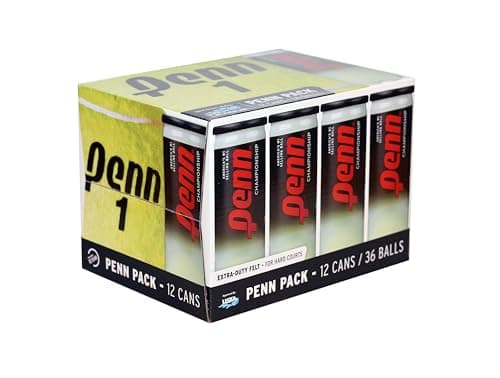
Penn Penn Championship Extra Duty (12 cans)
Penn Championship Extra Duty (12 cans)

The most-played ball in America, bought the way you should buy balls — by the case. Extra duty felt for hard courts.

Hard-court club play
8.2
$34.97Amazon
02
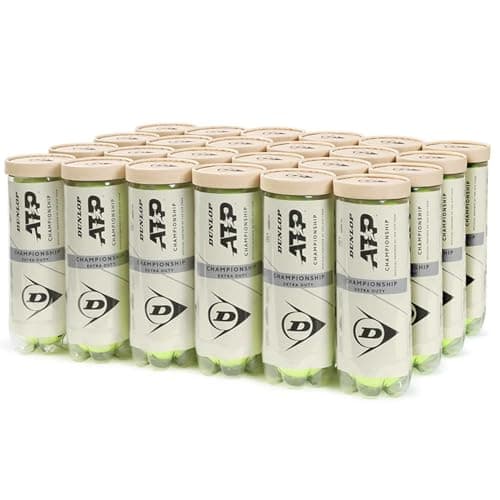
Dunlop Dunlop ATP Championship Extra Duty (24-can case)
Dunlop ATP Championship Extra Duty (24-can case)

The ATP tour's ball supplier, in extra duty felt, by the case. The middle option on price between buying Penn by the dozen and Wilson US Open by the case.

Hard-court value by the case
8.2
$99.99Amazon
03
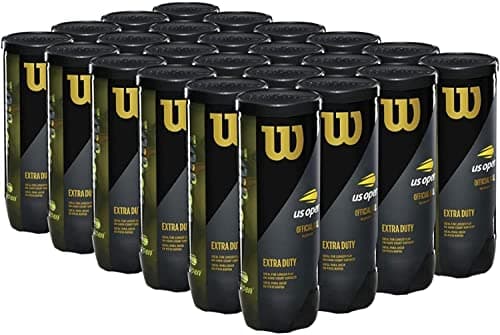
Wilson Wilson US Open Extra Duty (24-can case)
Wilson US Open Extra Duty (24-can case)

The official ball of the US Open, bought by the case. If you want the ball the pros are hitting, this is literally it.

Clubs and leagues
8.4
$129.99Amazon

#ad · Live prices from the Amazon Product API, as of October 20, 2026. Where we have no verified live price, we show none — we would rather leave a gap than print a number that has rotted.

In detail

The picks, in full

01
Penn Penn Championship Extra Duty (12 cans)

Hard-court club play

Penn Championship Extra Duty (12 cans)

Extra duty felt12 cans / 36 ballsPressurizedUSTA approved
8.2/10

The most-played ball in America, bought the way you should buy balls — by the case. Extra duty felt for hard courts.

Durability
8
Consistency
8
Feel
7
Visibility
8
Value
10

Pros

  • Extra duty felt is woven thicker specifically for abrasive hard courts — a regular duty ball fluffs up and dies in a set
  • Buying by the case is substantially cheaper per can than singles
  • The default club ball in the US, so it is the ball you will play matches with anyway

Cons

  • Pressurized balls go dead whether you use them or not once the can is open
  • Extra duty felt is the wrong choice on clay, where it picks up and holds the surface

Don't buy this if…

…you play on clay or indoor carpet. Buy regular duty felt instead.

$34.97View on Amazon

Price as of October 20, 2026. Prices change — Amazon's is the one that counts.

#ad · we may earn a commission from this link to Penn Championship Extra Duty (12 cans)

02
Dunlop Dunlop ATP Championship Extra Duty (24-can case)

Hard-court value by the case

Dunlop ATP Championship Extra Duty (24-can case)

Extra duty felt24 cans / 72 ballsPressurizedATP-series ball
8.2/10

The ATP tour's ball supplier, in extra duty felt, by the case. The middle option on price between buying Penn by the dozen and Wilson US Open by the case.

Durability
8
Consistency
8
Feel
8
Visibility
8
Value
9

Pros

  • Extra duty felt is the correct choice on an abrasive hard court — regular duty fluffs up and goes dead inside a set
  • Case pricing sits between the Penn 12-can and the Wilson US Open 24-can, so it is the cheapest 72-ball option here
  • Dunlop supplies the ATP tour, so this is a genuine performance ball specification rather than a club-only product

Cons

  • A 24-can case is a lot of balls to store, and pressurized balls age in the cupboard whether you open them or not
  • Not the default club ball in the US, so you may play league matches with something else

Don't buy this if…

…you play on clay or indoor carpet. Extra duty felt picks up and holds those surfaces; buy regular duty instead.

$99.99View on Amazon

Price as of October 20, 2026. Prices change — Amazon's is the one that counts.

#ad · we may earn a commission from this link to Dunlop ATP Championship Extra Duty (24-can case)

03
Wilson Wilson US Open Extra Duty (24-can case)

Clubs and leagues

Wilson US Open Extra Duty (24-can case)

Extra duty felt24 cans / 72 ballsOfficial US Open ballPressurized
8.4/10

The official ball of the US Open, bought by the case. If you want the ball the pros are hitting, this is literally it.

Durability
9
Consistency
9
Feel
8
Visibility
8
Value
8

Pros

  • The actual US Open match ball specification, not a licensed lookalike
  • Case pricing at the lowest per-can cost here
  • Consistent bounce and weight from can to can, which matters more than any other ball property

Cons

  • A 24-can case is a lot of balls to store, and they age in the cupboard
  • Costs more per can than Penn Championship for a difference most club players will not detect

Don't buy this if…

…you play once a week alone. Twelve cans of Penn will outlast your interest.

$129.99View on Amazon

Price as of October 20, 2026. Prices change — Amazon's is the one that counts.

#ad · we may earn a commission from this link to Wilson US Open Extra Duty (24-can case)

The three cases compared

BallFeltCase sizeSpecificationBest for
Penn ChampionshipExtra duty12 cans / 36 ballsUSTA approvedLowest per-can cost, club default
Dunlop ATP ChampionshipExtra duty24 cans / 72 ballsATP-series ballCheapest route to 72 balls
Wilson US OpenExtra duty24 cans / 72 ballsOfficial US Open ballClubs, leagues, matching the pros

Every case size above is the quantity the live listing states. Case configurations change between listings for the same ball, so check the can count on the listing before you order — a 24-can case and a 4-can sleeve of the same ball are very different purchases.

How long a can of balls actually lasts

Shorter than people expect, and the honest numbers are worth having. For competitive singles on a hard court, a fresh can is genuinely fresh for one to three sets. For social doubles, an afternoon. For drilling and rallying where pace matters less, several sessions.

The signal is not visual. A ball that looks fine can be dead, because what goes first is internal pressure, not felt. If the ball is noticeably quieter off the strings and sits up shorter than it used to, it is finished regardless of how the felt looks.

Making an open can last

Once a can is open the balls start losing pressure to the atmosphere, and nothing stops that completely. A re-pressurizing canister slows it substantially and is the only accessory here that genuinely pays for itself — it is on the main tennis balls page.

What does not work: taping the can shut, or keeping balls in the fridge. Cold temporarily reduces bounce and does not preserve pressure, and a ball that has been in a hot car has aged faster, not slower.

Pressureless balls, and when they are right

A different product: a solid-walled ball that gets its bounce from the rubber rather than internal air. They never go flat, so they are the standard choice for ball machines, hitting walls and teaching baskets.

They also feel distinctly heavier and duller than a pressurized ball, and they wear the felt the same way. Use them for repetition work; do not play matches with them and then wonder why your timing is off against a real ball.

Pressureless balls are also the honest answer to a question this page gets asked a lot, which is which balls last the longest. They cannot go flat because there is no pressure in them to lose. The full comparison — including the two premium pressurized balls that publish a real durability mechanism — is at the longest lasting tennis balls.

Indoor hard courts are a different answer

Indoor hard courts are usually less abrasive than outdoor ones, and indoor carpet or cushioned surfaces are much less abrasive again. On those, regular duty felt is the correct choice and extra duty is overkill — the thicker felt simply makes the ball slower without buying you any life.

The measured query this page answers is “outdoor hard court”, and outdoors the answer is extra duty, every time. If you split your week between an outdoor hard court and an indoor surface, buy for the outdoor one; the penalty indoors is small, and the penalty outdoors with regular duty is a ball that dies in a set.
How we picked

We have not physically tested this gear

Everyone in this category says they tested twenty racquets. We have not tested any — and we say so. What we did instead: compiled the manufacturer-published specifications (head size, strung weight, string pattern, stiffness, outsole compound), normalized them, and scored each product against a published rubric weighted for the NTRP tier this page serves. The scores are judgments from documented research, not measurements we took, because we do not have a lab and are not going to pretend we do.

Questions

Frequently asked

What are the best tennis balls for hard courts?
Penn Championship Extra Duty, bought by the 12-can case — extra duty felt, USTA approved, the default club ball in the US and the lowest cost per can here. The Dunlop ATP Championship 24-can case is the cheapest way to get 72 balls.
Should I use extra duty or regular duty balls on a hard court?
Extra duty, outdoors, always. A hard court is acrylic over concrete with silica sand in the coating, and that texture abrades felt rapidly. Regular duty felt fluffs up and dies inside a set on it. Regular duty is for clay and indoor carpet.
What are the best tennis balls for outdoor hard court?
Any extra duty ball from a manufacturer that supplies professional events — Penn, Dunlop or Wilson here. After felt type, the thing that matters is consistency can to can, and price per can decides the rest. Above about 4,000 feet, buy high altitude balls instead.
How long do tennis balls last on a hard court?
For competitive singles, a fresh can is genuinely fresh for one to three sets. For social doubles, an afternoon. The signal is not visual: internal pressure goes before the felt does, so a ball that looks fine can be dead.

Keep reading

Receipts

Sources

We do not run a testing lab, and we do not pretend to. Our specs come from manufacturer listings and spec sheets; our rules and dimensions come from the official rulebook. Where we could not verify something, we say so on the page rather than quietly leaving it out. Read our full method.