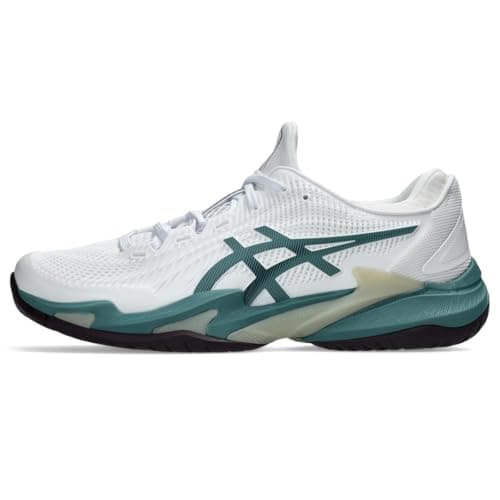
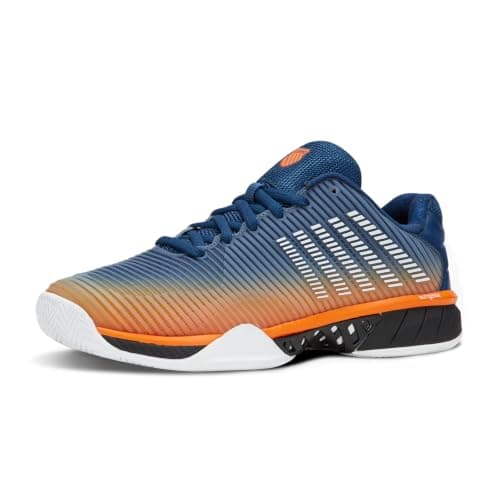
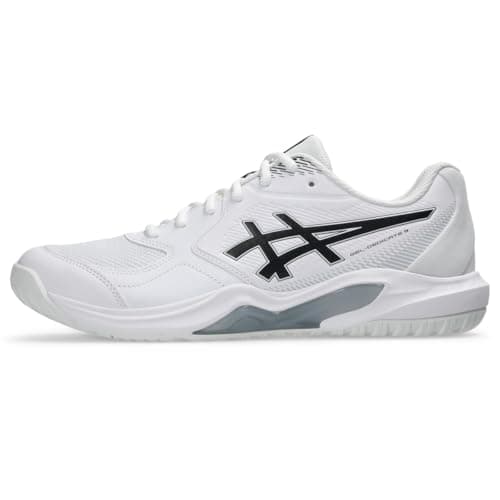
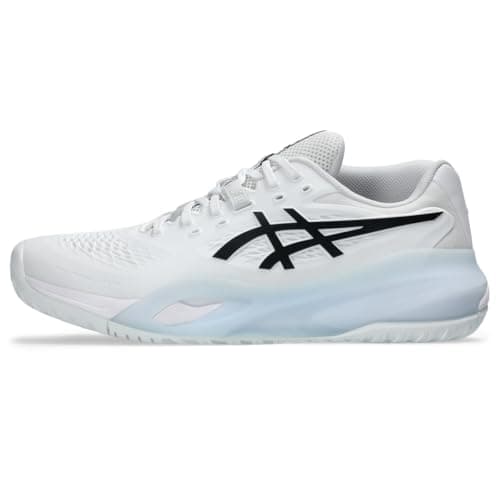
The best tennis shoe you can buy is the ASICS Gel-Resolution X. Its re-engineered DYNAWALL physically stops the foot rolling over the edge of the midsole during a hard lateral stop — which is the single most important thing a tennis shoe does. If you want something lighter and faster, the ASICS Court FF 3. If you have wide feet, the K-Swiss Hypercourt Express 2. If you are buying your first pair and do not want to spend much, the Gel-Dedicate 9 is genuinely adequate.
Why a tennis shoe is a different object
A running shoe is engineered for one thing: repeated heel-to-toe impact in a straight line. To do that well it has a tall, soft, narrow heel and a flexible forefoot. Both of those are actively dangerous sideways.
Tennis is a lateral sport. You push off hard to one side, plant, reverse, and do it again several hundred times a match. A tall soft heel rolls outward under that load; a flexible sole twists. That is how ankles go over. A tennis shoe answers with a low, wide, firm platform, a torsional shank that resists twisting, and a reinforced lateral wall that catches the foot before it rolls.
It also has to survive the court. Hard courts are acrylic over concrete with sand in the coating for grip — functionally an abrasive. A running outsole is gone in weeks. Tennis outsoles use harder compounds in a herringbone or multi-directional tread, and the good ones name the compound.
The three things that decide a tennis shoe
Lateral support. The structure that stops your foot sliding off the midsole sideways. ASICS calls theirs DYNAWALL; adidas uses a Torsion shank plus a high medial wall; Wilson has a 4D Support Chassis. These are real engineering, not decals, and they are the reason a tennis shoe costs more than a cross-trainer.
Outsole durability. Measured in whether the shoe survives a season. The brands that are confident publish the compound — ASICS AHAR Plus, adidas Adiwear, K-Swiss Aösta 7.0, Babolat's Michelin partnership. A shoe whose maker will only tell you about the cushioning is telling you something.
Fit and width. The one people ignore until it ruins a season. Court shoes have to be snug or your foot slides inside the shoe on hard cuts, which causes blisters and defeats the support structure you paid for. Brands differ enormously here — Babolat is narrow, K-Swiss is roomy, and New Balance is the only one selling genuine width options.
What we do not do
We have not worn these shoes. Nobody at this site has run a hundred miles in a Gel-Resolution and measured the outsole wear. What we have done is compile the published construction details — named compounds, named support systems, stated widths, stated surface designations — and score them against a rubric we publish. Where a claim belongs to a retailer rather than the manufacturer, we say so on the page.
Two questions this ranking does not answer directly. If you have rolled an ankle on court, the specs that matter are torsional stiffness and lateral containment rather than cushioning, and the shoes are not the same ones — tennis shoes for ankle support ranks for exactly that. And when a pair is finished, how long tennis shoes last has the four-point test that beats looking at the tread.
Which shoe, in one line
| If you… | Buy | Because |
|---|
| Play hard courts two or more times a week | ASICS Gel-Resolution X | DYNAWALL support plus full-length AHAR Plus outsole |
| Attack the net and want to feel the court | ASICS Court FF 3 | Lighter and lower, same outsole pedigree |
| Have wide feet or hate breaking shoes in | K-Swiss Hypercourt Express 2 | Roomiest toe box here, comfortable on day one |
| Have foot pain or need a true wide fitting | New Balance FuelCell 996 v6 | Genuine 2E and 4E widths, maximum cushioning |
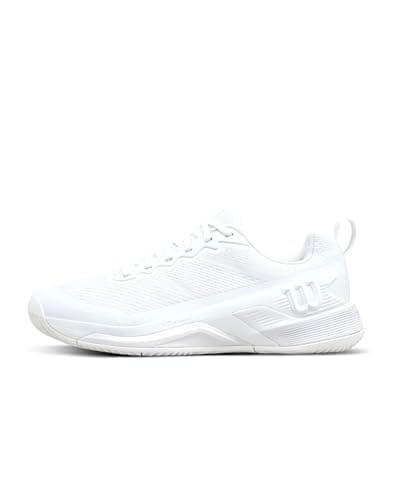
| Want performance features on a budget | Wilson Rush Pro 4.5 | 4D Support Chassis at a mid-range price |
| Are buying your first proper pair | ASICS Gel-Dedicate 9 | A real court outsole for a third of the money |
Surface matters, and most people ignore it
Hard court shoes have a durable compound in a multi-directional or modified herringbone tread. This is what you want unless you know otherwise, and everything on this page except the clay model is one. If you are only ever on hard courts, the dedicated ranking is at tennis shoes for hard courts, which scores purely on what each maker publishes about the rubber.
Clay court shoes have a tight, full-coverage herringbone that both grips and releases, and sheds clay instead of packing it. A hard-court outsole on clay just skids. If you play on Har-Tru or European red clay regularly, see tennis shoes for clay courts.
All court is a compromise that works fine for a player who is mostly on hard courts and occasionally elsewhere.
How long should a pair last?
For a club player on hard courts, roughly 60–100 hours of play for a performance shoe and considerably less for a budget one. The honest signal that you are past it is not the tread — it is the midsole: when the shoe stops feeling supportive sideways, the foam has compressed and the support structure no longer holds you, even though the outsole looks fine.
If you drag your toe on serve, you will destroy the medial forefoot long before anything else. That is what toe-drag guards are for, and the adidas Barricade's Adituff is the best of them — see tennis shoes for men.
Sizing: go up a half
Most tennis shoes run slightly short, and most players size up a half from their street shoe. You want roughly a thumbnail's width in front of your longest toe when standing, with the heel locked and no lift. Try them in the afternoon, when your feet are at their largest, and in the socks you actually play in — sock thickness is a real part of this fitting, and the sock ranking explains how much it moves.
A shoe that is slightly too big is not a safe compromise here: the foot sliding inside the shoe is what causes blisters and black toenails, and it also means the lateral support structure is catching the shoe rather than your foot.
Fit comes before brand, always. But once width and surface are settled, brand does decide what kind of shoe you get — the best tennis shoe brands ranks the makers by what each one actually builds for.
The cheapest upgrade in tennis
If you are currently playing in running shoes, the pair of court shoes at the bottom of this page will do more for your tennis — and your ankles — than any racquet on this site. It is the one piece of gear where the entry-level option is genuinely sufficient and the upgrade from zero is enormous.