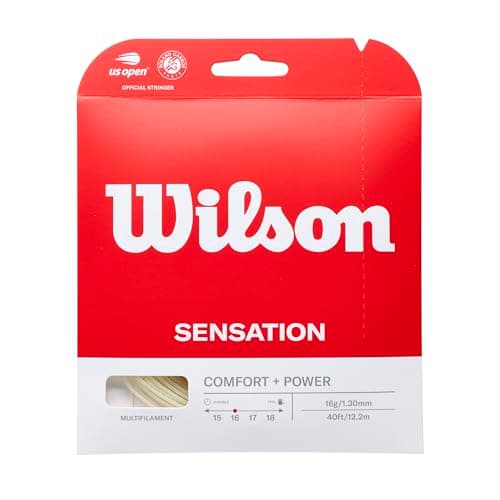
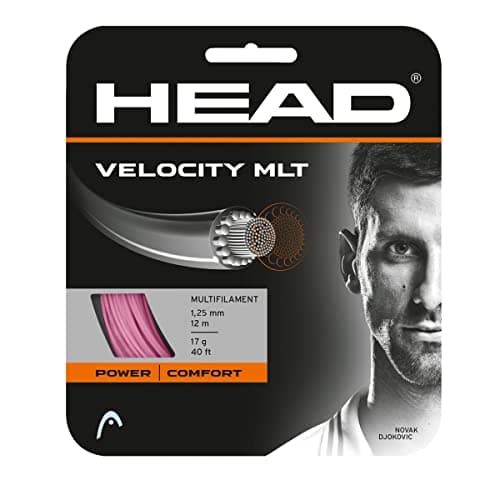
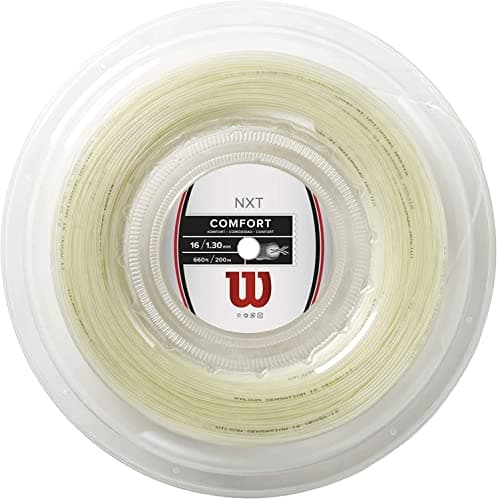
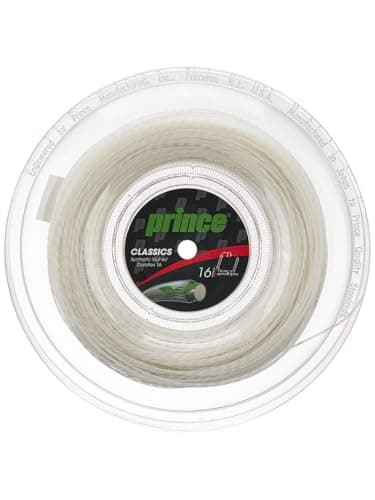
Buy Prince Synthetic Gut Duraflex 16. It is the string that has sat in the stringer at every club pro shop for thirty years, it is the cheapest string here per restring, and a beginner cannot tell it apart from anything more expensive. If your elbow or shoulder already grumbles after a session, step across to a multifilament instead — Wilson Sensation 16 is the soft, forgiving default (it is the string Wilson puts in its own frames at the factory) and HEAD Velocity MLT 17 is the cheapest way to get multifilament comfort. Wilson NXT 16 is the premium version of that same idea, and the one to grow into rather than start with. What you should not buy at this level is polyester, at any price, in any color.
Here is the thing nobody tells you when you buy your first racquet: the frame came strung from the factory, and that string will go dead long before it snaps. Strings lose tension from the day they are installed. A string bed that has gone soft feels powerful in a bad way — the ball flies, you have no idea where it is going, and you assume the problem is your forehand. It is not. It is a six-month-old string bed.
So the real beginner question is not "which string is best". It is "what do I ask for when I hand the racquet over", and the answer is a name and a number: synthetic gut, 16 gauge, mid-range tension. That sentence gets you a perfectly good string job anywhere in the country for the price of two cans of balls.
Why synthetic gut, and why not polyester
Three families of string exist for a club player. Synthetic gutis a solid nylon core with a wrap around it — cheap, predictable, moderately soft. Multifilamentbundles thousands of fibers in polyurethane to imitate natural gut — much softer, livelier, breaks sooner, costs more. Polyester(also sold as "co-poly") is a stiff monofilament that gives a fast swing control and spin, and gives a slow swing nothing but a jarred elbow.
That last point is the one that matters at 2.5 to 3.0. Polyester only works if you swing fast enough to make it bend around the ball; below that speed it behaves like wire. The USTA's own level guidelines describe a 2.5 as a player still developing consistent racquet-head speed, which is precisely the swing a poly punishes. Every one of the polyester entries in our registry carries the same "do not buy if" line for the same reason — and a beginner who strings poly because the pros do it is the most common self-inflicted injury in club tennis. Read poly vs multifilament if you want that argument in full.
The other reason to start cheap is honest: you do not yet know what you like, and you will not know until you have worn out two or three string jobs. Spending more at this point buys information you cannot read yet.
Gauge: ask for 16, not 17
Gauge is string thickness, and the US numbering runs backwards — a higher number is a thinner string. Published gauge charts put 16 gauge at roughly 1.26–1.34 mm and 17 gauge at 1.16–1.24 mm. Thicker lasts longer; thinner grips the ball slightly better. For a beginner that trade is not close: take the thicker string and the longer life. Our full treatment of this is on 16 vs 17 gauge.
Tension: the middle of the printed range
Every frame has a manufacturer-recommended tension range printed on the inside of the throat — typically something like 50–60 lb. String in the middle of it. Lower tension gives more power and less control; higher gives the reverse. A beginner has no basis for choosing a deliberate extreme, and the middle is the setting the frame was designed around. The tension guide covers what to change and when, once you have a reason.
What a restring actually costs you per hour
A restring is labor plus string. The labor is the fixed part and the string is the variable part, which is why the cheap string saves less than you would think in percentage terms — and why it is still the right call, because you are going to do this two or three times a year, every year. What restringing costs works the arithmetic with real numbers, and how often to restring gives the old rule of thumb: restring as many times per year as you play per week, whether or not anything has broken.
One caveat on the reels. Two of the four picks below are sold as 200 m reels rather than single 40 ft sets, because that is the cheap way to buy a string you will use repeatedly. A reel only makes sense if you string your own frames or have a stringer who will work from your reel — otherwise buy sets and let the shop charge you for theirs. If stringing your own appeals, the whole process is in how to restring a racquet.
The one-sentence answer to take to the shop
"Synthetic gut, 16 gauge, middle of the recommended range." If they ask which synthetic gut, say Prince Duraflex. If they do not stock it, any solid-core synthetic gut in 16 gauge is the same decision.
When to upgrade, and to what
Two signals. If your arm aches after playing, move to a multifilament — that is a comfort problem and a softer string bed is the cheapest fix available. If you are breaking strings in under ten hours, your swing has developed and you are ready for the conversation in strings for intermediate players, which is where polyester finally becomes a sensible idea.
Do not match your string to your racquet brand
A Babolat frame does not need Babolat string. The string and the frame interact through stiffness and power, not branding — a soft string in a stiff frame is the classic comfort fix, regardless of whose logo is on either. If you want the frame side of that decision, start at the best beginner racquets.