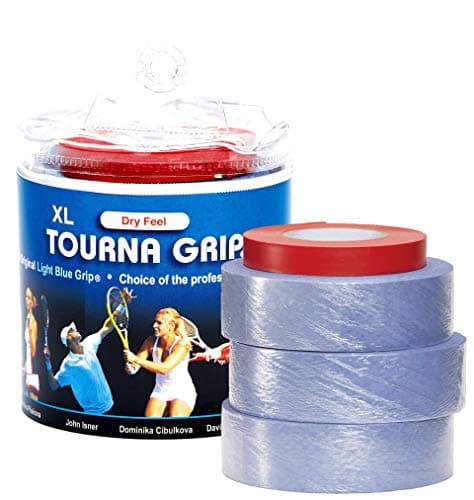
An overgrip is a thin wrap that goes over the grip already on your racquet. You change it every few weeks, it costs a couple of dollars, and it is the one almost every club player needs. A replacement grip is the base grip itself, glued to the handle from the factory — you replace it maybe once a season, when it has gone hard and flat. Buy overgrips in a multi-pack; buy a replacement grip when the handle underneath has actually died.
The confusion is understandable, because the two products sit next to each other on the shelf in near-identical packaging and the words are used interchangeably by people who should know better. The difference is physical and easy to see once you know what you are looking at: thickness. An overgrip is published at around half a millimeter. A replacement grip is published at three to four times that.
What each one actually is
The replacement grip (also called the base grip). When a racquet leaves the factory there is a grip wrapped around the bare handle, usually a cushioned polyurethane, running from the butt cap to the throat and finished with a strip of tape. It is thick, it provides the cushioning you feel through the handle, and it is part of your grip size. Replacing it is a job: you unwrap the old one, wrap the new one from the butt cap upward with a consistent overlap, trim it, and finish it with the tape. Fifteen or twenty minutes the first time.
The overgrip. A much thinner strip that wraps on top of the base grip, held with the same kind of finishing tape. It is a consumable. It is there to take the sweat, give you tack and get thrown away, which is exactly why you do not want it thick: every millimeter of overgrip is a millimeter between your hand and the handle shape you chose. Ten seconds to fit once you have done a few.
That is the whole distinction. One is structural and semi-permanent; one is a sacrificial layer. The reason people get it wrong is that both are sold as "grips."
The thickness numbers, and what they do to your grip size
This is where it becomes a buying decision rather than trivia, because grip size is the racquet spec most commonly got wrong and both products move it.
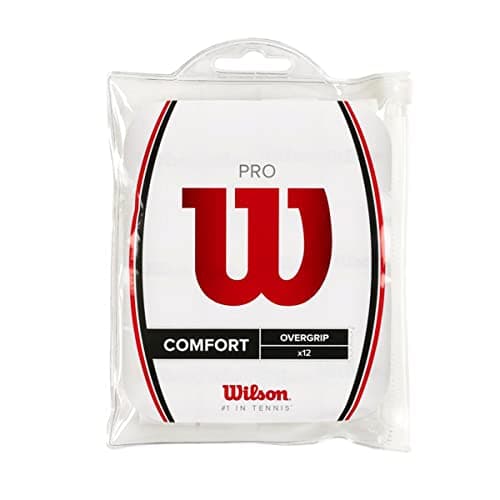
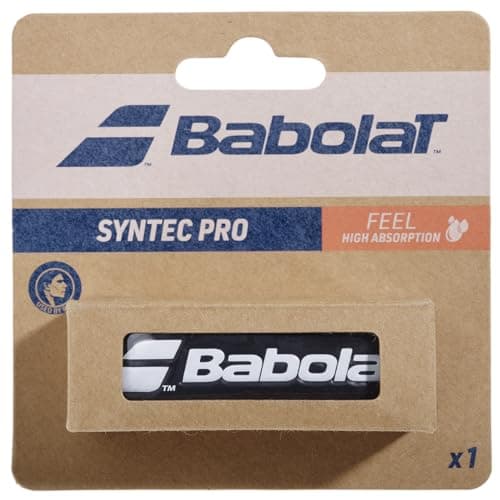
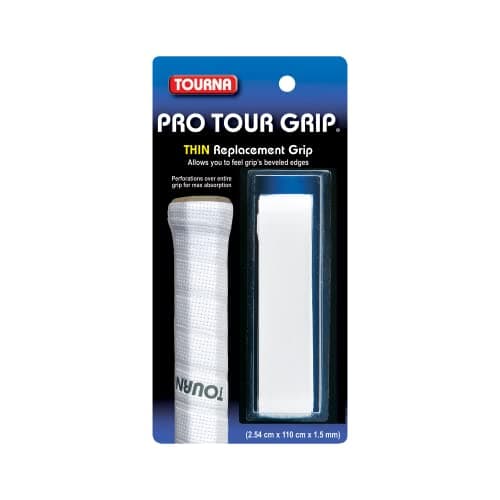
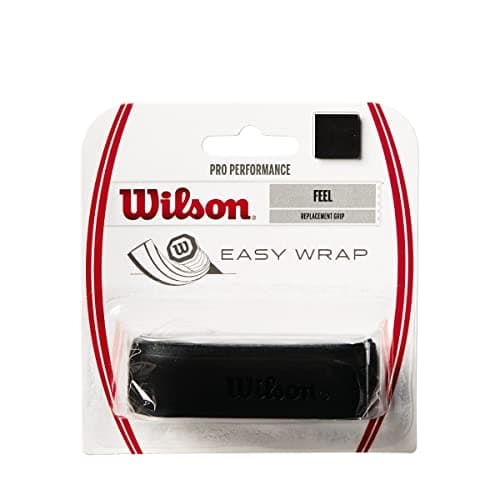
Published figures on the five grips here: the Wilson Pro Overgrip at 0.5 mm, the Babolat VS Original thinner again, the Tourna Pro Tour replacement grip at 1.5 mm, and the Babolat Syntec Pro replacement grip at 1.9 mm with a published length of 110 cm. Wilson does not publish a thickness for its Pro Performance replacement grip on the listing we resolved, so we are not going to print one.
The working rule used throughout tennis is that one overgrip is worth roughly half a grip size. It is a rule of thumb rather than a measurement, and it is why the standing advice when you are between sizes is to buy the smaller racquet and add an overgrip — a grip can always be built up and can never be reduced. Measure first; the method and the chart are at tennis grip size.
Swapping a replacement grip is a bigger move than that. Going from a 1.5 mm base grip to a 1.9 mm one adds thickness all the way around the handle, and if you then put an overgrip on top you may have walked up most of a full grip size without buying a different racquet. That is useful if you want to go up. It is a problem if you did not notice. And it is worth caring about beyond comfort: a grip that is too large is one of the recognized contributors to tennis elbow, which is covered on the tennis elbow racquet page.
Do you need both?
Nearly everyone is already running both, whether they know it or not. The standard club setup is the factory base grip plus one overgrip, and that is the right answer for the overwhelming majority of players. You change the overgrip when it goes slick, and you leave the base grip alone until it is genuinely finished.
The two deliberate exceptions are worth knowing.
Base grip only, no overgrip. Some players prefer the feel of a tacky replacement grip directly in the hand — the Syntec Pro is designed to work this way, and its cushioning is the point. It also keeps the handle at exactly the size the manufacturer intended. The cost is that when it wears out you are doing the 20-minute job instead of the 10-second one.
A thin base grip specifically to leave room for an overgrip. This is why the 1.5 mm Tourna Pro Tour exists. If you want to feel the bevel edges of the handle through the grip — which is how a lot of players find their grips without looking — a thin base plus a thin overgrip gets you there at close to stock grip size. Two overgrips stacked on a thick base grip does the opposite: a round, vague handle you cannot orient by feel.
When to change which
The overgrip. Change it when it stops doing its job, which for a tacky grip means it has gone shiny and slick and for an absorbent one means it has gone gray, hard and stopped taking up moisture. For a player hitting two or three times a week in normal conditions, that is every few weeks. In summer heat it can be every session, which is the whole reason the 30-grip Tourna pack exists.
The replacement grip. Much less often, and the signals are different. It is done when the cushioning has compressed flat so the handle feels hard and thin, when it has started to come unwrapped at the throat or the butt cap, or when it has gone slimy in a way washing does not fix. Realistically once a season for a regular club player, and for someone who always runs an overgrip over the top, potentially years — because the overgrip has been absorbing all the damage. That is the quiet second benefit of overgrips: they protect the expensive layer.
Tacky or absorbent — the choice inside the overgrip decision
Once you know you want overgrips, there is one more fork, and most players have never been told there is a choice.
Tacky grips, like the Wilson Pro Overgrip, are polyurethane and sticky out of the pack. They feel great immediately and the tack falls off as they get wet, which is precisely when you need it.
Absorbent grips, of which Tourna Grip is effectively the only serious one, work the other way round: dry and papery when new, and grippier as they take up moisture. If your hands sweat or you play in humidity, nothing else is close. If you have only ever used tacky grips, the first five minutes feel wrong.
The full ranking on tack, absorption and durability is at the best tennis overgrips. This page is about the other axis: which kind of grip you are buying in the first place.
If sweat is the specific problem, the dry-feel grips are ranked on their own at overgrips for sweaty hands. And once you have decided which kind you need, the method for fitting either one — ten minutes, scissors, start at the butt cap — is in how to regrip a tennis racket.
What it costs across a season
Grips are the cheapest consumable in tennis and the one with the highest return per dollar, which is a strange thing to have to argue. Overgrips land in the low-single-dollar bracket each, lower again in a 12 or 30 pack, and a player changing one every two weeks is spending less across a season than a single restring. A replacement grip is a low-double-digit purchase once a season.
Put next to a racquet, a stringing job or a pair of court shoes, the entire grip budget for a year is a rounding error — and it is the layer actually touching your hand. Live prices for all five are on the buy rows above and re-checked daily; the whole kit budget is at how much tennis gear costs.
A replacement grip is also the easiest way to change a racquet's balance, which is the other half of a customization question. How to add weight to a racquet covers the handle methods in full — tape under the grip, weight inside the butt cap, or simply a heavier replacement grip — and what each one does to how the frame swings.
Side by side
| Overgrip | Replacement grip |
|---|
| Where it goes | On top of the existing grip | Directly on the bare handle |
| Published thickness | Around 0.5 mm | 1.5 mm to 1.9 mm |
| Effect on grip size | Roughly half a size per wrap | Sets the base size; a thicker one moves it |
| How often you change it | Every few weeks, or every session in heat | About once a season |
| Fitting time | Under a minute | Fifteen to twenty minutes |
| Cushioning | Almost none — that is the point | This is where handle comfort comes from |
| Sold as | Multi-packs of 3, 12 or 30 | Single grips |
| Who needs it | Essentially every player | Anyone whose base grip has gone hard or is unwrapping |
Which of the five, in one line each
Your hands sweat or you play in humidity → Tourna Grip XL, the absorbent overgrip, in the 30-pack. You want the default tacky overgrip and no thinking → Wilson Pro Overgrip, 0.5 mm, 12-pack. Your factory grip has gone hard and you want the handle padded again → Babolat Syntec Pro, 1.9 mm. You want a thin base so you can run an overgrip without going up a size → Tourna Pro Tour, 1.5 mm. You want a like-for-like swap on a Wilson frame → Wilson Pro Performance replacement grip.
How to fit an overgrip, properly
Start at the butt end, not the throat. Peel the backing a few inches at a time, lay the first wrap flush with the butt cap, and work up the handle with a consistent overlap of roughly a third of the grip's width, pulling light tension as you go. Stop an inch or so short of the throat, cut at an angle so the end lies flat, and finish with the tape in the pack. Right-handers wrap counter-clockwise looking at the butt cap, left-handers the other way, so the overlap edges point away from the hand.
Three mistakes to avoid: too much tension, which stretches the grip thin and shortens its life; inconsistent overlap, which creates ridges you will feel on every shot; and starting at the top, which leaves the overlap facing into your palm so it peels.
How to fit a replacement grip
Same direction, more care. Unwrap the old grip and peel off the old tape — if there is adhesive residue on the handle, leave it unless it is lumpy, because it is doing no harm. Check the handle for a staple at the butt end; some frames have one, and it holds the start of the grip.
Then wrap from the butt cap up with a slightly smaller overlap than an overgrip, keeping the tension even, because a replacement grip is thicker and any unevenness shows as a lump rather than a ridge. Trim at an angle at the throat and finish with the tape. If you want the handle marginally bigger, a half-wrap more overlap at the top end does it; if you want it smaller, you cannot, which is the asymmetry that makes grip size worth measuring before you buy a racquet.
The common mistake worth naming
Stacking a second overgrip on top of a worn first one instead of removing it. It is quick, it feels like a fix, and it leaves you playing with a dead, compressed layer underneath a new one — a handle a full size too big with no tack where it matters, and sweat trapped between the two. One overgrip at a time. Peel the old one off; it takes four seconds.
The second-most-common: ignoring the base grip for years because the overgrip always feels new. If the handle has started to feel hard and thin, or you can feel the bevel edges unusually sharply, the cushioning underneath has compressed flat and a replacement grip will make the racquet feel new for the price of a can of balls.
Where this sits in the kit
Grips are the smallest decision on this site and one of the few with no downside — nothing about a fresh overgrip makes you play worse. For everything else that goes in the bag, start at the gear checklist if you are building from nothing, or the men's bag ranking if what you actually need is somewhere to put it all.