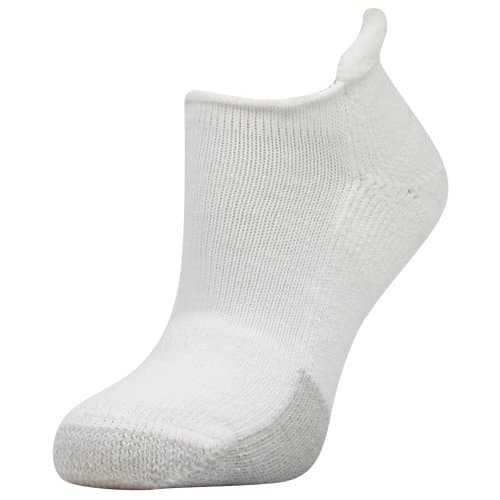
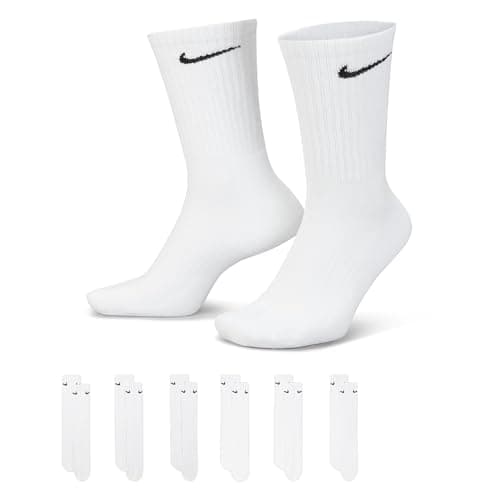
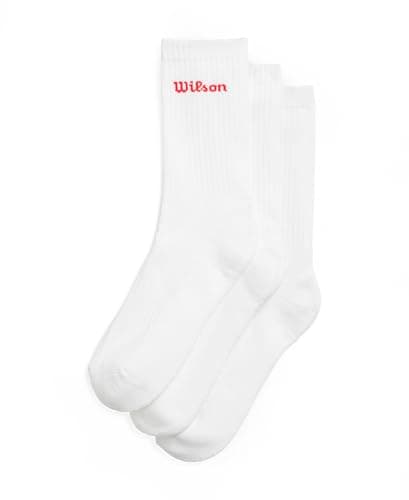
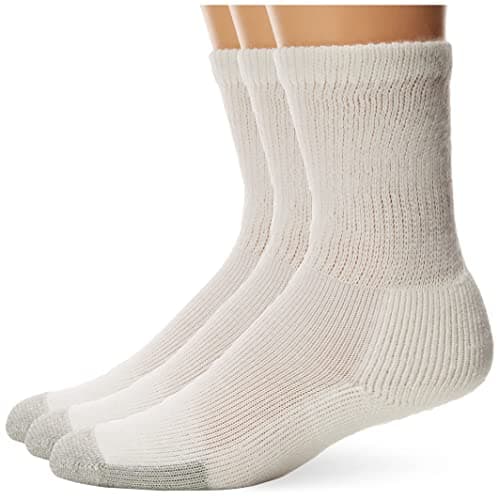
The best tennis sock is the Thorlos Tx max cushion crew, in the women's rolltop cut if you do not want a sock showing above the shoe. The padding is placed under the forefoot and the heel rather than spread evenly, which is exactly where a court shoe stops and starts you, and it is the one sock here built for tennis rather than for sport in general. If you want value, the Nike Everyday Cushioned six-pack does 80% of the job for a quarter of the cost per pair — and if your shoes already fit snugly, it is actually the better choice.
That last point is the thing almost no sock page tells you, and it is the reason this page exists on a site about court shoes: a thick tennis sock changes your shoe fit. A max-cushion sock adds a few millimeters under the forefoot and around the heel. In a shoe that is a half size roomy, that is a free fix for heel slip. In a shoe that already fits closely, it is how a well-fitting shoe becomes a tight one, and tight shoes cause the exact blisters you were trying to prevent.
So the decision is not "which is the best sock". It is:
Shoes slightly roomy, or you get heel slip → max cushion. Thorlos.
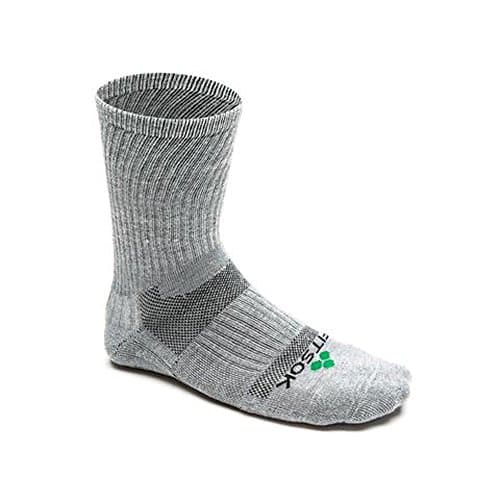
Shoes fit well → medium cushion. Fitsok CF2, or the Nike six-pack.
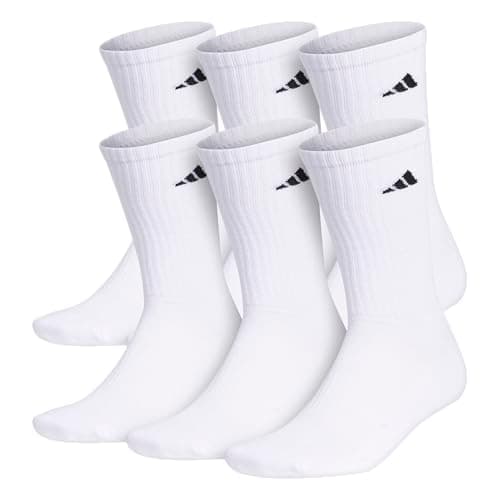
Shoes already snug → thin. The adidas six-pack, and consider going up a half size in the shoe next time instead.
If you are buying shoes at the same time, try them on in the socks you intend to play in. Our how to choose tennis shoes guide covers the rest of that fitting. Socks are also the piece people leave off a clothing list and then notice first, which is why they are in the kit at the best tennis outfits for women.
Tennis socks for women
Two things genuinely differ, and one does not.
What differs: the last. A sock built on a women's last puts the heel pocket and the forefoot pad in different places from a unisex sock in the equivalent size. That is not marketing — a pad in the wrong place is a pad doing nothing. The Thorlos women's max cushion rolltop is the specific pick here, and it is the reason it is ranked second overall rather than lower: for a woman, it is the best sock on the page.
What also differs: cuff preference. The rolltop is the useful format and it is genuinely hard to find. It sits right at the shoe line — the low-profile look, without dropping to a no-show sock, which slips and leaves your heel in direct contact with the shoe collar. If you have ever abandoned no-show socks for court use, the rolltop is what you wanted.
What does not differ: everything else. The Nike, Fitsok and adidas packs are sold in unisex or men's sizing and work fine; you are sizing down, not buying a different product. Do not pay a premium for a "women's" sock that is a unisex sock in a pastel.
Tennis socks for men
The men's search is the same question with one extra wrinkle: volume. Men's club tennis skews toward league play and more sessions per week, which means more laundry, which means the six-packs are a better answer than they look on a quality ranking.
The honest math: a three-pair pack of Thorlos costs roughly what a six-pair pack of Nike Everyday Cushioned costs. If you play twice a week, three pairs is fine and the better sock wins. If you play four or five times a week, six pairs of a good-enough sock beats three pairs of a great one, because the alternative is doing laundry around your tennis schedule or playing in a damp sock — and a damp sock is a blister.
The adidas six-pack is the cheapest per pair here by a wide margin and is men's sized. Its arch compression band is the detail that matters: it is what stops a sock migrating and bunching under the forefoot mid-match.
Cushioning placement, not cushioning amount
Here is the mechanism, briefly, because it is the only technical thing on this page.
Tennis does not load the foot the way running does. Running is repeated forward impact through the heel and the forefoot in a predictable line. Tennis is a hard stop from a sprint, a push off the outside edge, and a drag of the toe — so the load concentrates at the forefoot, the heel, and across the ball of the foot laterally. Friction at those points, especially when the sock is damp, is what raises a blister.
A specialist tennis sock puts its material there specifically. A generic cushioned athletic sock spreads a thinner layer everywhere. That is the actual difference you are paying for — not total thickness, but where the thickness is. It is also why a thick running sock is not automatically a good tennis sock.
Crew, quarter or no-show
Crew is the default and the right default. It covers the ankle above the shoe collar, which matters because a court shoe has a reinforced, stiffer collar than a running shoe — that is part of what makes it a court shoe — and a stiff collar against bare skin rubs on lateral movement.
Rolltop or quarter sits right at the collar line. The compromise, and the one to pick if a crew sock is not the look you want.
No-show is the one to avoid for tennis. Not because of the look — because it sits below the collar, so the collar contacts skin, and because a no-show sock has the least material holding it in place and tennis is the sport most likely to drag it down off your heel.
What socks will not fix
If you blister in the same place every time you play, a sock is a partial answer at best. The usual causes are shoes that are the wrong width for your foot, a shoe a half size too small, or a foot shape the model does not suit. Those are shoe problems. Start with court shoes for wide feet if your foot is broad, or the support-focused shoe ranking if there is arch pain alongside it.
And one genuinely cheap trick that works: own enough socks that you never play in a sock that is still damp from last session. That is the entire argument for the six-packs.
While you are buying the unglamorous half of the kit: the same logic applies one layer up. Men's tennis shorts and women's tennis skirts are both decided by two details nobody photographs — the pockets and the fabric — rather than by the logo on the leg.
Socks are the one soft good where a specialist beats every giant, which is the argument made in full on the best tennis clothing brands — along with where to spend on the rest of your kit and where the budget labels are the better buy.