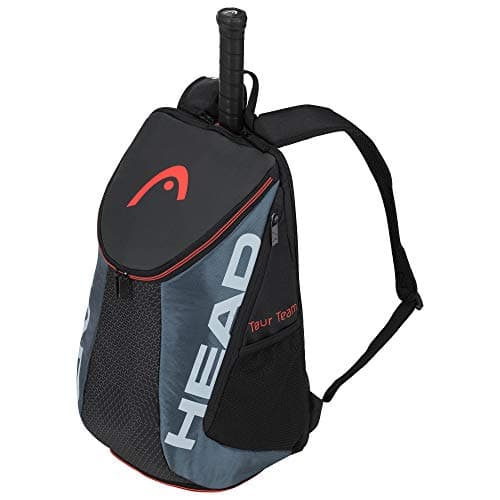
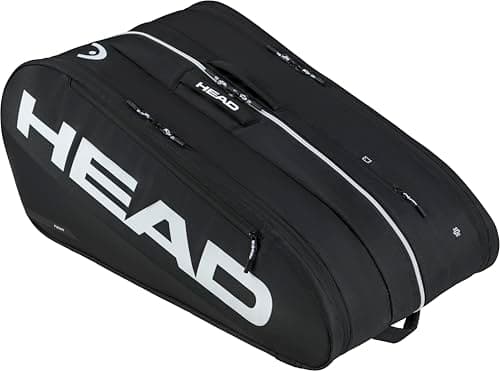
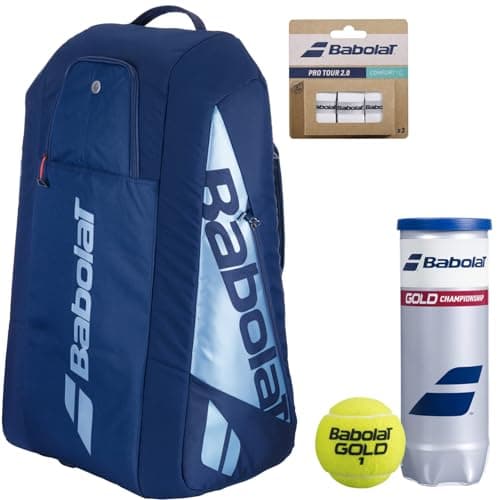
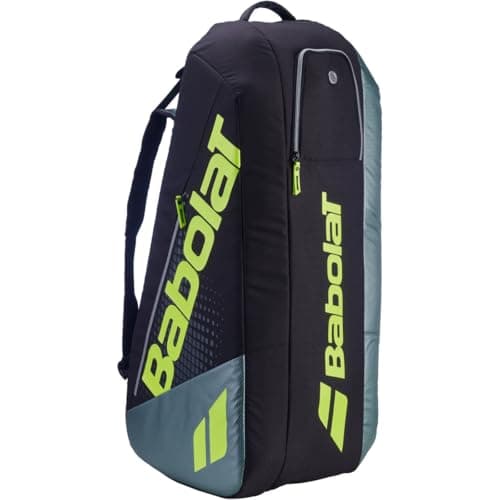
The best tennis bag for most men playing club tennis is the Babolat Pure Aero RH6: six frames, a thermal main compartment, a separate shoe compartment and backpack straps that survive being loaded. If you carry one racquet to a weekly hit, stop there and buy the HEAD Tour Team backpack instead — it is a quarter of the bulk and the right size. If you want the most capacity per dollar, the HEAD Tour Racquet Bag XL publishes 75 liters across three compartments. If you want everything insulated, the Babolat RH12.
Say the obvious thing first, because the query implies something that is not true: there is no men's tennis bag. No men's pattern, no men's construction, no men's sizing standard. Every bag on this page is sold to everybody, and the same seven bags are the right answer for a woman carrying the same kit — which is why the ranking on tennis bags for women differs from this one on carry comfort rather than on the bags themselves.
What does change, reliably, is the kit. A men's court shoe in the common 10–13 range is physically longer than the shoe compartment on several popular bags. The frames are usually heavier, so a loaded bag weighs more and the strap geometry starts to matter. And men's club tennis skews toward league play, which means a spare frame, which means capacity you did not need as a beginner. Those three things are what this page ranks on.
Start with the only question that matters: how many frames do you carry?
Everything else follows from this, and most people buy two sizes too big because the big bags look like what the professionals carry. Here is the honest mapping.
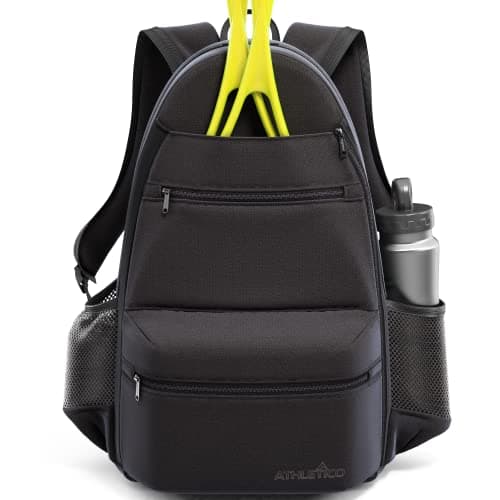
One frame, once or twice a week. A 2-racquet backpack. That is the whole answer. You need somewhere for the racquet, a can of balls, a towel, a bottle and your shoes, and a bag that holds six frames will spend its life three-quarters empty with the contents sliding around inside it. The HEAD Tour Team or, if money is the constraint, the Athletico Compact City.
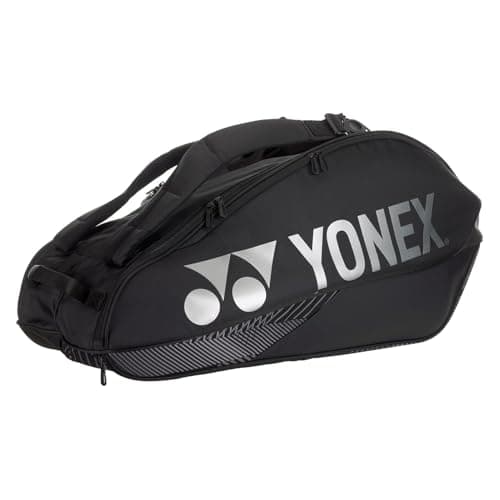
Two frames, league or regular matches. A thermal 6-pack. The step up is not really about the extra frames — it is that this is the first size where you get an insulated compartment, and a spare frame strung to match is worth nothing if the tension in it has drifted in a hot trunk. The Babolat Pure Aero RH6 or the Yonex Pro Racquet Bag 6.
Three or more frames, tournaments, or you coach. A 12-pack. At this point you are living out of the bag for a day or a weekend: frames, two pairs of shoes, wet clothes, food, a stringing kit. The HEAD Tour Racquet Bag XL at a published 75 liters, or the Babolat RH12 if you want all three compartments insulated rather than one.
Nobody at 3.5 needs a 12-pack, and nobody playing a Saturday league with a spare frame is well served by a 2-racquet backpack. Buy for the tennis you actually play. If you are not sure yet which that is, the tennis gear checklist walks the whole kit in buying order.
The shoe compartment test nobody runs before buying
This is the single most common disappointment with a bag, and it is specific to larger feet. A "shoe compartment" on a compact backpack is often a vented pouch sized for a women's 7–9. A men's 12 court shoe is a long object with a thick outsole, and two of them side by side is a surprising amount of volume.
The fix is to check published dimensions rather than the word "compartment." Two of the bags here publish real numbers: the HEAD Tour Racquet Bag XL at 31 x 13 x 17 in and 75 liters, and the Babolat RH12 at 35 x 45 x 80 cm. Both swallow a pair of 13s without an argument. On the compact backpacks, assume your shoes go in diagonally or not at all, and treat the compartment as a bonus rather than a feature you are paying for.
The second half of the test is ventilation. A sealed pocket with damp shoes in it is a science experiment by Wednesday. The Babolat RH12's shoe pocket is published as seamless, waterproof and vented to the outside, which is the correct design: the water stays out of the bag and the air gets out of the pocket.
Thermal lining is the one feature worth paying up for
Everything else on a bag spec sheet is convenience. The insulated compartment is the only one that changes how your racquet plays.
Strings lose tension continuously from the moment they are installed, and heat accelerates it. A car trunk in July is the worst environment your frame will ever sit in, and it is where most club players store their bag between matches. An isothermal compartment does not make the heat go away; it slows the swing, which is enough to matter across a season of matches rather than a single afternoon.
The practical ranking: the Babolat RH12 insulates all three main compartments; the Pure Aero RH6 insulates the main compartment; the HEAD Tour Racquet Bag XL insulates one of its three with CCT+ lining; the Yonex Pro 6, the HEAD Tour Team backpack and the Athletico have no thermal lining at all. If you own one frame and restring it on a schedule, that is a non-issue. If you carry a matched spare for league, it is the feature to buy. How fast tension actually goes is covered in how to choose tennis strings.
Carry format: backpack, shoulder, or both
Loaded weight is where bags separate, and it is the thing you cannot tell from a photograph.
Backpack straps. Both shoulders, load centered, hands free. Right for anything up to a 6-pack and for anyone walking, cycling or taking transit to the courts. Every bag on this page except the Wilson Super Tour has them as the primary carry.
Single shoulder strap. Faster on and off, and genuinely fine for a short walk from a parking lot. It stops being fine the moment the bag is full, because a 12-pack on one shoulder is a lever working against your spine for the whole walk.
Load stabilization. The detail worth knowing about on the big bags. The RH12 publishes a load-management system across its two straps, which is what stops a full tour bag from swinging as you walk. On a bag that size it is not a luxury — an unstabilized 80 cm bag swings into the back of your legs on every step.
One piece of practical advice that costs nothing: pack the heavy things against the panel that sits on your back. Frames and shoes close to your spine, light kit outboard. A badly packed good bag carries worse than a well-packed cheap one.
What you should not pay for
A tour colorway. A limited-edition cosmetic on an identical bag is a paint job. Check that the spec is the same rather than a smaller variant in prettier colors, and buy whichever is cheaper.
Capacity you are aspiring to. The 9-pack and 12-pack bags are superb at what they do and ridiculous at everything else. A half-empty tour bag is heavier, bulkier and worse-carrying than the right-sized bag, and it does not make you look like a tour player — it makes you look like somebody who bought a tour bag.
Waterproofing claims on the main compartment. Almost no tennis bag is genuinely waterproof, and the zips are the reason. Treat every bag as shower-resistant and put anything that must stay dry in a plastic bag inside it.
Where the bag sits in the budget
In rough terms, a competent 2-racquet backpack is the cheapest real item in a tennis kit after balls and grips, a thermal 6-pack sits in the mid bracket alongside a good pair of court shoes, and a 12-pack tour bag is a step above that again. None of them is close to the cost of the racquet and strings they protect, which is the argument for not buying the cheapest thing on the shelf. We do not print price numbers in prose because they move; the live figure sits on every buy row above and is re-checked daily. The full kit budget is at how much tennis gear costs.
If a 6 or 12-pack is more bag than your tennis needs, the two smaller formats have their own pages: tennis backpacks, which put two racquets and a shoe compartment on both shoulders, and small 3-racquet bags, which are flat enough to live in a car footwell.
If a shoe compartment is the one feature you will not compromise on — and it is the one that keeps damp court shoes away from your grips and your frames — tennis bags with a shoe compartment ranks only the bags that publish one and explains what separates a vented pocket from a fabric sleeve.
The seven bags, by published spec
| Bag | Racquets | Thermal | Shoe compartment | Primary carry |
|---|
| Babolat Pure Aero RH6 | 6 | Main compartment | Yes, ventilated | Backpack + shoulder |
| HEAD Tour Team Backpack | 2 | No | Yes | Backpack |
| HEAD Tour Racquet Bag XL (12R) | 12 | 1 of 3 (CCT+) | Yes, integrated | Backpack + top handles |
| Babolat Pure Drive RH12 | 12 | All 3 compartments | Yes, sealed and vented | Backpack, load-stabilized |
| Yonex Pro Racquet Bag 6 | 6 | No | No dedicated pocket | Backpack + grab handle |
| Athletico Compact City | 2 | No | No | Backpack |
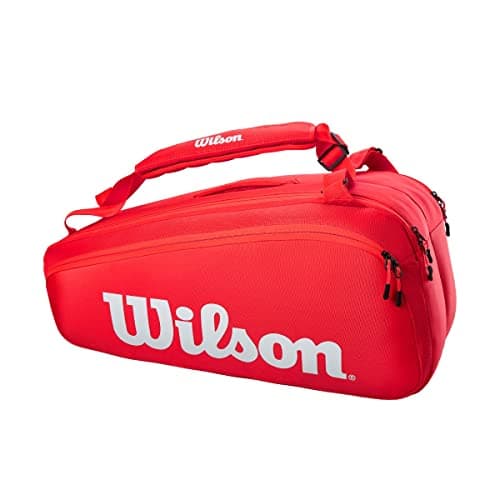
| Wilson Super Tour 9-Pack | 9 | Racquet compartments | No dedicated pocket | Backpack + shoulder |
Published volume and dimensions exist for two of the seven: the HEAD Tour Racquet Bag XL at 75 liters and 31 x 13 x 17 in, and the Babolat RH12 at 35 x 45 x 80 cm. The rest of the category publishes a racquet count and nothing else, which is why "6-pack" is a marketing unit rather than a measurement — two 6-packs from different brands are not the same size inside.
Which one, in one line each
You play league with a matched spare frame → Babolat Pure Aero RH6. You carry one racquet to a weekly hit → HEAD Tour Team Backpack. You want the most space per dollar → HEAD Tour Racquet Bag XL. You want every compartment insulated → Babolat RH12. You want the best-organized 6-pack → Yonex Pro Racquet Bag 6. You want a real tennis backpack for the least money → Athletico Compact City. You play multi-day tournaments or coach → Wilson Super Tour 9-Pack.
How to pack a bag so it does not wreck your frames
Four habits, none of which cost anything.
Frames go head-to-tail, not stacked face to face. Two string beds pressed together in a compartment flex against each other every time the bag is set down. Alternate them so the hoops sit beside the handles.
Shoes never ride with the frames. This is what the separate compartment is for, and it is as much about grit as about smell. A shoe outsole carries court dust, and court dust in a string bed is an abrasive.
Do not store the bag in the car. A thermal compartment buys you a drive, not a summer. If the bag lives in the trunk year-round, no amount of lining will save the tension in the frames, and the grips will go hard and shiny.
Empty the balls. A pressurized can loses pressure whether you open it or not, so a bag with four half-dead cans in it is carrying weight that will not help you win a match. Take out what you are not using.
When a bag is actually worn out
Bags usually fail at one of three places, and only one of them is terminal. Zips go first and are repairable at any cobbler or luggage shop for a fraction of a new bag. Strap stitching goes second and is also repairable. The terminal failure is the base fabric abrading through from being set down on hard courts hundreds of times — once the floor of the racquet compartment is thin, your frames are protected by nothing, and it is time.
That is the practical case for spending once on a 6-pack rather than three times on a budget backpack: the cheap bags fail at the base, and the base is the part that is doing the actual work.
What to buy alongside the bag
The bag is the container. What goes in it matters more, and most of it is cheap: court shoes with a tennis outsole, a pack of overgrips, a replacement grip when the one on the handle has gone hard, and a set of string chosen for your arm. Full list, in the order worth buying, at tennis gear for men. If you are deciding between overgrips and a new base grip, the difference is explained at overgrip vs replacement grip.