You cannot restring a tennis racket by hand. The job needs a stringing machine — something that holds the frame rigid in a mount and pulls each string to a measured tension with a tensioner — and that is the entire reason most players pay a shop about $25 in labor instead. If you string two or more racquets a month, a drop-weight machine like the Klippermate pays for itself in about a season and then keeps paying. Allow 30 to 40 minutes per racquet once you are practiced, and considerably longer than that for your first two.
That is the decision. The rest of this page is what the job involves, so you can make it honestly rather than discovering halfway through that you needed equipment you do not own.
Should you do it yourself?
Pay a shop if: you string one or two racquets a year, you have no interest in the process, or you want a specific setup (a hybrid, a precise tension) done reliably by someone who does it daily. Published shop labor runs about $25 per racquet, so a once-or-twice-a-year player is spending $25 to $50 annually, and a machine makes no sense at all.
Do it yourself if: you break strings often, you own two or more frames you keep matched, you want to experiment with tension (which is where most of the available improvement actually is), or you are the household that strings for three people. The break-even is roughly where you cross $25 of labor a month.
The honest third option: learn on an old frame. Buy a cheap machine, buy a reel of synthetic gut, and practice on a racquet you do not care about. You will make a mess of the first one. This is normal, and it is a $4 mistake rather than a $200 one. Full economics in what restringing costs.
What you need
A stringing machine. Non-negotiable. It does two jobs: it holds the frame rigid at six points so the frame does not distort while you pull 50-plus pounds through it, and it pulls each string to a repeatable measured tension. The machine type is the main decision:
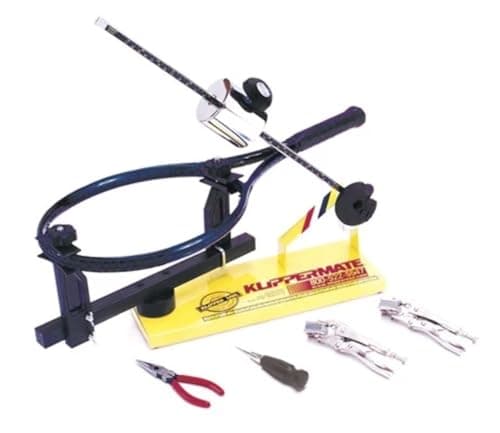
Drop-weight — the tension comes from a weighted arm that you let fall until it is level. Slow, mechanically simple, nothing to calibrate or break, and genuinely accurate. The Klippermate is the classic example and the right first machine for almost everybody.
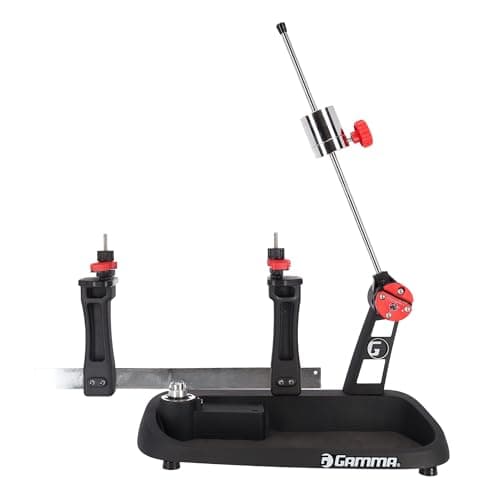
Crank (lockout) — a geared crank that locks out at the set tension. Faster per racquet and the usual step up if you are stringing in volume. The Gamma Momentum is the one here.
Electronic constant-pull — what shops use. Several thousand dollars and not a sensible home purchase.
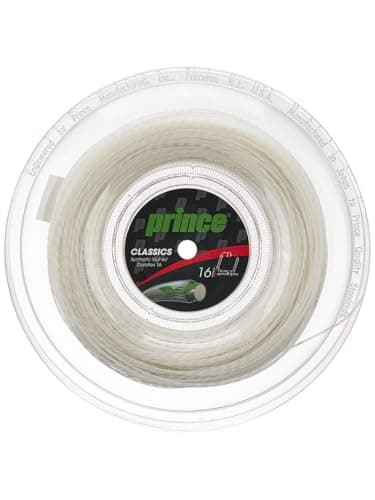
A set or a reel of string. A set is one racquet's worth, roughly 40 feet. A reel is 200 meters and does about sixteen racquets at a far lower cost per restring — which is the real saving in home stringing, not the labor. Prince Synthetic Gut is the string to learn on: cheap, forgiving to handle, and a perfectly good string to actually play with.
Tools. Awl, starting clip, pliers and a straightening tool. Decent machines include these; check before you buy.
The process, in plain steps
This is an overview, not a substitute for your machine's manual and a video of your specific pattern. Every frame has a published string pattern and some have shared grommets or skipped holes, so the pattern diagram matters.
1. Cut the old string out, from the middle outward. Not from one side. Cut the central mains first and work outward alternately, so tension comes off the frame symmetrically. Cutting one side first leaves the frame loaded unevenly, which is how frames get distorted. Count your cuts as a sanity check against the pattern.
2. Mount the frame. Six-point mounting, snug but not crushing, with the frame sitting square. A badly mounted frame strings badly and there is no recovering from it later.
3. String the mains (the long vertical strings). Start at the two center holes at the throat, work outward, two strings at a time — one on each side — keeping the frame evenly loaded. Tension each one, clamp it, move on. The mains typically take about 60% of the string.
4. Tie off the mains. At the designated tie-off holes for your frame, which are published in its pattern. Two or three knots, pulled tight against the grommet.
5. String the crosses (the horizontal strings), from the top down. This is the slow half and the part where technique shows. Each cross has to be woven alternately over and under the mains before it is tensioned — over, under, over, under — and getting one wrong means unpicking it. Weaving one cross ahead of the one you are tensioning makes this far easier.
6. Tie off the crosses, trim, straighten. Knot at the published tie-off, trim the tails to a few millimeters, then straighten the string bed with the tool so every intersection sits square. The last step is cosmetic and takes two minutes; skip it and the job looks amateur.
7. Check it. Press the middle of the string bed with your thumb. It should feel even across the face with no soft patch. A soft spot means a clamp slipped on that string.
The mistakes everybody makes on their first racquet
Cutting the old string out from one side. Covered above, and the only one on this list that can damage a frame. Middle outward, alternating.
Mis-weaving a cross. Over, under, over, under — get one wrong and you will see it, because the string bed looks wrong. Unpick it; do not leave it. Weaving one cross ahead is the fix.
Clamping on the frame or on a grommet. Clamps go on the string, inside the frame. A clamp on the frame marks it.
Letting the clamp slip. Snug up the clamp before you release the tensioner, not after. A slipped clamp is the soft patch you feel in step 7.
Stringing poly at the tension you used for multifilament. Polyester is a stiffer string and should normally be strung a few pounds lower than a soft multifilament, or you get a board. This is a playing mistake rather than a stringing mistake, and it is the most common cause of arm pain in club tennis — see the tension guide and how to prevent tennis elbow.
How long it takes
Thirty to forty minutes per racquet once you are practiced. Your first will take well over an hour and will not be good. Your third will be fine.
That time figure is the real argument against home stringing, and it is worth doing the arithmetic honestly: if 40 minutes of your time is worth more than the $25 of labor you are saving, pay the shop. The money in home stringing is in buying string by the reel, not in saving the labor — which is exactly why the break-even is about volume rather than about being handy.
What to string it with
A separate question from how, and the one that actually changes how your racquet plays. Briefly:
Learning to string: Prince Synthetic Gut, on a reel. Cheap, forgiving to handle, no stiffness to fight while you are learning to weave.
Comfort and an easy arm: a multifilament like Wilson NXT or HEAD Velocity MLT. See arm-friendly strings.
Control and spin, if you swing fast: a polyester like Solinco Hyper-G. See the spin string ranking and poly vs multifilament.
The whole category is laid out in types of tennis strings, and the "when" question — how often this job needs doing — comes down to a simple rule: restring as many times per year as you play per week, and immediately if you break one.
Two pages follow directly from this one. If you are choosing the machine rather than learning the job, the best stringing machines has the price ladder from a drop weight to an electronic constant-pull machine and the payback math at published shop rates. And if you are not sure how often to go through all this, how often to restring gives the published frequency table.