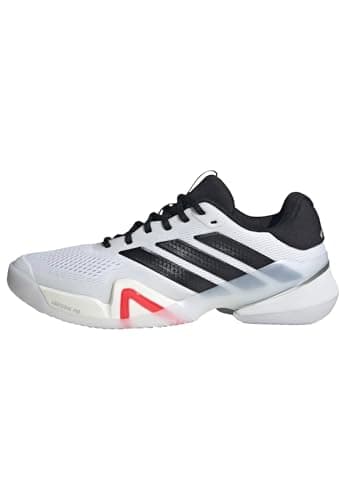
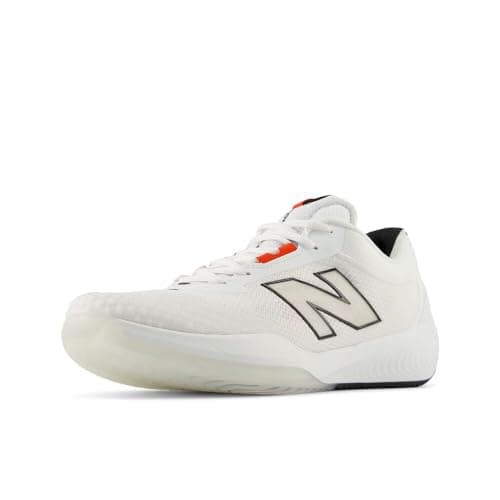
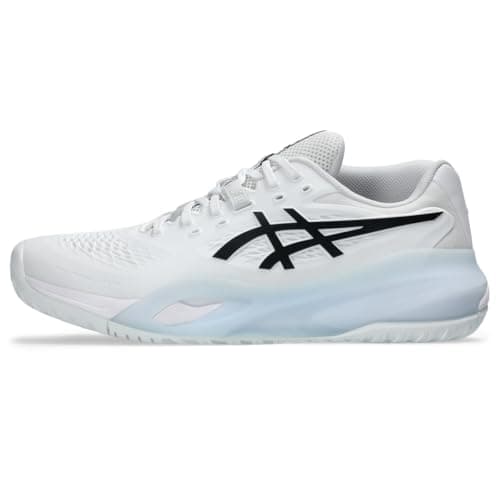
The best hard-court tennis shoe is the ASICS Gel-Resolution X: a full-length AHAR Plus outsole in a multi-directional tread with pivot points, under the most protective lateral support structure in tennis. If you drag your toe on serve, the adidas Barricade and its Adituff reinforcement will outlast it. If your feet hurt or you need a genuine wide fitting, the New Balance FuelCell 996 v6.
Hard court is a durability problem, not a grip problem
Grip is rarely the issue on a hard court. The surface is acrylic paint over asphalt or concrete, with silica sand mixed into the coating to create pace and traction. That texture is what gives a hard court its grip — and it works on rubber exactly the way a file works on a fingernail.
So the question is not “does this shoe grip?” Almost all of them do. It is “how long does the outsole survive?” and, right behind it, “how long does the midsole keep supporting me?”
The criterion: does the maker name the compound?
A shoe earns a place here by publishing something concrete about the rubber: a named compound, a stated tread geometry, or a reinforcement technology. We do not score on how a shoe “feels on concrete”, because we have not worn them, and a guide that pretends otherwise is the thing this site exists to be an alternative to.
That rule has teeth. Several shoes we rank highly on the main court shoe list are not here, not because they are bad but because their makers publish a cushioning story and say nothing about the rubber. On a question that is entirely about rubber, that silence is the answer.
Toe drag is the failure mode on hard courts
Watch any club men's match and count the players finishing the serve with the back toe scraping. It is most of them, and on an abrasive hard court the result is a hole through the medial forefoot while the rest of the shoe is barely broken in.
adidas Adituff is the best answer to this: a reinforced panel bonded over exactly the area that wears. If you have ever worn a hole in one spot, buy for that feature and it will save you a pair of shoes a year. See also tennis shoes for men, where this is ranked in detail.
Judge the midsole, not the tread
The honest replacement signal on hard courts is not a worn outsole. It is the moment the shoe stops feeling supportive on a lateral push, which means the midsole foam has compressed permanently and the support structure now sits too low to catch your foot.
That is roughly 60–100 hours of play for a performance shoe, and considerably less for a soft budget midsole under a heavier player. If you play three or more times a week, rotating two pairs meaningfully extends both, because foam needs about a day to recover.
What each maker publishes
| Shoe | Published outsole | Toe protection | Widths |
|---|
| ASICS Gel-Resolution X | Full-length AHAR Plus, multi-directional with pivot points | Standard | Standard |
| adidas Barricade | Adiwear | Adituff — best here | Standard |
| New Balance FuelCell 996 v6 | NDurance in high-wear zones | Standard | D / 2E / 4E |
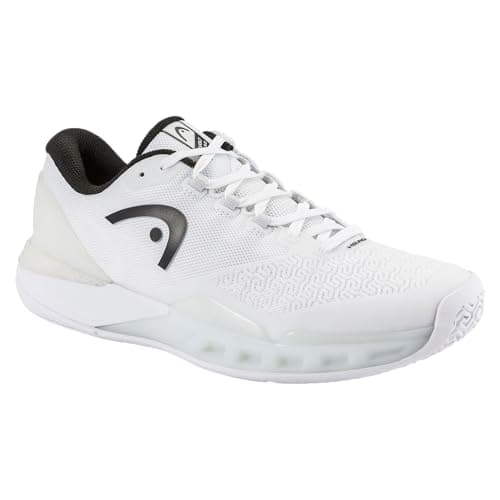
| HEAD Revolt Pro 5.0 | Michelin-tested | Standard | Standard |
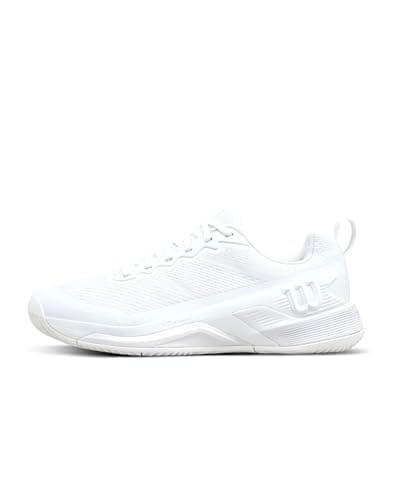
| Wilson Rush Pro 4.5 | Duralast | Standard | Standard |
Outsole warranties, and whose they are
You will see “six-month outsole guarantee” attached to several of these models. Worth being precise: that is typically a retailerwarranty — a specialist shop backing the shoe — not a manufacturer one. It is a real and useful thing, and it tells you the retailer is confident in the compound, but it comes from the shop you buy from rather than from ASICS or adidas.
Amazon does not offer it. If outsole durability insurance matters to you more than price, that is an argument for buying from a tennis specialist instead, and we would rather say so than pretend the guarantee follows the shoe.
Heavier players need more shoe
Lateral force scales with body mass, and a 200 lb player loads a midsole far harder than a 150 lb one. Soft entry-level foams compress permanently much faster under a heavier player, and once the foam has packed out the support structure sits too low to do its job.
If you are a larger player on hard courts, go to the Gel-Resolution or Barricade end of this list. The extra cost is recovered in the pair you do not have to replace.
What about all-court shoes?
“All court” is a compromise tread that works acceptably everywhere and excellently nowhere. For a player who is on hard courts most weeks and clay occasionally, it is a perfectly sensible buy. For a player who is on hard courts every week, a dedicated hard-court outsole lasts longer.
If clay is a regular part of your week, that is a genuinely different outsole and a different page — see clay court shoes.
Fit first, always
None of this matters if the shoe does not fit. Heel locked with no lift, foot sitting on the footbed rather than over its edges, a thumbnail of room in front of the longest toe. Brand lasts vary more than sizes: Babolat is narrowest, ASICS standard-to-snug, K-Swiss roomiest, New Balance the only brand with genuine 2E and 4E. Full method at how to choose tennis shoes, and the width question at tennis shoes for wide feet.