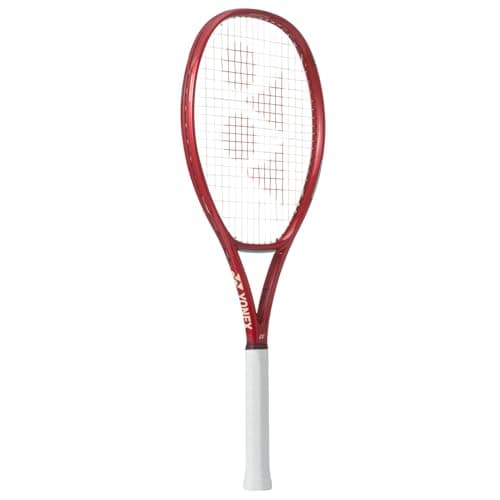
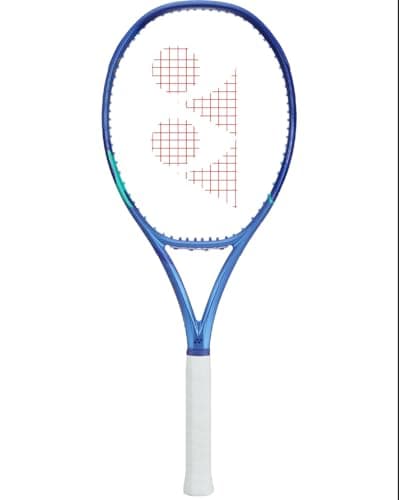
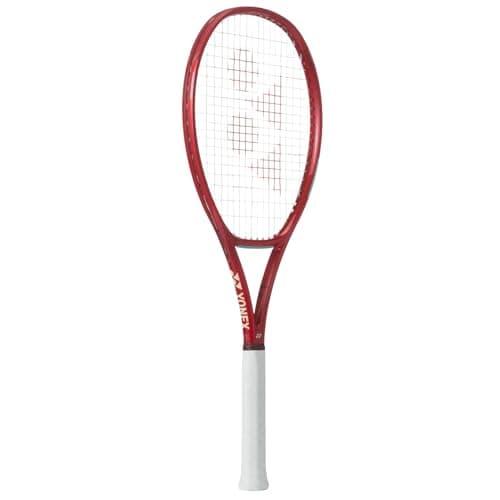
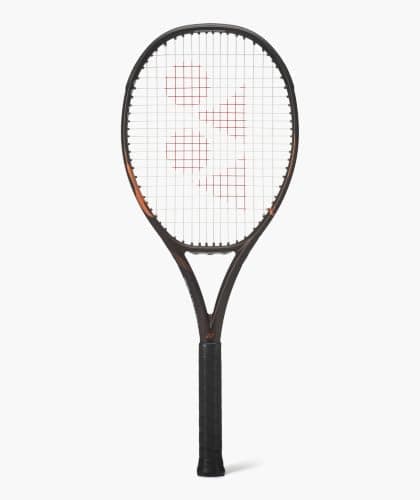
Buy the EZONE if you want the frame to do some of the work, and the VCORE if you already swing fast and want the ball to dip. In the 8th generation that is a smaller difference than Yonex's own marketing suggests: the EZONE 100 and VCORE 100 are both published at 11.2 oz / 318 g strung, both 4 points head-light, both 16x19. The two numbers that actually separate them are swingweight — 315 for the EZONE, 325 for the VCORE— and published stiffness, 68 against 65. The EZONE swings lighter and plays stiffer. The VCORE swings heavier and flexes more. For most 3.5 to 4.0 club players, the EZONE 100 is the right default.
The 98s are a stranger story, and it is the reason this page exists rather than just a sentence on a roundup. On paper the EZONE 98 and the VCORE 98 are almost the same racquet: both 11.4 oz / 323 g strung, both 6 points head-light, both published at stiffness 63, swingweight 320 against 321, both 16x19. If you were shopping those two frames from a spec sheet alone you would have nothing to go on. What differs is the geometry around the spec, and that is a real difference even though it is not a number.
What Yonex says each line is for
Start with the manufacturer's own positioning, because it is accurate as far as it goes. The EZONE is sold on power and comfort: the 8th-gen listing claims the largest sweet spot in EZONE history from an elongated frame top, that a wider beam increases the power & responsiveness by 4.8% over the previous model, and that an extended tapered inner-frame increases flex and ball-pocketing by 6.0%. The EZONE 98 is pitched at intermediate to advanced players looking for electrifying blasts of power and ultimate comfort.
The VCORE is sold on spin. The retailer spec page calls the VCORE 100 a powerful and spin-friendly weapon that gets outfitted with a new beam for 2026, and describes the 98 as using a modified “Energized” Isometric head shape with an enlarged frame top for a wider spin window. Both lines get Yonex's Isometric (squared) head and both get Vibration Dampening Mesh in the handle, which is why both are considered arm-friendly frames by the standards of the category.
So: EZONE for free depth and a forgiving face, VCORE for shaping the ball. That is the correct one-line summary and it is also where most comparisons stop. The published specs tell you something more useful.
The spec sheet, side by side
Every figure below is published by the spec sheets cited at the foot of this page, read on the day this comparison was written. We have not measured a frame and we do not have a lab.
| Published spec | EZONE 100 | VCORE 100 | EZONE 98 | VCORE 98 |
|---|
| Head size | 100 sq in | 100 sq in | 98 sq in | 98 sq in |
| Strung weight | 11.2 oz / 318 g | 11.2 oz / 318 g | 11.4 oz / 323 g | 11.4 oz / 323 g |
| Balance | 4 pts head-light | 4 pts head-light | 6 pts head-light | 6 pts head-light |
| Swingweight | 315 | 325 | 320 | 321 |
| Stiffness | 68 | 65 | 63 | 63 |
| Beam width | 24.5 / 26.5 / 23.0 mm | 24 / 26 / 23 mm | 23.8 / 24.5 / 19.5 mm | 23 / 23.5 / 22 mm |
| String pattern | 16x19 | 16x19 | 16x19 | 16x19 |
| Tension range | 45-60 lb | 45-60 lb (53 optimum) | 45-60 lb | 45-60 lb (53 optimum) |
Two things in that table are worth saying out loud, because they contradict how these frames get described in forums.
The “power” frame is the stiffer one, and the “spin” frame is the softer one. The EZONE 100 is published at 68, the VCORE 100 at 65. Stiffness is the spec most closely tied to how much shock a frame passes into your arm, so if comfort is your reason for looking at Yonex at all, the VCORE 100 is on paper the gentler of the two 100s. That is the opposite of what “EZONE is the comfort racquet” implies. Both are far softer than a Pure Drive, which is why Yonex owners tend to stay Yonex owners.
Ten points of swingweight at the same strung weight is the real difference. Identical static weight, ten points of swingweight apart, means the VCORE 100 carries its mass further from your hand. That is more plow-through on contact and more work to accelerate — which is exactly how a frame converts a fast swing into a heavy, dipping ball, and exactly how it punishes a slow or late one. If you have not read what swingweight actually measures, that page is the single most useful background for this decision.
The 100s: EZONE 100 vs VCORE 100
This is the comparison most people searching for “EZONE vs VCORE” are actually making, because the 100 sq in frames are the mainstream models in both lines.
Buy the EZONE 100 if you want a frame that gives depth back when your swing is not perfect. The lower swingweight makes it the easier racquet to get through the ball late in a third set, the wider 26.5 mm throat section is doing the power work, and the elongated-top Isometric head is a genuinely forgiving face on the off-center ball. This is the Yonex we would put in a 3.5 or 4.0 player's hand by default, and it is the one that sits on our intermediate racquet ranking.
Buy the VCORE 100 if you brush up on the ball and your misses are long rather than short. The extra ten points of swingweight give you something to swing against, the published stiffness is three points lower, and the spin-oriented frame geometry is the whole point of the line. The retailer's own description — a stable ride, while still offering enough all-court speed to attack the net— is a fair characterization of a mid-320s swingweight: stable, not quick.
Honest cons on both. Yonex discounts almost nothing, so both frames sit at the top of the price range we see on this site — the live table above will tell you today's number, and the gap between the two is usually small enough that price should not decide this. The EZONE's damped feel reads as muted if you are coming off a crisp HEAD or Wilson; several players describe it as losing string-bed feedback. The VCORE asks for racquet-head speed you may not have, and a 325 swingweight in the hand of a flat hitter is just a heavy control frame with an unusual beam.
The 98s: nearly the same racquet on paper
Here is where a spec sheet stops helping. Same strung weight, same balance, same stiffness, one point of swingweight apart, same pattern. If you asked us to separate the EZONE 98 and VCORE 98 from numbers alone, we could not do it honestly.
What does differ is the beam. The EZONE 98 is published at 23.8 / 24.5 / 19.5 mm— note the 19.5 mm section, which is unusually thin and is where the EZONE's ball-pocketing claim comes from. The VCORE 98 is a more even 23 / 23.5 / 22 mmbox. In practice that makes the EZONE 98 the frame that bends and holds the ball slightly longer, and the VCORE 98 the one that feels more uniform through contact — the spec page's phrase for the 98 against the 100 is a more precise and predictable response.
Our read, stated as a judgment rather than a measurement: at 98 sq in the choice is a feel preference, not a performance gap, and you should pick on the swing you already have. The EZONE 98 is the better frame for a player who wants the comfort package with some free depth — it is the frame we rank on 98 vs 100 head size. The VCORE 98 is the better frame for an advanced spin player, and it is the one on best racquets for advanced players.
The decision that matters more than EZONE vs VCORE
Head size. The gap between a 98 and a 100 in the same line is larger than the gap between the two lines at the same head size — 5 g of strung weight, two points of balance, and a smaller face to find. A 3.5 player on a 98 because a 4.5 recommended it will mishit more and enjoy tennis less, whichever badge is on the throat.
So answer the head size first, then pick the line. If you are between them, the 100 is the safer answer for anyone under about 4.5, and the EZONE 100 is the safest answer of the four frames on this page. If the arm is your reason for shopping at all, read arm-friendly racquets before you spend this much — and note the useful comparison next door, where Wilson Clash vs Blade shows an eight-point published flex gap between two frames sold to the same player. Yonex's two lines are three points apart. Wilson's are eight.
One more piece of context, because a lot of players arrive at this comparison from a Wilson. Both frames here are among the closest spec matches to the Blade 98 on the market, and the Blade alternatives page lines them up against it directly — head size, strung weight, swingweight and stiffness — if that is the switch you are actually weighing.
Which one, in one line each
| If you are | Buy | Because |
|---|
| A 3.5-4.0 who wants a forgiving, comfortable frame | EZONE 100 | Lowest swingweight of the four, biggest effective face, free depth |
| A 4.0+ whose misses go long | VCORE 100 | Spin geometry plus 325 swingweight to swing against |
| An advanced player who wants comfort in a 98 | EZONE 98 | Stiffness 63 with the thin 19.5 mm section for ball-pocketing |
| An advanced spin player who wants a smaller face | VCORE 98 | Energized Isometric head, even box beam, predictable response |
| Coming back from elbow trouble | Neither, yet | Fix string and tension first — it is far cheaper than a frame |
Demo before you buy, and what to look for
These are expensive frames and the differences between them are small enough that a demo settles it in twenty minutes. Three things to check, in order:
1. Can you still swing it at the end of a set? This is the swingweight question and it is the one that matters. If your last few forehands are landing short, the VCORE 100 is too much frame today.
2. Where do your misses go? Long misses mean you want more spin and a lower launch — the VCORE direction. Short misses mean you want free depth — the EZONE direction. This is more reliable than asking yourself which one “feels” better in the first ten minutes, because the first ten minutes always favor the more powerful frame.
3. How does your arm feel the next morning? Both of these frames carry Vibration Dampening Mesh and both are softer than most of the category, but published stiffness is a frame property and your elbow is the only instrument that matters.
String the two lines differently
A spin frame and a power frame want different string beds, and this is where club players waste the money they spent on the racquet.
On a VCORE, a shaped or textured polyester at the lower end of the 45-60 lb published range plays to the frame's strength: the mains move and snap back, the ball dips. On an EZONE, a full bed of stiff poly can make an already stiff frame feel harsh — the 100 is published at 68 — so a multifilament, a softer poly, or a hybrid setup is usually the better pairing. Our tension reasoning is on the tension guide, and strings for spin ranks the shaped polys.
Both frames ship unstrung in most listings, so the price you see is not the price to play: add a string job. What that costs is on what restringing costs.
What about the Percept?
Fair question, since it is the third Yonex line and it shows up in the same autocomplete. The Percept is the control line — the replacement for the old VCORE Pro — and it is a 4.5-and-up frame rather than a club-player default. We rank the Percept 97 on tour-spec racquets. If you are choosing between EZONE, VCORE and Percept, the short version is: Percept if you take pace off the ball and redirect it, VCORE if you shape it, EZONE if you want help.
What we did not do
We have not hit with these four frames back to back, and nothing above is presented as a play test. Every spec is quoted from the published spec sheets cited below, read on the day this page was written; the judgments about who each frame suits are ours, made against the rubric on methodology. Where a figure differs between retailers — and Yonex swingweights do vary a point or two by source — we quote the sheet we cite rather than averaging numbers we cannot verify.