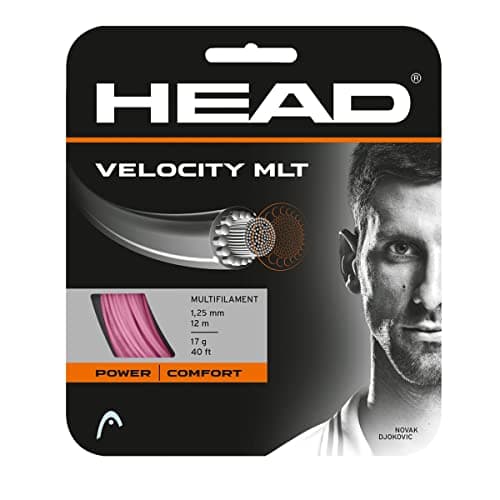
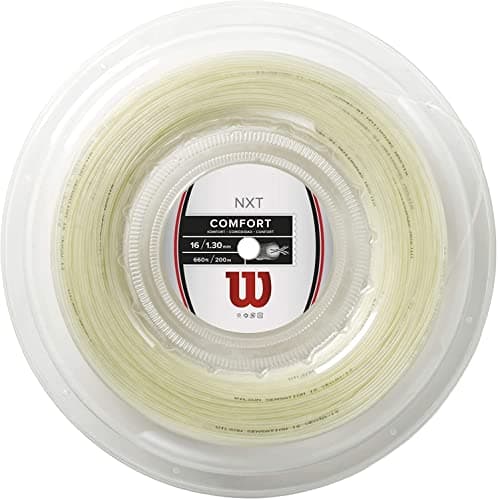
If you have tennis elbow, the first thing to change is your string — not your racquet. Switch from polyester to a multifilament such as Wilson NXT or HEAD Velocity MLT, and drop the tension four to six pounds. That is the cheapest and most effective intervention available, and for a large share of club players it is sufficient on its own.
Why polyester is usually the culprit
Polyester is a stiff monofilament. It has very little elasticity, so when the ball hits the string bed, the string stretches barely at all and most of the impact energy has to go somewhere else — into the frame, and then into your arm.
A multifilament does the opposite. Thousands of fibres in a flexible matrix stretch substantially on impact, absorbing energy and returning it over a longer, gentler period. The ball stays on the string bed fractionally longer and the peak force your arm sees is lower.
The injury pathway in club tennis is almost always the same combination: a stiff frame, a full polyester bed, high tension, and a player whose technique is efficient enough to swing hard but not efficient enough to do it cleanly. Remove any one of those and the risk drops. The string is by far the cheapest one to remove.
The order to change things
1. String type. Poly to multifilament. Costs one restring. Biggest single effect.
2. Tension. Drop four to six pounds. Costs nothing extra if you are restringing anyway. A looser bed deforms more and transmits less.
3. Grip size. A grip that is too small forces you to squeeze, and sustained gripping loads the same extensor tendons. Check it against our grip size guide; building up costs the price of an overgrip.
4. The frame. Last, because it is by far the most expensive. If you have done the first three and it still hurts, see arm-friendly racquets— the published RA stiffness figure is the number to compare.
What about the hybrid?
The honest middle path for a player who genuinely needs polyester's control but cannot tolerate a full bed of it: poly in the mains, multifilament in the crosses.
You keep the snapback that generates spin, because that happens in the mains. You get a meaningful share of the comfort, because the crosses do a lot of the energy absorption. For a 4.0–4.5 with mild arm sensitivity this is very often the right answer, and it costs no more than a normal restring.
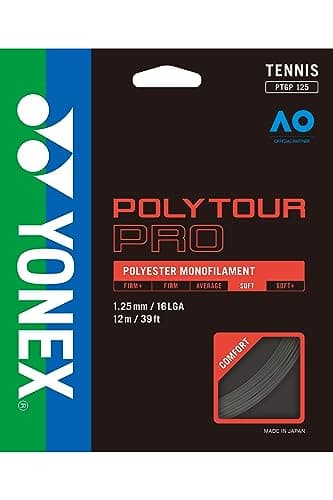
A softer polyester helps too. Yonex Poly Tour Pro is silicone-infused and genuinely gentler than ALU Power or RPM Blast, which is why it is the one poly on this page.
This is not medical advice
We can tell you which strings are published as softer materials and why the physics favours them. We cannot diagnose you. Persistent elbow pain warrants a physiotherapist, and the actual treatment is load management and progressive strengthening. A string change stops you re-injuring yourself twice a week; it is not a cure.
Arm-friendly strings compared
| String | Type | Comfort | Trade-off |
|---|
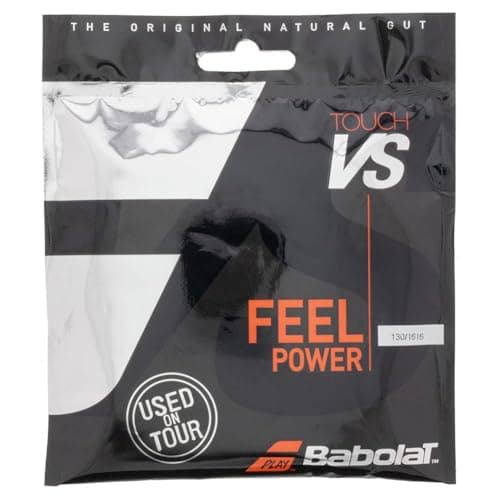
| Babolat VS Touch Natural Gut | Natural gut | Highest available | Price; damaged by moisture |
| Wilson NXT 16 | Multifilament | Very high | Breaks fast under spin; sold as a reel |
| HEAD Velocity MLT 17 | Multifilament | High | Least durable here |
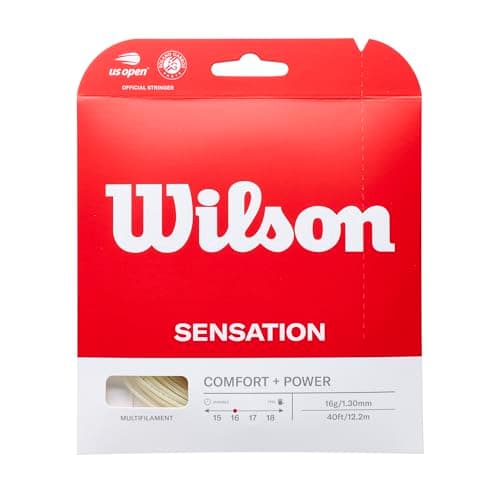
| Wilson Sensation 16 | Multifilament | High | Low control at high swing speed |
| Yonex Poly Tour Pro 125 | Soft polyester | Moderate — best poly option | Still a poly; less comfortable than any multi |
Tension, specifically
The published range on a modern frame is typically something like 46–55 lb. If your elbow hurts, string toward the bottom of it.
You will gain a little power and lose a little control, and if that sends balls long, the answer is a lower-powered frame or a slightly thicker gauge — not going back up in tension. A tight string bed is a stiff string bed, and stiffness is the thing you are trying to remove.
One note specific to poly: if you are staying with polyester despite everything, string it two to four pounds lower again, because it plays considerably tighter than the number on the machine suggests. The tension guide explains why.
Restring more often, not less
Counterintuitive if you are trying to save money, but important. Strings stiffen as they lose elasticity, so an old string bed is a harsher string bed — particularly polyester, which goes dead long before it breaks.
Playing on a six-month-old poly bed because it has not snapped yet is one of the most reliable ways to aggravate an elbow. See how often to restring.
Durability, and the real cost
Multifilament breaks sooner than polyester, especially if you hit heavy spin. That is the genuine cost of this switch and there is no way around it: you will restring more often.
If you are a frequent breaker, a reel of NXT brings the per-job cost down to something comparable with buying poly sets, which is the practical reason the reel is our top pick rather than the set. And the alternative — a season lost to an elbow — costs more than any amount of string.
What will not help
A vibration dampener. It reduces the string-bed buzz you hear, not the frame vibration that loads the tendon. Buy one if the ping annoys you; do not buy one as treatment. A counterforce bracegenuinely does shift load off the tendon attachment, but it manages the symptom rather than removing the cause — which, on this page, is almost certainly the string.