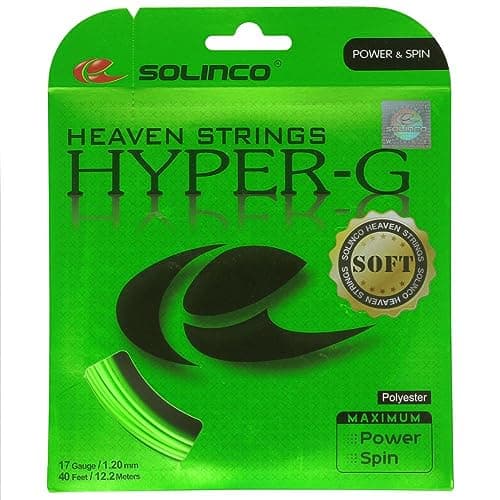
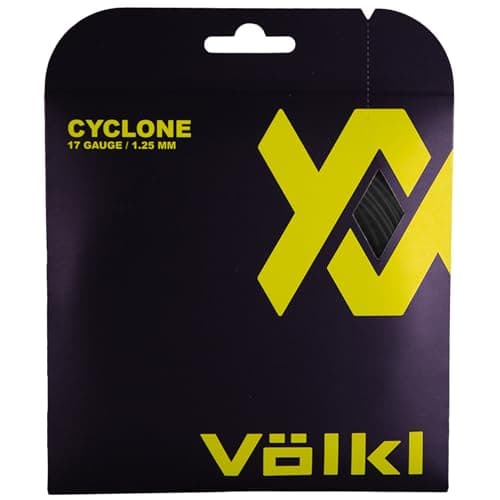
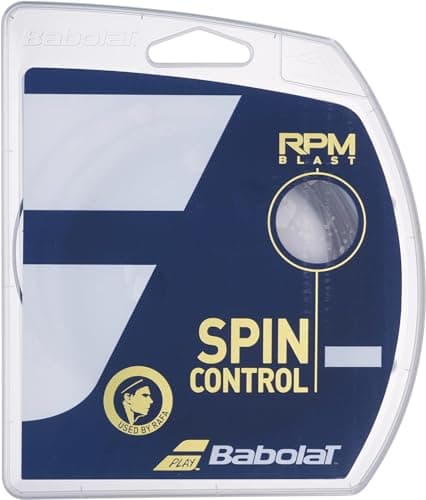
The best spin string is Babolat RPM Blast — an octagonal co-polyester whose edges bite the ball and whose snapback is the best here. If you want nearly all of that for substantially less, Solinco Hyper-G Soft. If you want to try a shaped poly for the price of a sandwich, Volkl Cyclone.
How a string generates spin
Not the way most people assume. Spin is not created by the string “gripping” the ball in a simple sense. The mechanism is snapback.
When you brush up the back of the ball, the main strings are dragged sideways out of their resting position. Because polyester is slick and low-friction against itself, those mains slide rather than locking against the crosses. Then, while the ball is still on the string bed, they snap back to their original position — and in doing so they drag the ball surface with them, adding rotation.
This is why polyester outspins multifilament despite being stiffer and apparently less grippy. A multifilament's rough surface locks the mains in place; they never slide, so they never snap back.
Why shaped profiles work
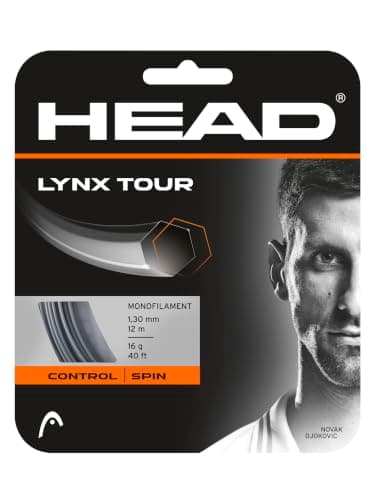
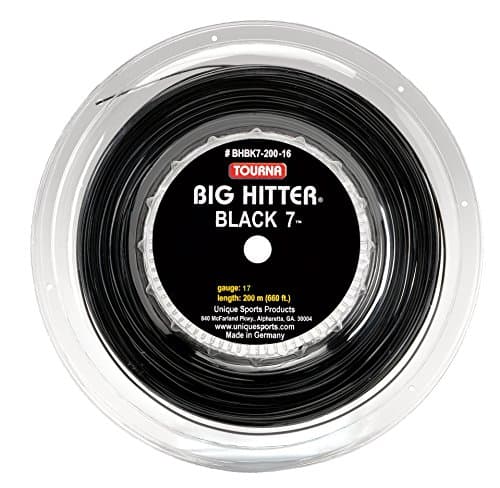
Round string snaps back. Shaped string snaps back and presents edges to the ball. The RPM Blast is octagonal, the Lynx Tour hexagonal, Hyper-G square-profiled, Cyclone gear-shaped, and Big Hitter Black 7 has seven sides.
Those edges add a mechanical bite on top of the snapback effect. The trade is wear: edges saw against the crosses, so shaped strings notch and die faster than round ones at the same gauge.
Gauge matters as much as shape
A thinner string bites deeper into the ball and moves more freely, so it both grips and snaps back better. Going from 16g to 17g is a real spin increase in the same string; going to 18g is more again.
The cost is obvious: thinner breaks sooner. For a spin player this often works out anyway, because you will replace a dead poly before you break it — so the durability you gave up was durability you were not going to use.
The uncomfortable truth about spin strings
Every string here is a polyester, and polyester is stiff. If you are chasing spin and you have any arm history, you are chasing it into the most common injury in club tennis. The mitigation is a hybrid — poly mains for the snapback, multifilament crosses for comfort — which keeps most of the spin and removes much of the shock. See strings for tennis elbow.
The five, by profile
| String | Profile | Gauge | Format |
|---|
| Babolat RPM Blast | Octagonal | 17g / 1.25 mm | Set |
| Solinco Hyper-G Soft | Square | 17g / 1.20 mm | Set |
| HEAD Lynx Tour | Hexagonal | 17g / 1.25 mm | Set |
| Volkl Cyclone | Gear-shaped | 17g / 1.25 mm | Set |
| Tourna Big Hitter Black 7 | 7-sided | 17g | Reel |
More sides is not straightforwardly better. Seven edges bite harder and notch the crosses faster; an octagon is closer to round, which keeps snapback cleaner for longer. The genuine differences between these five are smaller than the marketing suggests.
String spin is downstream of swing path
The thing nobody selling string will tell you: if your swing path is flat, no string on this page will give you topspin. Snapback requires the mains to be dragged sideways, which requires you to be brushing up the back of the ball. A flat drive barely moves them.
If you are buying a spin string to acquire spin rather than to amplify it, the money is better spent on the swing. A topspin training aid that mechanically constrains the racquet path does more for a flat hitter than any restring will.
Your frame is half the equation
Spin potential is a property of the whole setup. An open 16x19 pattern lets the mains move; a dense 18x20 restricts them, and a shaped poly in an 18x20 is largely wasted money.
Frame geometry matters too — the Babolat Pure Aero's aerodynamic beam exists to increase racquet-head speed, which is the other input to spin. If spin is your priority, pair a shaped poly with a 16x19 frame built for it; see intermediate racquets.
Tension, for spin
Lower tension generally increases spin, because looser mains move and snap back more freely. The old advice to string tight for control is largely a pre-polyester idea.
Most players using a shaped poly are best served two to four pounds below the middle of the frame's published range. It also reduces the stiffness of the string bed, which helps the arm. See the tension guide.
Replace it before it breaks
Polyester loses tension and elasticity fast, and a dead poly has lost exactly the snapback you bought it for. A spin string that has gone stiff and notched is giving you the comfort penalty with none of the benefit.
If you can see deep notching where the mains cross, it is already past it — regardless of whether it has broken.
How we picked
We have not physically tested this gear
Everyone in this category says they tested twenty racquets. We have not tested any — and we say so. What we did instead: compiled the manufacturer-published specifications (head size, strung weight, string pattern, stiffness, outsole compound), normalized them, and scored each product against a published rubric weighted for the NTRP tier this page serves. The scores are judgments from documented research, not measurements we took, because we do not have a lab and are not going to pretend we do.