Skip to content
Four Oh Club

Know your level · Guides

How to Practice Tennis Alone

Three of the four most valuable things you can practice in tennis need nobody else. Here they are, in order of how much they improve your actual match play.

By Stephen V.Updated How we score
#ad

We earn a commission when you buy through our Amazon links, at no extra cost to you. It never changes our rankings, and we say so when the cheaper racquet is the better buy. How this works.

The best way to practice tennis alone, for free, is to take a basket of balls to a court and hit serves — it is the only shot in tennis nobody else is involved in, it is roughly a quarter of the points you play, and it is the shot club players practice least. After that: rally against a wall for timing and footwork, and shadow-swing at home for technique. If you want to buy something, buy a hopper and a case of balls first (around $75 together), a rebound net second, and a ball machine only once you know you have court time to use it.

The frustrating part of club tennis is that improving seems to require another person, and another person is the one thing you cannot schedule. The good news is that this is mostly false. Here is the honest ranking of what you can do alone, by how much it moves your actual match results.

1. Serve practice (free, highest value)

If you do one thing on this page, do this one. Serving is the only stroke in tennis that is entirely yours: no opponent, no feed, no timing to match. And it is roughly a quarter of every point you play, which makes it the highest-leverage shot in the sport for a club player.

What you need: a court, and enough balls that you are not walking after every four. That is the whole list. Fifty to a hundred balls is the practical number, which is two to four cases.

How to structure it so it is not just hitting. Serve in sets of ten to one specific target — the deuce-court T, then the ad-court body, then the deuce-court wide — and count how many land in. Writing down 6/10 and then 8/10 next week is what turns hitting serves into practicing serves. Alternate first and second serves in the same set so you are also practicing the decision, not just the motion.

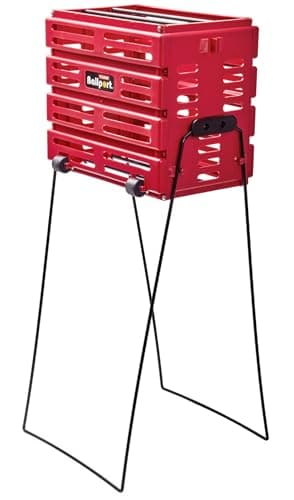
The one piece of gear that changes this. A hopper, which is the wire basket on legs. Without one you bend down a hundred times per session and pick balls up by hand, which is genuinely why people stop doing this. The Tourna Ballport Deluxe collects by being pressed over the balls and then stands upright and opens into a stand you can feed from. Buy it with a case of practice balls and you have a complete solo serve setup for well under $100. Alternatives in the ball hopper ranking and the ball ranking.

2. The wall (free, and underrated)

A practice wall, a backboard, or the side of a handball court. Free, available, and the best groundstroke practice you can get without a person.

What the wall is genuinely good at is timing and recovery, because it gives the ball back instantly and relentlessly. There is no time to admire your shot. You hit, recover, and hit again, which is precisely the habit that most club players lack.

Three drills worth doing properly rather than just bashing:

Count-to-twenty. Twenty consecutive forehands without a miss, then twenty backhands. Simple, measurable, and it exposes which side falls apart under repetition.

Alternating sides. Forehand, backhand, forehand, backhand, which forces the footwork and the grip change you will actually need in a rally.

Volley drill. Stand close, keep the ball up with short punched volleys. Nothing improves hands at the net faster, and nothing is more awkward to practice with a partner who has to feed you.

The honest limitation. A wall gives the ball back flat, fast and with no spin, and it comes back sooner than a real ball would. Practice only against a wall for a season and you will train yourself to take the ball earlier and flatter than a real opponent requires. It is a complement to court time, not a substitute.

3. Shadow swings and footwork (free, at home)

This is the "practice tennis alone at home" answer, and it is more useful than it sounds, because technique is a motor pattern and motor patterns are built by repetition without consequence.

Shadow swinging. Full strokes, no ball, in front of a mirror or a window where you can see your reflection. Ten minutes of slow, correct forehands is better practice than an hour of fast ones with a flaw in them, because you are not distracted by where the ball went. Watch one thing at a time: the unit turn, the contact point out in front, the finish.

Serve motion without a ball. Same logic, and the serve is the stroke where it works best, because the whole motion is self-generated. You can do this in a garden or a garage.

Footwork: split step and recovery steps. Side-to-side shuffles, split steps on a count, and the recovery step back toward the middle. Unglamorous, and it is the thing that decides whether you arrive at the ball in a position to hit it.

Ball on racquet. Bounce the ball on the strings, upward and downward, alternating faces. Genuinely builds racquet-face awareness, which is the thing you are using when you have to improvise a shot.

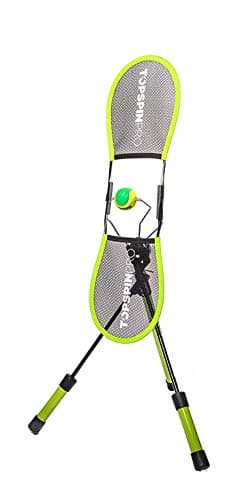
If you want a device for home technique work, the TopSpin Pro is the one that is a real coaching tool rather than a gadget: it physically constrains the racquet path so you cannot brush the ball the wrong way, which is useful for learning topspin. It is reviewed alongside the others in the training aid ranking.

4. A rebound net (around $100, the best middle option)

A rebound net is a frame with an angled elastic net that returns the ball to you. It is the step between a wall and a ball machine, and it has one real advantage over a wall: it gives the ball back with an arc rather than flat and fast, so the contact point you practice is closer to the one you will face.

It is also portable and it works on a driveway, which is the practical difference. A wall requires finding a wall. More in the training aid ranking.

Honest limits: the return is shorter and softer than a real ball, so it is timing and repetition practice rather than rally practice.

5. A ball machine ($700+, the real answer if you have court time)

A ball machine is the only option on this page that genuinely replaces a hitting partner. It feeds a consistent ball to a chosen spot at a chosen pace, which means you can hit two hundred backhands to the same place, which is how a stroke actually changes.

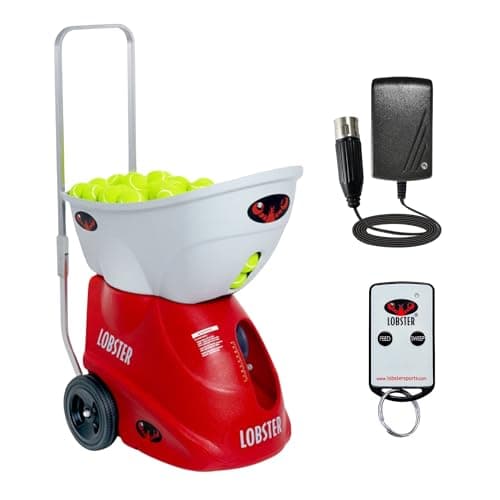
The Lobster Elite Liberty is the entry point into real machines — battery powered, oscillating, and portable enough for one person to get out of a car. The full range, from cheap to serious, is in the ball machine ranking — or the single lightest one, looked at on its own specs, in the TENNIIX review — with a budget page if the number is the problem.

Two things to check before you spend this, because they are the reasons machines end up in garages:

Court access. You need a court you can have to yourself for an hour. Public courts with a queue do not work, and many clubs restrict machines or require a booking. Check this first.

Balls and transport. A machine needs 100–150 balls to be worth setting up, plus a hopper to reload it, plus the ability to move 40-odd pounds of machine from a car to a court. Budget those alongside it.

If either is a problem, buy the hopper, the balls and a rebound net instead. You will use them.

A weekly solo plan that actually works

Session one, on court, 45 minutes: ten minutes of serve warm-up, then 80 to 100 serves in counted sets of ten to specific targets. Log the numbers.

Session two, at a wall, 30 minutes: count-to-twenty forehands and backhands, then alternating sides, then five minutes of close volleys.

Daily, at home, 10 minutes: shadow swings on one specific thing you are working on, plus split steps and recovery steps.

That is roughly two hours a week, it costs the price of a hopper and some balls, and it will move your level more than an extra social doubles match. If you want to know what moving a level actually looks like, read what a 4.0 tennis player does and the NTRP ratings explained.

If you are practicing alone because you have only just started rather than because you cannot find a partner, the tennis beginner's guide puts this in order — what to buy first, the two grips to learn, and what to work on in the first three months.

If the conclusion you are reaching is that you want a machine, two pages answer the next two questions. Are ball machines worth it does the cost-per-session arithmetic against a lesson and lists the cheaper things to try first, and the advanced-player machines are the ones to look at if you are 4.5 or above and a one-spot feed is no longer useful to you.
The short answer

Quick picks

#Racquet / gearBest forScorePrice
01
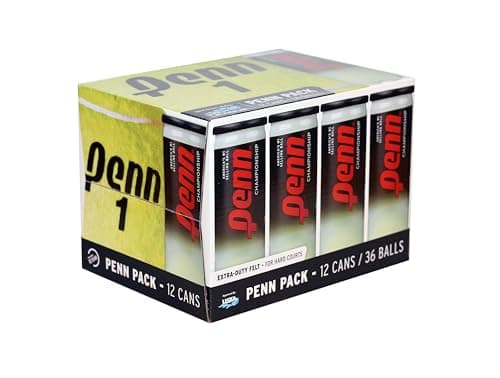
Penn Penn Championship Extra Duty (12 cans)
Penn Championship Extra Duty (12 cans)

The most-played ball in America, bought the way you should buy balls — by the case. Extra duty felt for hard courts.

Hard-court club play
8.2
$34.97Amazon
02
Tourna Tourna Ballport Deluxe (wheeled)
Tourna Ballport Deluxe (wheeled)

The hopper with wheels and a handle — the upgrade that matters if you are the one pushing it around the court all session.

Coaches and long sessions
8.8
$43.95Amazon
03
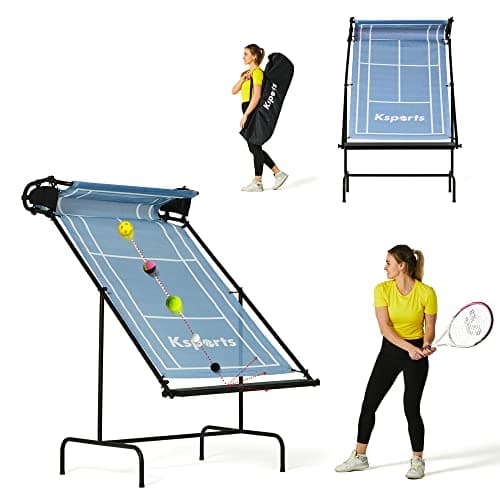
Ksports Ksports Tennis Rebounder Net
Ksports Tennis Rebounder Net

A real hitting wall you can put up anywhere. The closest thing to a practice partner that fits in a carry bag.

Solo rally practice
7.8
$189.00Amazon
04
TopspinPro TopspinPro Training Aid
TopspinPro Training Aid

The most targeted training aid here: a frame that physically forces the low-to-high brushing path that makes topspin, in a space the size of a doormat.

Learning topspin
7.8
$169.00Amazon
05
Lobster Sports Lobster Sports Elite Liberty
Lobster Sports Elite Liberty

The ball machine to buy. Battery powered, genuinely portable, with oscillation and spin — the cheapest machine that is not a compromise.

Most club players
8.4
$1,179.00Amazon

#ad · Live prices from the Amazon Product API, as of October 20, 2026. Where we have no verified live price, we show none — we would rather leave a gap than print a number that has rotted.

In detail

The picks, in full

01
Penn Penn Championship Extra Duty (12 cans)

Hard-court club play

Penn Championship Extra Duty (12 cans)

Extra duty felt12 cans / 36 ballsPressurizedUSTA approved
8.2/10

The most-played ball in America, bought the way you should buy balls — by the case. Extra duty felt for hard courts.

Durability
8
Consistency
8
Feel
7
Visibility
8
Value
10

Pros

  • Extra duty felt is woven thicker specifically for abrasive hard courts — a regular duty ball fluffs up and dies in a set
  • Buying by the case is substantially cheaper per can than singles
  • The default club ball in the US, so it is the ball you will play matches with anyway

Cons

  • Pressurized balls go dead whether you use them or not once the can is open
  • Extra duty felt is the wrong choice on clay, where it picks up and holds the surface

Don't buy this if…

…you play on clay or indoor carpet. Buy regular duty felt instead.

$34.97View on Amazon

Price as of October 20, 2026. Prices change — Amazon's is the one that counts.

#ad · we may earn a commission from this link to Penn Championship Extra Duty (12 cans)

02
Tourna Tourna Ballport Deluxe (wheeled)

Coaches and long sessions

Tourna Ballport Deluxe (wheeled)

Wheeled baseTelescoping handlePress-down pickupFolding legs
8.8/10

The hopper with wheels and a handle — the upgrade that matters if you are the one pushing it around the court all session.

Capacity
8
Build
8
Ease of use
10
Portability
9
Value
9

Pros

  • Wheels and a pull handle turn a heavy carry into a walk, which changes how long you can keep feeding
  • Same press-down pickup mechanism as the standard Ballport
  • Still folds down to stand at feeding height

Cons

  • The wheels and handle add bulk in a car boot
  • More moving parts than the plain hopper, so more to eventually break

Don't buy this if…

…you feed from one spot and never move the hopper. The standard Ballport is cheaper and simpler.

$43.95View on Amazon

Price as of October 20, 2026. Prices change — Amazon's is the one that counts.

#ad · we may earn a commission from this link to Tourna Ballport Deluxe (wheeled)

03
Ksports Ksports Tennis Rebounder Net

Solo rally practice

Ksports Tennis Rebounder Net

Portable rebound netQuick assemblyCarry bag includedMulti-sport
7.8/10

A real hitting wall you can put up anywhere. The closest thing to a practice partner that fits in a carry bag.

Effectiveness
8
Build
7
Ease of use
8
Portability
8
Value
8

Pros

  • Returns a live ball you have to move to, which is the thing a tethered trainer cannot do
  • Assembles in minutes and packs into a carry bag, so it works in a driveway or a park
  • Adjustable tension changes how fast the ball comes back

Cons

  • Needs a flat surface and space behind you — not a small-garden item
  • The rebound is flatter and faster than a real rally ball

Don't buy this if…

…you have a real wall at your club. A brick wall is better and free.

$189.00View on Amazon

Price as of October 20, 2026. Prices change — Amazon's is the one that counts.

#ad · we may earn a commission from this link to Ksports Tennis Rebounder Net

04
TopspinPro TopspinPro Training Aid

Learning topspin

TopspinPro Training Aid

Topspin swing-path trainerPortable frameIndoor/outdoor useNo court needed
7.8/10

The most targeted training aid here: a frame that physically forces the low-to-high brushing path that makes topspin, in a space the size of a doormat.

Effectiveness
9
Build
8
Ease of use
8
Portability
8
Value
6

Pros

  • Mechanically constrains the racquet path so you cannot swing flat — you learn the feel rather than being told about it
  • Works in a garage, garden or hallway, which means daily reps rather than weekly ones
  • Solves one specific, very common problem rather than being a general gadget

Cons

  • Expensive for a training aid that does exactly one thing
  • Once topspin is grooved, it has nothing left to teach you

Don't buy this if…

…you already hit with topspin. There is no second use for it.

$169.00View on Amazon

Price as of October 20, 2026. Prices change — Amazon's is the one that counts.

#ad · we may earn a commission from this link to TopspinPro Training Aid

05
Lobster Sports Lobster Sports Elite Liberty

Most club players

Lobster Sports Elite Liberty

Battery, 2-4 hr runtimeRandom horizontal oscillationTopspin/backspin~35 lb
8.4/10

The ball machine to buy. Battery powered, genuinely portable, with oscillation and spin — the cheapest machine that is not a compromise.

Portability
9
Features
7
Build
9
Ease of use
9
Value
8

Pros

  • Battery operation and large wheels mean one person can actually get it onto a public court — the thing that decides whether a machine gets used
  • Random horizontal oscillation makes you move, which is the entire reason to own a machine rather than a basket
  • Adjustable topspin and backspin, not just a feed

Cons

  • Horizontal oscillation only — no vertical, so every ball arrives at the same depth
  • Four figures. This is the most expensive thing on the site

Don't buy this if…

…you want varied depth as well as width. Step up to the Elite Two for vertical oscillation.

$1,179.00View on Amazon

Price as of October 20, 2026. Prices change — Amazon's is the one that counts.

#ad · we may earn a commission from this link to Lobster Sports Elite Liberty

How we picked

We have not physically tested this gear

Everyone in this category says they tested twenty racquets. We have not tested any — and we say so. What we did instead: compiled the manufacturer-published specifications (head size, strung weight, string pattern, stiffness, outsole compound), normalized them, and scored each product against a published rubric weighted for the NTRP tier this page serves. The scores are judgments from documented research, not measurements we took, because we do not have a lab and are not going to pretend we do.

Questions

Frequently asked

What is the best way to practice tennis alone?
Take a basket of balls to a court and practice serves. It is the only stroke that involves nobody else, it is about a quarter of every point you play, and it is the shot club players practice least. Serve in counted sets of ten to specific targets and write down how many land in — that is what turns hitting into practicing.
How can I practice tennis alone at home?
Shadow swings in front of a mirror (full strokes, no ball, watching one thing at a time), the serve motion without a ball, split steps and recovery footwork, and bouncing the ball on the strings to build racquet-face awareness. Ten minutes a day of slow correct repetitions beats an hour of fast ones with a flaw in them.
Is hitting against a wall good tennis practice?
Yes, particularly for timing and recovery, because the ball comes back instantly and you have no time to admire your shot. The limitation is that a wall returns the ball flat, fast and spinless and sooner than a real ball would, so training only on a wall teaches you to take the ball earlier and flatter than an opponent requires.
Is a tennis ball machine worth it for practicing alone?
It is the only option that genuinely replaces a hitting partner, because it feeds a consistent ball to the same spot so you can hit two hundred of the same shot. Check two things first: that you have a court you can book alone, and that you can budget 100 to 150 balls and a hopper alongside the machine.
What should I buy first to practice tennis alone?
A ball hopper and a case of practice balls, for well under $100 together. Without a hopper you bend down a hundred times a session to pick balls up, which is the actual reason people stop practicing serves. A rebound net is the next step; a ball machine only once court access is sorted.

Keep reading

Receipts

Sources

We do not run a testing lab, and we do not pretend to. Our specs come from manufacturer listings and spec sheets; our rules and dimensions come from the official rulebook. Where we could not verify something, we say so on the page rather than quietly leaving it out. Read our full method.