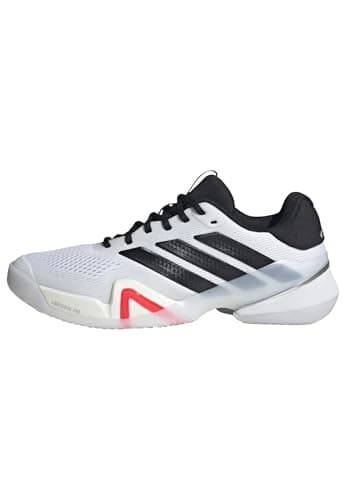
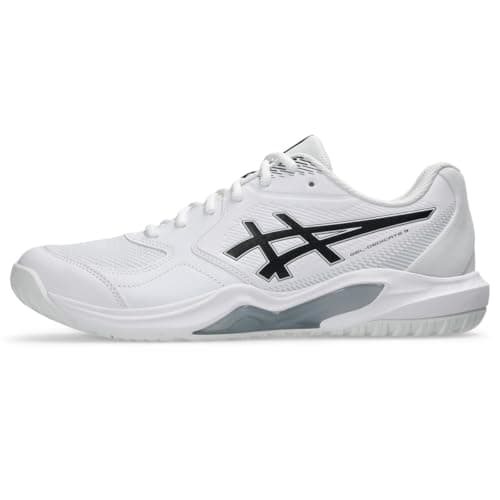
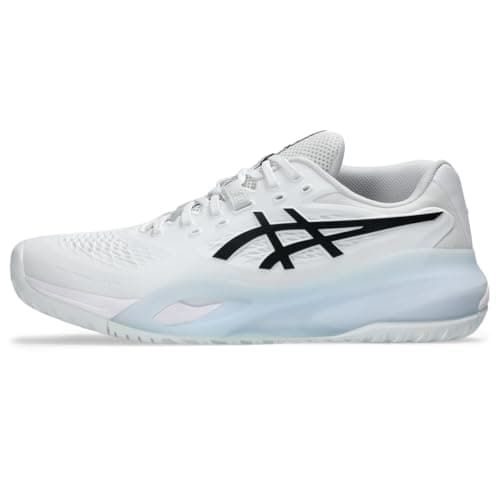
Do not play tennis in running shoes. A running shoe is built to move you forward and is deliberately soft and flexible through the sides; tennis asks you to stop and change direction sideways, which is the exact load a running shoe has no structure for. The cheapest fix is a real court shoe such as the ASICS Gel-Dedicate 9 or the adidas Gamecourt 3; the benchmark is the ASICS Gel-Resolution X. Running in court shoes is less dangerous but still wrong — they are heavier, stiffer and far less cushioned front to back.
One clarification before anything else, because this query is two different questions depending on who is asking. In American English "tennis shoes" often just means sneakers — any casual athletic shoe. This page is about actual tennis court shoes: shoes with a court outsole, a reinforced lateral chassis and a tennis last. If you are shopping for something to walk the dog in, nothing here applies. If you are about to step onto a court, all of it does.
The four structural differences
These are not marketing distinctions. They are visible if you put the two shoes next to each other on a table.
1. The outsole pattern and rubber compound. A running outsole is tuned for forward grip and wear in a straight line, with soft blown rubber under the forefoot and often a cut-out through the middle to save weight. A tennis outsole is a dense, abrasion-rated compound laid out in a multi-directional pattern — herringbone for clay, a modified tread with pivot points for hard courts. The ASICS Gel-Resolution X publishes a full-length AHAR Plus rubber outsole in a multi-directional tread; adidas publishes an Adiwear outsole on the Barricade. Full-length matters: a running shoe with a hollow midfoot has nothing under the arch at exactly the moment you are sliding into a wide forehand.
2. Lateral walls and a torsion chassis. This is the big one. A court shoe has a stiffened structure wrapping the sides of the foot to stop the upper shearing off the midsole when you load it sideways — ASICS publishes a re-engineered DYNAWALL on the Gel-Resolution X, adidas a Torsion System on the Barricade, Wilson a 4D Support Chassis. A running shoe is intentionally soft there, because a runner never loads the shoe laterally and flexibility is a comfort gain.
3. The toe drag guard. A serving player drags the toe of the back foot across the court on every serve, and a slice server will do it a hundred times in a match. Court shoes armor that exact spot — adidas publishes an Adituff toe drag guard on the Barricade. On a running shoe the toe is thin mesh, and it wears through in weeks. This is the failure most players notice first, and it is cosmetic damage that tells you something structural.
4. Stack height and heel-to-toe drop. Running shoes have got taller and softer: a thick foam stack is excellent for absorbing repeated forward impact and terrible for stability, because it raises your foot further from the ground and gives the ankle a longer lever to roll over. Court shoes sit lower and firmer. A court midsole still cushions — the Gel-Resolution X publishes FlyteFoam Blast+ with GEL, the New Balance FuelCell 996 v6 publishes FuelCell foam — but it does so at a height that keeps you connected to the court.
What the injury risk actually is
This is the part worth taking seriously, and it is not our opinion. A podiatry practice specializing in court-sport injuries puts it plainly: "wearing running shoes for tennis significantly increases lateral ankle sprain risk because running shoes are designed for forward motion, not the lateral cuts that tennis requires constantly." The same source describes the court-shoe features that address it — "reinforced lateral walls, extra durability at the toe drag area, and appropriate lateral stability" — and notes that lateral sprains cluster around direction changes and net approaches.
Two honest qualifications. First, a shoe is one factor among several: court surface, how hard you play, ankle strength and your own injury history all matter, and a court shoe is not a brace. Second, plenty of people have played a lot of social tennis in running shoes and never hurt themselves. The argument is about risk across many hours, not about whether you will roll an ankle on Saturday.
There is also a non-medical reason clubs care. Running outsoles are often made of compounds that leave marks, and plenty of clubs — and most indoor facilities — require non-marking soles. Turning up in road shoes is a reasonable way to be sent home.
So can you run in tennis shoes?
You can, and it is much less of a problem than the reverse, but it is still the wrong tool. A court shoe is heavier, stiffer through the forefoot and less cushioned in the heel than a running shoe at the same price, because every one of those properties was traded away for lateral stability and outsole life. Over a mile you will not notice. Over a 10K you will.
The one case where it genuinely makes sense: court sprints, ladder work and agility drills, which are lateral and stop-start and exactly what the shoe was designed for. For the jog you do as a warm-up, wear whatever is on your feet. For actual distance running, use running shoes.
Tennis shoes vs walking shoes, since people ask
A walking shoe is a third category again: soft, rockered, built for a slow heel-to-toe roll over long duration. It has less lateral structure than a running shoe and far less than a court shoe, and the outsole rubber is not rated for the abrasion a hard court inflicts. If the question is "can I wear my walking shoes for a club social," the answer is the same as for running shoes, only more so.
Equally — and this is the part the sneaker phrasing hides — a court shoe is a poor everyday walking shoe. It is stiff, hot and heavy for standing all day. These are three different products and there is no single shoe that does all three jobs well.
What a running shoe is genuinely better at
Worth stating, because the honest comparison is not a wipeout.
Straight-line cushioning. Modern running foams absorb repeated forward impact better than anything in a court shoe, and that is the whole point of them.
Weight. A running shoe is usually meaningfully lighter, because it is not carrying a torsion chassis, lateral walls, a drag guard and a dense full-length outsole.
Breathability and break-in. Engineered mesh uppers are cooler and comfortable immediately. Court shoes, especially the stability models, often want a few sessions.
Price per mile. On the road a running shoe lasts a long time. On a hard court it will be shredded at the toe in weeks, which is the cost nobody counts.
The nearer-miss version of this comparison is worth reading too. Tennis shoes vs badminton shoes covers two shoes that genuinely are both court shoes — where the difference is outsole rubber and weight rather than the whole design intent, and where swapping them costs you an outsole in one direction and foot speed in the other.
If the reason you are on this page is an ankle you have already hurt, go one step further: tennis shoes for ankle support ranks court shoes specifically on torsional chassis, lateral containment and platform width, and is honest about the part a shoe cannot do.
Side by side
| Feature | Tennis court shoe | Running shoe |
|---|
| Primary movement | Lateral, stop-start, multi-directional | Forward, repetitive |
| Outsole | Dense abrasion-rated rubber, full-length, court-specific tread | Blown rubber forefoot, often a hollow midfoot |
| Lateral structure | Reinforced walls plus a torsion chassis | Deliberately soft and flexible |
| Toe | Armored drag guard | Thin mesh |
| Stack and drop | Lower and firmer, closer to the ground | Taller, softer foam stack |
| Weight | Heavier | Lighter |
| Life on a hard court | Months; some models carry outsole guarantees | Weeks, usually failing at the toe |
| Marks the court | Non-marking by design | Often yes |
Which court shoe to switch into
You want the benchmark and play a lot → ASICS Gel-Resolution X. Full-length AHAR Plus outsole, re-engineered DYNAWALL, and the shoe most hard-court baseliners end up in. You are heavy, hard on shoes, or grind out long rallies → adidas Barricade, for the Adituff drag guard and Torsion system. You are coming from cushioned running shoes and want the softest honest landing → New Balance FuelCell 996 v6, which also comes in D, 2E and 4E widths. You just want to stop playing in road shoes without spending much → ASICS Gel-Dedicate 9 or adidas Gamecourt 3. Both are real court shoes with real court outsoles, and either is a bigger upgrade than any amount of money spent on a racquet.
If your feet are wide or you have had plantar pain, the fit pages are more useful than this one: best tennis shoes for wide feet and best tennis shoes for flat feet.
Match the outsole to the surface you actually play on
The second decision after "court shoe, not running shoe" is which court. Hard courts chew rubber, so you want a dense, abrasion-rated full-length outsole; our ranking is at best tennis shoes for hard courts. Clay needs a full herringbone pattern that clears and releases the surface rather than packing with it; that list is at best tennis shoes for clay courts. An all-court outsole is the compromise, and it is the right buy if you play on both or do not know yet.
How long should a court shoe last?
There is no honest universal number — it depends on the surface, your weight, whether you slide and whether you drag your toe on serve. What is worth knowing is the failure order, because it tells you when to replace rather than when to worry.
The outsole tread goes smooth under the pivot points and the ball of the foot first. That is the replacement signal: a smooth patch there is where you lose the ability to stop, and it is why a shoe that still looks fine can feel skittish. Next is the toe guard, which is cosmetic until it is not. The midsole foam going flat is the slowest and hardest to see; when a shoe that used to feel stable starts feeling harsh and dead, it has usually been gone for a while.
Two practical notes. Several ASICS models carry an outsole durability guarantee through specialist retailers — a retailer promise rather than an ASICS one, but a real one, and worth checking before you buy elsewhere. And rotating two pairs does not just extend total life, it lets the foam recover between sessions.
The upgrade order, if you only change one thing
Court shoes first. Of everything in a tennis kit, footwear is the item with the clearest link to injury risk and the most immediate effect on how you move, and the cheapest real court shoe on this page does most of that job. Racquets are the fun purchase and the one people make first; shoes are the one that changes whether you can get to the ball. If you are building a kit from nothing, the order is set out in the tennis gear checklist, and the whole shoe decision is at how to choose tennis shoes.
Two near-miss comparisons get a much less blunt answer than this one, and both are worth reading if the shoes already in your closet are the question: tennis shoes vs basketball shoes — basketball shoes do have real lateral support — and tennis shoes vs paddle-court shoes, where your tennis shoes turn out to be the over-specified option rather than the wrong one.