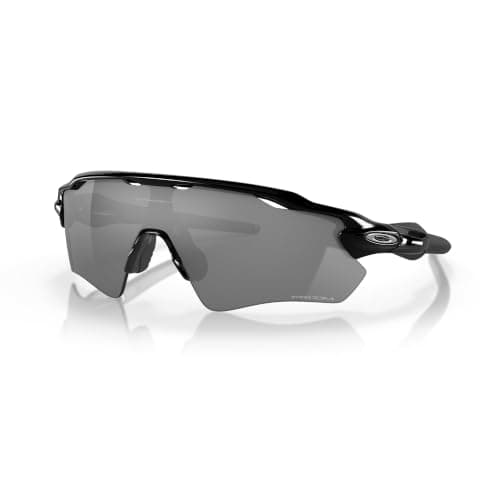
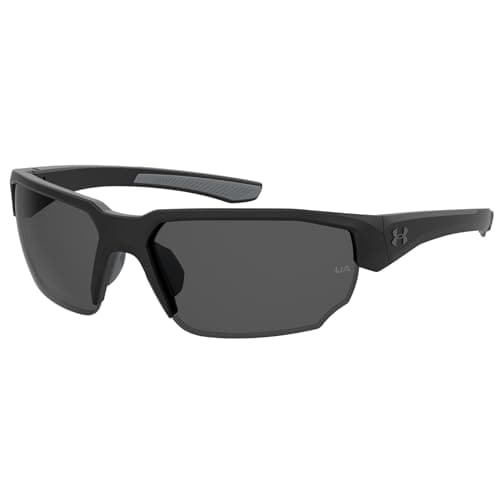
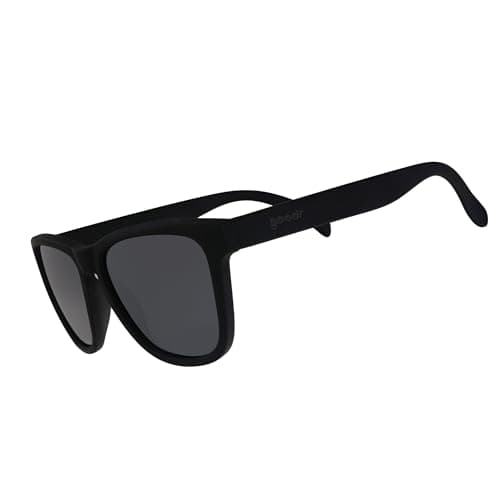
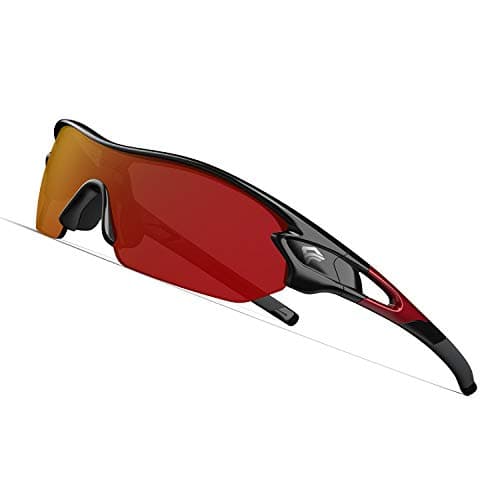
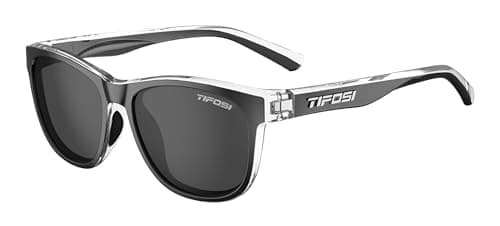
The best tennis sunglasses for most club players are the Tifosi Swank: a real sport frame at about $30, light enough that it does not shift when you hit an overhead, and cheap enough that catching a ball with your face is a bad afternoon rather than a $250 one. If you want the genuine upgrade, the Oakley Radar EV Path is the only pair here that is a real optical step up — its tall shield lens keeps a high ball inside the lens instead of behind the frame. If sunglasses slide down your nose when you sweat, buy the Under Armour Blitzing for its non-slip temples. If you want polarized on a budget, the goodr OG.
Tennis asks something of sunglasses that almost no other sport does: you have to look almost straight up. A serve, an overhead, a lob — your eyes travel to the top of your field of view while your head stays relatively level. In a small fashion frame, that is precisely where the top rim is, so the ball disappears behind plastic at the moment you most need to see it. This is the single biggest reason people try sunglasses on court once and give up.
Which makes the ranking criteria short and unusual for eyewear:
The three things that actually matter
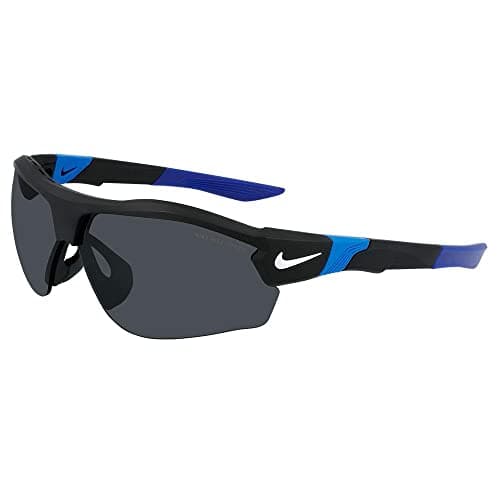
1. Lens height. Measured at the top, not the width. A tall lens or a single-lens shield keeps your upward sight line inside the glass. A shield frame — the Oakley Radar EV, the Nike Show X3 — has no bar across your vision at all. This is the one thing worth paying for, and it is the thing nobody lists in a spec.
2. Grip. If they move, you take them off, and then you own sunglasses you do not play in. Two features do the work: non-slip temple material, which is a published feature of the Under Armour frame here, and a frame light enough not to have momentum when you move your head quickly. Cheap and light beats heavy and expensive here.
3. Tint, matched to when you play. A dark smoke or mirror lens is a bright-sun lens and nothing else. If you play at 7am or 6pm, or under lights, a dark lens makes a yellow ball on a dark surface harder to see, not easier. This is the most common way people buy the wrong pair.
Notice what is not on that list: brand, polarization and price. Which brings us to the question everybody actually asks.
Should tennis sunglasses be polarized?
The honest answer is probably, but not certainly, and you should try it.
Polarization filters light reflected off flat surfaces. On a tennis court that is genuinely useful: the glare bouncing up off a light-colored hard court on a bright day, and off a wet or damp surface, is exactly what a polarized lens kills. If the thing bothering you is glare off the court, polarized helps a lot.
The counter-argument is real too. Some players find polarized lenses make it harder to pick up the ball against a shiny surface or a bright sky, because the lens removes the very reflections the eye uses for depth and surface cues. It is a minority complaint and it is not universal, but it exists and it is not nonsense.
So: the goodr OG and the TOREGE TR02 are both polarized and both cheap, which makes them good experiments. If polarization suits you, you will know in one session, and the money is trivial. If it does not, the Tifosi, the Nike shield and the Oakley Prizm on this page are all non-polarized.
Tennis sunglasses for women
Frame width and nose-bridge geometry are where eyewear genuinely differs between faces, and that difference is more pronounced in sunglasses than in almost any other tennis purchase. A frame that is too wide does not grip the temples, so it slides on the first change of direction — and most sport frames are designed around a broader face.
Practically: buy a medium or small fit rather than a men's wrap. The goodr OG is the best starting point here because it is sold in a medium size and is designed to grip without a strap, and the Tifosi Swank is a narrow, light frame rather than a wide wrap. The Oakley Radar EV is the upgrade in either case — the lens height argument applies to everybody.
The thing to avoid: buying a large wrap because it looks more serious. A big frame that slips is worse on court than a small frame that stays on.
Tennis sunglasses for men
Same three criteria, with a wrap generally fitting better. The Under Armour Blitzing is the specific pick for anybody who sweats heavily, because the non-slip temples and auto-lock hinges are published features aimed at exactly that, and because a wrap cuts side glare on a west-facing court in the evening.
One trade-off to know: a wrap sits close to the face, which means less airflow and earlier fogging on a humid day. If you fog up in every wrap you have ever owned, go to an open frame like the Tifosi instead — the glare you lose is less than the vision you gain.
Sunglasses or a hat?
A cap and sunglasses solve different halves of the problem and work best together. A brim blocks the sun above your eyeline, which is what makes a high ball against a bright sky visible at all. Sunglasses cut glare reflecting up off the court, which a brim cannot touch.
If you only wear one, and you play outdoors on a hard court, wear the cap — it is cheaper, it never slips, and it does not go dark when a cloud passes. If you play on a light-colored hard court in full sun, you want both.
One practical note: a shield-shaped frame that sits flat (the Nike Show X3, the Oakley) goes under a cap brim without fighting it. A tall-templed frame catches the underside of the brim and lifts.
A note on prescription and on impact
Nothing on this page is a prescription lens, and nothing on this page is certified eye protection. If you play doubles at the net and have been hit, that is a different category of product — proper sport eye guards — and these are not a substitute. Sport sun lenses do give you more coverage than nothing, but a $24 frame is not an impact standard.
And if you need prescription lenses to play, the realistic routes are prescription inserts in a shield frame, or contacts plus any pair on this page. The second is what most club players do, for good reason.