Most adult men take a 4 3/8" grip (size 3) and most adult women take 4 1/4" (size 2) — but measure rather than assume, because a grip that is too small makes you squeeze, and squeezing is one of the most direct contributors to tennis elbow there is.
The grip size chart
| US size | European size | Circumference | Typically |
|---|
| 4 in | L0 | 4" / 101.6 mm | Junior |
| 4 1/8 in | L1 | 4.125" / 104.8 mm | Small adult hands |
| 4 1/4 in | L2 | 4.25" / 108 mm | Most adult women |
| 4 3/8 in | L3 | 4.375" / 111.1 mm | Most adult men |
| 4 1/2 in | L4 | 4.5" / 114.3 mm | Larger adult hands |
| 4 5/8 in | L5 | 4.625" / 117.5 mm | Rare, very large hands |
European frames are usually marked with the L number; US-market frames are usually marked with the fraction. They are the same scale.
Method 1: the ruler test
Open your dominant hand, palm up, fingers together and extended. Find the lowest horizontal crease on your palm — the one that runs across the base of your fingers. Measure from that crease to the tip of your ring finger, in inches. That measurement is your grip size.
Most people land between 4 1/8" and 4 1/2". If you measure between two sizes, take the smaller one — see below for why.
Method 2: the finger test
Hold a racquet in an eastern forehand grip (palm on the same bevel as the string face). Slide the index finger of your other hand into the gap between your fingertips and the base of your palm.
One index finger fits snugly → correct size. No room at all → too small. Room to spare→ too big. This is the test coaches use, and it works on a racquet you are holding in a shop.
Why too small is worse than too big
A grip that is too small does not feel wrong. It feels fast and manoeuvrable, which is why people choose them. What happens underneath is that your hand has to close further to hold the frame, and the racquet twists more on off-centre contact, so you grip harder to stop it. Sustained gripping loads the forearm extensor tendons, which is precisely the mechanism behind lateral epicondylitis — tennis elbow.
A grip that is slightly too big is less efficient and a bit tiring, but it does not drive that cycle. If you must err, err large — though the real answer is to buy small and build up.
Buy small, build up
This is the rule that makes grip sizing low-risk. You can always increase a grip; you can almost never reduce one without stripping the handle.
An overgrip adds roughly 1/16", which is half a grip size. So a 4 1/4" frame with one overgrip is effectively a 4 5/16", and with two it is close to a 4 3/8". If you are between sizes, buy the smaller frame and let the overgrip you were going to use anyway take you to the right place.
A heat-shrink sleeve adds a full size and is a permanent, professional option if you bought a frame a whole size too small. Most stringers will fit one.
Overgrip or replacement grip?
Two different products that people confuse. A replacement gripis the base layer that goes directly onto the bare handle — thicker, leather or synthetic, changed maybe once a year. An overgrip goes on top of it, is thin and cheap, and is a consumable you change every few sessions.
Never strip the replacement grip to fit an overgrip; you will lose the handle's bevel definition and a quarter of a grip size at once.
Which overgrip
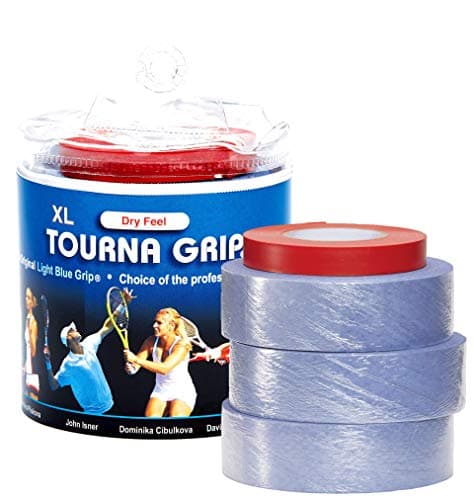
The choice comes down to how much your hands sweat. If you play in heat or humidity, or your hands are simply damp, Tourna Gripis the answer — it is absorbent rather than tacky, which means it gets grippier as it takes up moisture, the opposite of every other grip. Players either love it immediately or find it dry and papery for the first five minutes.
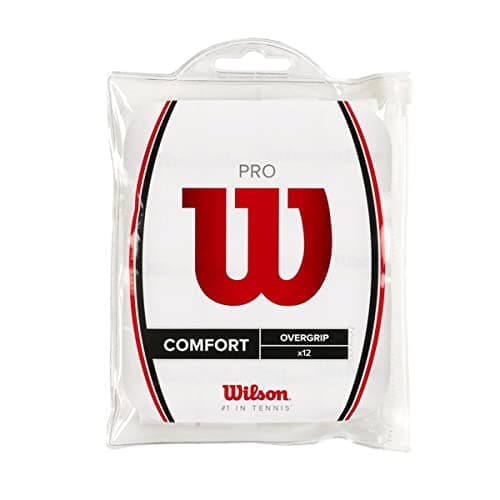
For everyone else, the Wilson Pro Overgrip is the default for good reason: thin, tacky from the first wrap, and cheap in a 12-pack. If you want to feel the bevels as sharply as possible, the Babolat VS Original is thinner still.
Does grip size change how a racquet plays?
Marginally, and in one direction worth knowing. A larger grip is slightly more stable against twisting on off-centre hits; a smaller grip allows slightly more wrist action, which some players use for spin and others use to injure themselves. The effect is small compared with getting the size right for your hand.
What does change meaningfully is weight and balance: every overgrip adds a few grams at the handle, which makes the frame marginally more head-light. Three overgrips is enough to notice. If you are also adding lead tape at the head, account for both.
When to change your grip
An overgrip is finished when it stops absorbing or stops being tacky — for most players that is every three to six playing hours, and more often in summer. It is a few dollars, and playing on a slick grip means squeezing, which brings us back to where this page started.