The Proton is the machine to look at if portability is the thing stopping you from owning one. Hydrogen Sports publishes a weight of under 20 pounds in roughly the dimensions of a backpack, a folding hopper holding up to 100 balls, feeds up to 70 mph with spin to 3,000 rpm off high-performance drone motors, and a smartphone app that places shots by tapping locations on a court diagram. Two things to know before you get attached: it is not sold on Amazon, so we cannot show you a live price on this page, and we have not used one. If you want a light machine you can buy today with a price next to it, the Tennis Tutor ProLite Plus and the TENNIIX are the realistic alternatives.
Establishing the ground rules first, because this page is a review in the sense of a specification review and not in the sense of a test: nobody on this site has owned or hit against a Proton. What follows is built from the figures Hydrogen Sports publishes and from Tennis.com's hands-on report, which is cited in the sources at the foot of this page. Where we cannot tell you something, we say so.
The second ground rule: Proton is a direct-sale product. We searched the Amazon catalog for it on 2026-10-13 and it is not listed. This site's prices come from a live Amazon feed that expires after 48 hours, which means there is no honest way for us to put a number on this machine — and we would rather show you nothing than a figure we read somewhere in 2024. Check the current price with Hydrogen Sports directly.
The published specs
Under 20 pounds, in backpack dimensions. This is the headline and it is the genuinely interesting number. For comparison, the Nisplay publishes 26 lb, the TENNIIX 18.7 lb and the Lobster Elite Liberty sits around 35 lb. Under 20 lb is the threshold where a machine becomes something you pick up with one hand on the way out of the door, and that threshold is the difference between a machine that trains you and a machine that stores things in your garage.
Up to 100 balls, in a folding hopper. The folding part is the clever bit: a rigid 100-ball hopper is most of the bulk of a conventional machine, and folding it is how you get to backpack dimensions without halving the capacity. 100 balls is roughly a hopper and a third — enough that a session is hitting rather than collecting.
Up to 70 mph, with spin to 3,000 rpm. 70 mph is squarely in the club-player band: comfortably above a 3.5 rally ball, below a 4.5 first serve. The 3,000 rpm spin figure is the more unusual one to publish, and it is a real number for a machine this size — spin is what makes a fed ball behave like a hit ball rather than a lobbed one.
Drone motors. Described as high-performance drone motors, which is a sensible piece of engineering borrowing: the drone industry has spent a decade making small, light, high-torque brushless motors cheap, and a ball machine wants exactly that. It is also part of why the published noise is described as a low hum rather than the whine most machines make.
Interchangeable lithium-ion batteries. The manufacturer claims up to 1,000 feeds per battery. Tennis.com's reviewer explicitly did not test that claim, completing a two-hour session without trouble — so treat 1,000 feeds as a maker's figure rather than a verified one. Interchangeable packs are the right architecture: batteries are the part of any machine that ages first, and a machine whose battery you can swap has a longer usable life than one whose battery is built in.
App shot placement, and an on-unit panel. The app lets you place shots by tapping court locations, with custom drills targeting 15 locations on your side, plus pre-programmed routines; there is also a physical control panel on the machine for basic functions. That combination — app for drills, panel for the basics — is the right answer, because an app-only machine is unusable the day your phone dies.
What we cannot tell you
Three things, and they are the three that would decide the purchase for us.
Whether it stays still. A very light machine firing a ball at 70 mph is subject to its own recoil, and there is published user commentary that the Proton's light weight lets it drift during use. We have not observed this ourselves and cannot quantify it. It is the most important open question about the design, because drifting changes where the ball lands.
Long-term durability and service. Hydrogen Sports is a small company and this is a newer product than the Lobster or Tennis Tutor lines. Whether a drive wheel or a battery will be available in six years is unknowable today, and it is the main structural advantage the established brands retain.
The current price and availability. See above. Historically the machine has sold out and taken orders for later delivery. Check with the maker.
Who it suits, and who it does not
It suits you if portability is your binding constraint — steps, public transport, a small car, a bad back — and you want app-level drill control rather than a speed dial. That is a real and underserved buyer, and the Proton is aimed squarely at them.
It does not suit you if you are a 4.5+ player who wants match pace and vertical oscillation (the advanced machines are your page), if you need a live price and next-day delivery, or if parts availability in a decade is part of what you are buying. In that last case the established brands are the safer money.
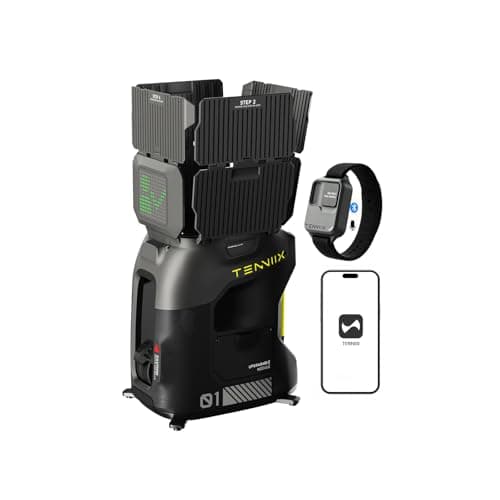
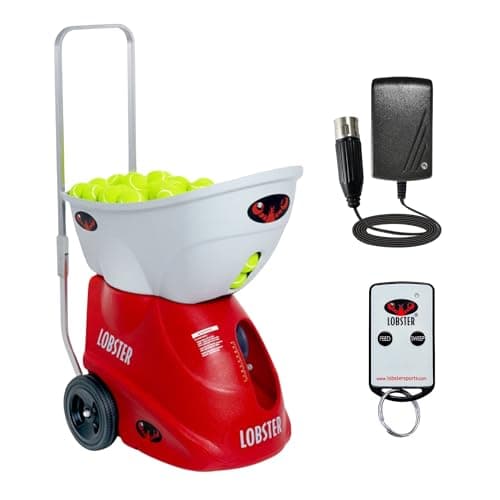
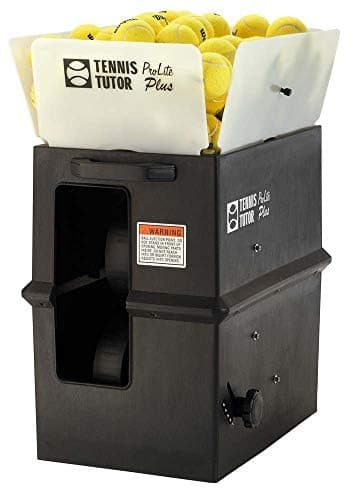
The picks below are the Amazon-sold machines we would actually compare it against: the Tennis Tutor ProLite Plus, which is the lightest full-feature machine from an established maker; the TENNIIX at a published 18.7 lb, which is the closest thing to the Proton's weight class at a fraction of the money; and the Lobster Elite Liberty, which is the default club machine and the one to buy if you decide portability is not actually your problem.