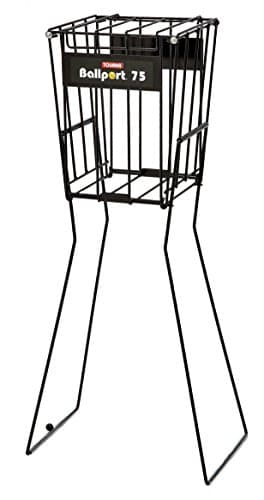
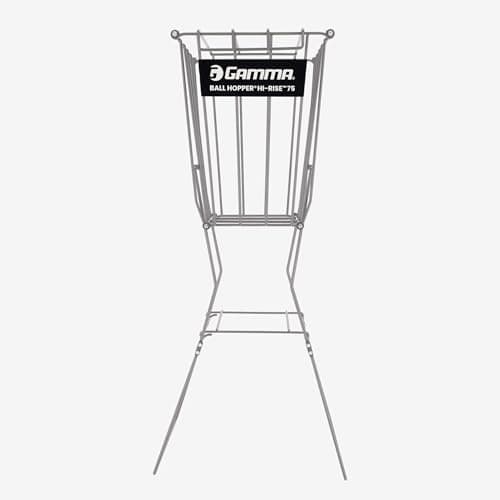
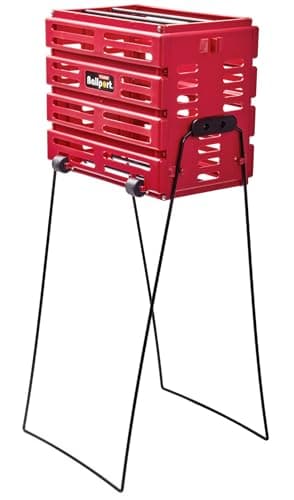
Buy the Tourna Ballport Deluxe. It is the standard 75-ball hopper with wheels and a pull handle, and the wheels are what let you keep feeding after the first twenty minutes. If you feed from one spot and never move it, the plain Ballport is cheaper and does the same job. If you are tall and feed standing for long periods, the Gamma Hi-Rise.
What a hopper is actually for
Two jobs that people usually only think about one of.
Collection.Press the hopper down over a ball and the wire fingers spread, the ball goes in, and the fingers close. You collect a court's worth of balls at walking pace without bending once. If you have ever picked up a hundred balls by hand, this mechanism justifies the purchase on its own.
Feeding. The legs fold out and turn the hopper into a stand at roughly waist height, so you can feed a drill from a basket without a separate piece of kit. That is why almost every coach in the world owns one of these rather than something cleverer.
Wheels, and why they are not a luxury
Seventy-five tennis balls weigh roughly nine to ten pounds, and you are carrying that in one hand, by a thin wire handle, repeatedly across a court.
It is fine for one trip. Across a 45-minute feeding session it is the thing that ends the session — not your arm from hitting, but your other arm from carrying. Wheels and a telescoping handle turn it into a walk, and the price difference is small.
Skip the wheels only if you genuinely feed from a fixed position, or you need the bulkiest thing in your car boot to be as small as possible.
If you own a ball machine, buy a hopper first
This is the accessory that machine buyers consistently forget. A ball machineholds 100–150 balls and fires them in roughly fifteen minutes. Collecting them by hand takes longer than hitting them did, and the session becomes 30% tennis and 70% stooping.
With a wheeled hopper, reload takes a couple of minutes and you can run three or four hoppers-worth in an hour. The hopper is what makes the machine usable.
Capacity: 75 is the number
Hoppers come in 36, 55, 75 and 140-ball sizes. 75 is the sweet spot and it is what all three picks here are: enough for a genuine drill session, light enough to carry, and compatible with the typical machine hopper size.
140-ball hoppers exist for clubs and academies. For an individual they are heavy enough that you will never fill one.
The three hoppers compared
| Hopper | Capacity | Wheels | Feeding height |
|---|
| Tourna Ballport Deluxe | 75 | Yes, plus pull handle | Standard |
| Tourna Ballport | 75 | No | Standard |
| Gamma Hi-Rise | 75 | No | Raised — taller legs |
That is genuinely the whole decision tree. Hoppers are a solved product and the differences between brands at the same capacity are small. Buy on wheels and height, not on badge.
The ball saver, and why it is on this page
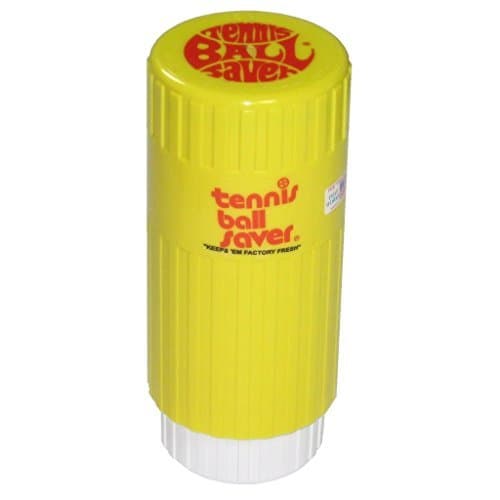
If you are buying a hopper, you own a lot of balls, and pressurised tennis balls go flat whether you use them or not once the can is opened. A re-pressurising canister holds three balls under pressure and keeps them playable for weeks rather than days.
It does not restore felt — a bald ball is finished regardless — but for a player who buys by the case it pays for itself quickly. See best tennis balls for the case-buying case.
Practice balls versus match balls
One thing worth getting right: do not fill a hopper with fresh match balls. Machine and drill use destroys balls far faster than play does, and there is no benefit to practising with pressure-perfect balls.
The standard arrangement is that balls graduate: new cans for matches, then they become practice balls, then they go in the hopper, then the dog gets them. A case of Penn Championship bought for the hopper is the cheapest way to keep the cycle fed.
Looking after a hopper
There is nearly nothing to it, which is part of the appeal. Two things: do not leave it outdoors permanently, because the wire frame will eventually rust at the joints and the coating will chip; and do not overload it past its capacity, because forcing extra balls in bends the collection fingers and once they are splayed the pickup mechanism stops working cleanly.
The Gamma's heavier-gauge steel and weather-resistant coating are the genuine upgrade here if your hopper is going to live in a court shed.