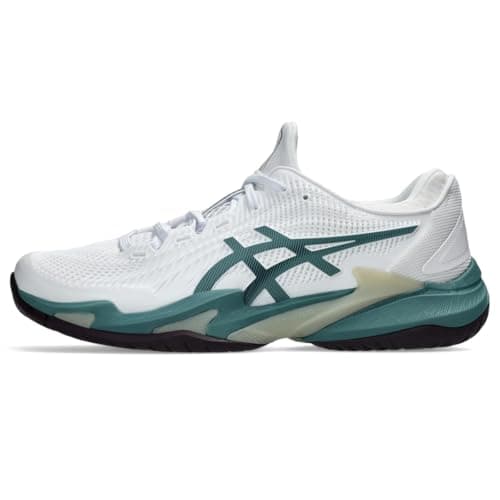
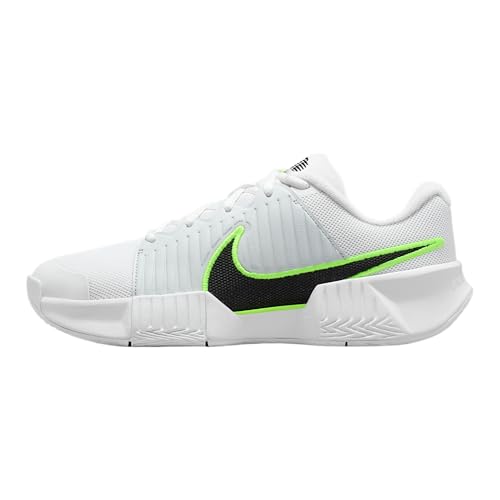
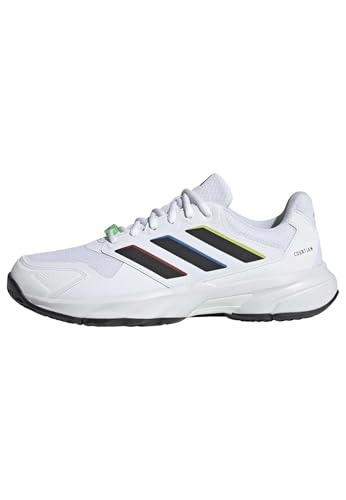
The best tennis shoe for narrow feet is the adidas CourtJam Control 3, and for once there is a number behind that: RunRepeat's calipers measured the widest point of its interior mold at 87.4 mm, against a 92.8 mm average across the 48 tennis shoes they have measured. Their verdict is that it “can only accommodate players with narrow feet or those with medium-width feet”. If your problem is specifically your toes swimming rather than your midfoot, the Nike GP Challenge Pro measures 65.5 mm at the big toe — the narrowest toebox here against a 69.3 mm average. The ASICS Court FF 3 is the strongest all-round performance pick of the snug-fitting shoes, and the CourtJam is also the cheapest shoe on this page, which makes it the budget pick as well as the winner.
Start with the uncomfortable fact that shapes this whole page. No tennis brand publishes a last width.You can buy a tennis shoe in a wide fitting from two or three brands, but nobody prints the interior width of the standard version, which means “runs narrow” in a review is almost always one person's foot in one size. The only comparable numbers in the category come from RunRepeat, which cuts shoes in half, takes a gel mold of the interior and measures it with calipers in a men's US 9, publishing the figure against the category average. Those are the numbers used here. They are theirs, not ours — we own no calipers and we have measured nothing.
The second thing worth knowing before you shop: narrow is two separate problems, and most players only have one of them. A narrow midfoot means the shoe's widest interior point is too wide for you, so your foot moves side to side inside it and you crank the laces to compensate. A narrow forefoot means the toebox is too roomy and your toes slide forward under braking. The measured data separates these cleanly, which is why this ranking does too: the CourtJam is the narrow-midfoot answer, the GP Challenge Pro the narrow-toe answer, and buying the wrong one of those two will not fix your fit.
Why a loose tennis shoe is worse than a loose running shoe
If you have narrow feet and have been getting away with roomy shoes for running, tennis will find you out. Published court-sport guidance explains why: running shoes are “designed for forward motion, not the lateral cuts that tennis requires constantly”, and court shoes answer that with “reinforced lateral walls, extra durability at the toe drag area, and appropriate lateral stability”.
That reinforced lateral wall only works if your foot is actually against it. In a shoe that is too wide for you, your foot slides to the outside edge before the shoe starts to resist, so you get the deceleration late, you roll further over the edge of the footbed, and you learn to lace the shoe painfully tight to stop it. Tight lacing across a narrow instep is its own injury pathway, and it is the thing most narrow-footed players are quietly doing instead of buying a narrower shoe.
The practical test takes one point. Play a few cross-court rallies and then look at where your foot sits in the shoe: if the upper creases hard on the outside edge, or your toes are touching the toe bumper on braking while the sides feel loose, the shoe is too wide for you. That is a fit problem, not a lacing problem, and it is what this page exists to solve.
The criteria, and the numbers behind them
- Measured interior width, where it exists.RunRepeat's gel-mold figure at the widest point, against their 92.8 mm category average. The CourtJam Control 3 reads 87.4 mm — the tightest they have measured in the category. The Court FF 3 reads 92.2 mm and the GP Challenge Pro 92.0 mm, both effectively average at the midfoot.
- Measured toebox width. The forefoot number matters more than the midfoot number for most narrow-footed players, and it is where these shoes separate: 65.5 mm for the GP Challenge Pro and 66.2 mm for both the CourtJam Control 3 and the Court FF 3, against a 69.3 mm average.
- Is a wide version offered?Counter-intuitively this is a negative signal here. A shoe sold only in one width tends to be built on a tighter standard last; a shoe with a wide version often has a roomier standard one. RunRepeat notes the CourtJam Control 3 “is not available in wide-width options”.
- Does it still play like a tennis shoe?A narrow fit is worthless if the shoe cannot take lateral load. Every pick here is a current court model with a tennis outsole and lateral reinforcement — no cross-trainers, no court-styled sneakers.
- Honest labeling of what is unmeasured. Two picks here have no third-party width measurement published. They are included because the fit is well documented at the model level and because they give you alternatives at different prices, and both are marked as unmeasured rather than dressed up with a number nobody has published.
The two picks with no measurement, stated plainly
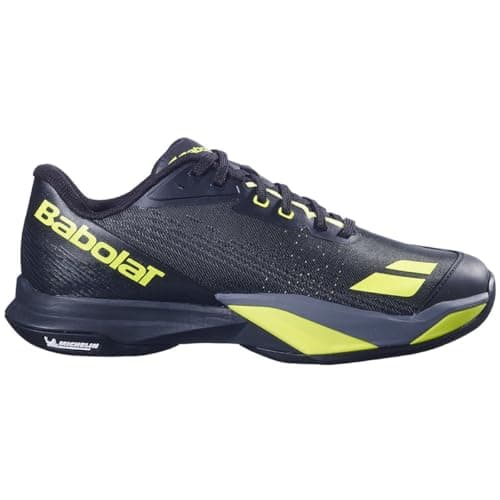
The Babolat Jet Mach 4 is the shoe narrow-footed club players most often end up in, and its fit is a known quantity: a Matryx woven upper that wraps rather than pads, on a performance-snug last. We have ranked it for years as a shoe wide feet should avoid. What we do not have is a published interior width from Babolat or a caliper figure from anyone else, so treat it as documented snug but unmeasured. It is also the lightest shoe here, which is why it appears on the lightweight ranking too.
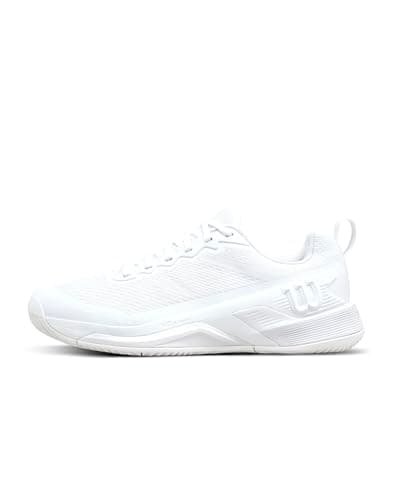
The Wilson Rush Pro 4.5 earns its place on a different mechanism: an Endofit inner sleeve, which is a bootie that wraps the midfoot inside the upper and takes up volume the way an insole cannot. For a foot that is narrow in the middle and normal at the toes, a wrapping inner sleeve is often a better answer than a narrower shell. Again: no published width figure, and it is the shoe here most buyers report sizing up a half in, which cuts against a narrow fit. Unmeasured, and included with that caveat.
Men's and women's, and why the two refinements of this search differ
The two clean refinements of this query are for men and for women, and the sensible answers diverge. Women's tennis shoes are built on narrower lasts than men's as a rule, so a woman with narrow feet has a better baseline chance in a standard women's shoe — which is why the women's GP Challenge Pro is the pick we price-check here, and why the CourtJam Control 3 is also sold in a women's version worth looking at if the men's figure is what attracted you.
Men with genuinely narrow feet have the harder problem, because the standard men's tennis last is built around a D width and almost no brand offers anything narrower. The measured route is the only reliable one: start with the tightest-measured shoe, and use lacing and an insole to take up the rest. One thing not to do is buy a women's shoe in a men's size equivalent to get a narrower last — the heel-to-forefoot proportions differ, and you will trade a width problem for a heel-slip problem.
If you are shopping the rest of the category by fit rather than by width, the wide-feet ranking is the mirror image of this page and shares none of its picks, while how to choose tennis shoes covers surface, cushioning and durability, which matter just as much once the width is right.
Three fixes before you buy a different shoe
Add an insole to take up volume. This is the cheapest real fix for a shoe that is slightly too roomy, and it works because the insole raises your foot in the shoe and fills the space under the arch. Remove the factory insole first and expect to re-lace. The tennis insole ranking covers which builds fit a snug court shoe and which are too bulky to try.
Change the lacing, not the tension. Narrow feet usually need the laces doing more work at the midfoot and less at the instep. Lace-locking through the top eyelets holds the heel without crushing the forefoot; skipping an eyelet over a high instep relieves pressure that cranking the whole lacing tighter only makes worse. Both are free.
Wear a thicker sock, deliberately. A cushioned tennis sock takes up real volume, and the difference between a thin dress sock and a proper cushioned tennis sock inside a court shoe is not subtle. The socks ranking is the cheapest experiment on this page, and the one a surprising number of narrow-footed players have never run.
If all three of those are already in place and your foot still moves, the shoe is the wrong shape and no amount of lacing will fix it. That is when the measured data above earns its keep.
How to read width numbers without fooling yourself
Interior width is not the same as midsole width.Published lab reviews of shoes quote several widths, and the one that tells you about fit is the interior measurement — a mold of the inside of the shoe — not the width of the midsole or outsole underneath your foot. A shoe can have a wide platform and a narrow interior, which is in fact a good combination for a narrow-footed player: stable underneath, snug around.
All measurements are one size.The figures here are taken in a men's US 9. Width scales with length, so the absolute millimeters do not transfer to your size — what transfers is the comparison against the category average at the same size, which is why the average matters as much as the figure.
Narrow at the midfoot and narrow at the toes are different specs. A shoe can be average in the middle and sharply tapered at the front, which is exactly what the GP Challenge Pro measures as. If your complaint is your toes, chase the toebox figure; if it is your arch sliding off the footbed, chase the interior width.
“Runs narrow” in a user review is one foot.It is still useful — a model with a hundred reviews saying it runs snug is telling you something — but it is not a measurement, and it is why this page labels two of its five picks as unmeasured instead of inventing a figure for them.
Sizing a narrow shoe, and the mistake to avoid
The temptation with narrow feet is to size down for a tighter fit. Do not: you will lose length you need, your toes will hit the bumper under braking, and toe-bumper contact is how narrow-footed players lose toenails in a sport full of hard stops. Buy your length, then solve the width with the shoe's shape, an insole, lacing and socks.
The other mistake is buying a performance shoe that is both narrow and unforgiving when what you need is narrow and supportive. A snug one-to-one fit leaves no room for an insole, so if you have an arch or heel complaint as well as a narrow foot, pick the roomier of the shoes here and fill it, rather than the tightest one. Our plantar fasciitis and high-arch rankings are built around that constraint.
Finally, buy from a listing that shows the size and colorway you want in stock. Tennis shoe listings are size- and color-specific by nature, and the narrow models in particular move in and out of stock on individual sizes — which is why every price on this page is pulled live from the retailer rather than typed into the copy.