Answer three questions in order and the string chooses itself. One: do you break strings? If you break them within a few weeks, you need polyester; if you never break them, you do not. Two: does your arm hurt? If yes, that outranks everything — buy a multifilament or natural gut and stop reading comparison charts. Three: what do you want more of? Spin means a shaped polyester, control means a smooth polyester, power and comfort mean a multifilament. If you are a 3.0 to 3.5 player with no arm trouble and no breakage problem, start with synthetic gut, play it for a season, and learn what you actually want before spending more.
The string is the only part of a racquet that touches the ball, and it changes how a frame plays more than most people believe — a 4.0 will notice a string change more readily than a frame change. It is also the cheapest thing in tennis to experiment with. What makes the choice feel hard is that the marketing talks about the string, and the right answer depends on the player.
Question 1: do you break strings?
This is the first filter because it eliminates the largest category of bad purchase, in both directions.
You break strings every two to four weeks. You need polyester. Nothing else will survive you, and a multifilament in your racquet is money going into the trash. Go straight to a co-polyester and consider buying it on a reel.
You break strings once a year, or never. You almost certainly should not be on full polyester. This is the single most common mistake in club tennis: a 3.5 player strings the same poly their favorite pro uses, never breaks it, leaves it in for eight months, and spends most of that time playing on a dead, stiff stringbed that is quietly working on their elbow. Polyester is the most durable string and the fastest to lose tension — see how often to restring.
Question 2: does your arm hurt?
If you have any history of elbow, wrist or shoulder trouble, this question outranks every other consideration on this page. A stiff string transmits more impact shock into the arm, and polyester is the stiffest common string.
The comfort order, softest first, is natural gut, then multifilament, then synthetic gut, then polyester. Natural gut has the highest elasticity of any string and is the most comfortable thing you can put in a racquet; multifilament is the practical, affordable version of the same idea. If you break strings and your arm hurts, the answer is a hybrid — poly in the mains for durability, a soft multifilament in the crosses — or a softer poly at lower tension.
Best strings for tennis elbow goes deeper, and the frame side of the same problem is arm-friendly racquets.
Question 3: what do you want more of?
Only now does the string's character matter, and it comes down to four families.
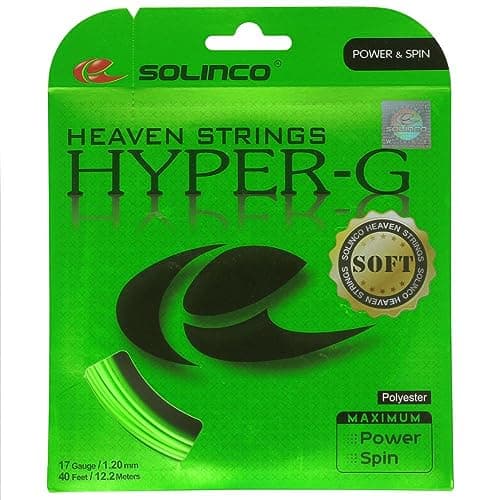
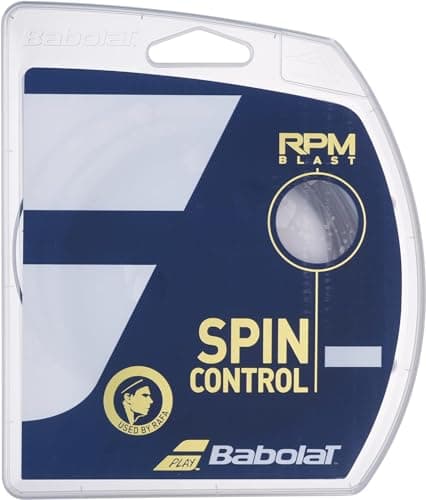
Polyester / co-poly — low power, high control, excellent spin, most durable, least comfortable, loses tension fastest. The string of the modern game and the wrong string for most 3.0 players.
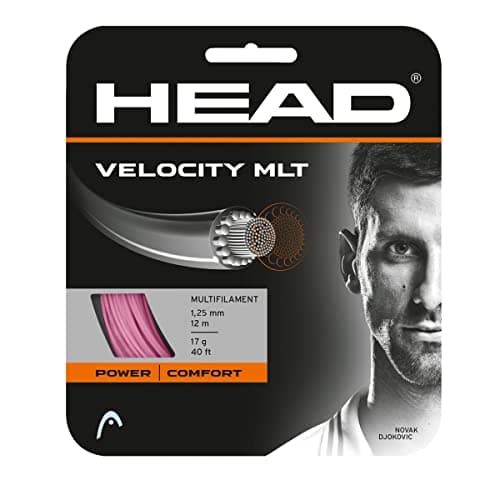
Multifilament — high power, high comfort, good feel, frays and breaks sooner. The right default for anyone who does not break strings.
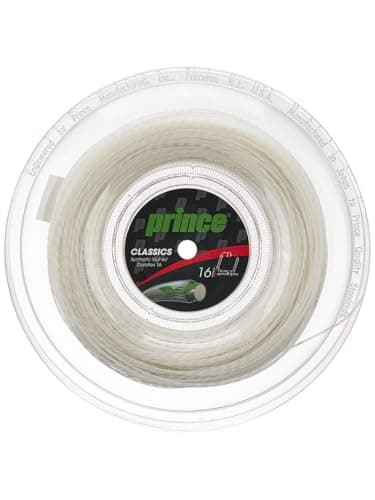
Synthetic gut — a solid nylon core with a wrap. Middling at everything, cheap, and genuinely the right place to start if you do not know what you want.
Natural gut — the best tension maintenance, the highest elasticity, the most comfort and feel, and the highest price. Dislikes moisture.
Within polyester, the shape matters more than the brand: a shaped profile (square, hexagonal, heptagonal, gear-shaped) bites the ball and snaps back for more spin, while a smooth round poly gives a flatter, more predictable ball for a control player. The full breakdown is on types of tennis strings, with the head-to-heads on spin, control and power.
What about gauge and tension?
Gauge is thickness, and in the US it runs backwards: a higher number is thinner. The published conversion is 16 gauge at 1.26–1.34 mm, 17 at 1.16–1.24 mm, 18 at 1.06–1.16 mm, with "L" variants (16L, 15L) sitting slightly thinner than the base number.
The trade is simple and published: "the heavier the gauge or thicker the string will be more durable and long-lasting," while "the thinner the string, the more potential for spin." So: 16 gauge if you break strings, 17 if you want spin and feel, 18 if you are a control player who never breaks anything. On comfort, the honest note from the same source is that studies on gauge and stringbed stiffness "have been inconclusive" — do not buy a thinner string expecting a softer arm. 16 vs 17 gauge is the full comparison.
Tension is the other dial, and it is a bigger lever than most string changes: lower tension gives more power and comfort, higher tension gives more control. The tension guide has the ranges by level and frame.
The four strings to start from
These are the four that answer the three questions above at the lowest cost of being wrong: the synthetic gut to start with, the arm-friendly multifilament, the best-value polyester, and the spin polyester.
The one comparison this decision tree leaves implicit is between the two soft nylon families, which is where most club players actually end up: multifilament vs synthetic gut is that page, including the reel arithmetic that makes a premium multifilament cost about what synthetic gut costs in sets.
If you would rather skip the decision tree and be handed an answer for your standard, the level pages do exactly that: strings for beginners is a single sentence to take to the shop, strings for intermediate players is where the polyester question gets settled, and strings for advanced players covers the gut hybrids and the reel arithmetic.
A one-season plan for finding your string
Season 1, first restring: synthetic gut at the middle of your frame's recommended tension range. This is your baseline. Note how the ball behaves and whether anything hurts.
Second restring: change exactly one thing. If you broke the synthetic gut quickly, go to a soft polyester. If you want more spin, go to a shaped polyester at the same tension. If your arm complained, go to a multifilament. One variable at a time, or you learn nothing.
Third restring: adjust tension on whichever string you preferred, by two pounds, in the direction you want. Two pounds is a noticeable change; five is a different racquet.
That is three restrings and roughly a season, which is exactly the cadence a club player who plays twice a week is on anyway. By the end of it you will know your own string, which is worth considerably more than any chart.
If you reach the end of that process and expect to keep experimenting, buying on a reel rather than in sets is where the cost drops — a 200 m reel runs to roughly sixteen jobs. That, plus a drop-weight machine, is how people who care about strings end up spending less on them than people who do not.