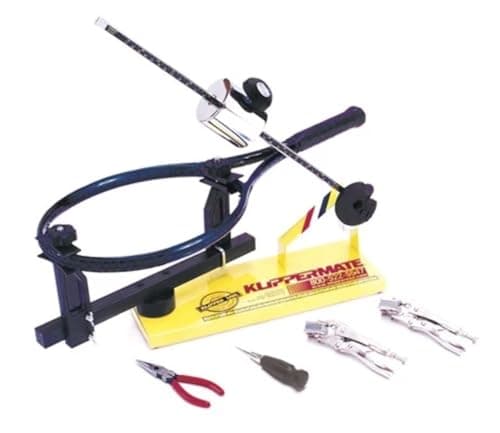
For a home stringer doing their own frames, buy the Klippermate. A drop-weight tensioner is gravity-based, which means it is inherently accurate and never needs calibration, and the Klippermate is the cheapest tennis stringing machine worth owning — it pays for itself in about ten restrings at club labor rates. If you are stringing for a family, a team or a junior program, step up to a six-point machine: the GAMMA Momentum 2 or the GLOPTIX GT-160 tabletop. If you intend to charge for the work, buy an electronic constant-pull machine and skip the ladder entirely. Everything between those three answers is marketing.
Four searches land on this page and they are all the same question asked with different anxieties: the best tennis stringing machine, the best one for home, the cheapest one, and how much a tennis stringing machine costs. The honest answer to the last one is that the range on this page spans roughly twenty times from bottom to top, the bottom of it does the job, and which end you need depends entirely on how many racquets go through it per month.
How much does a stringing machine cost — and when does it pay for itself?
Published stringing-service prices are the only sensible way to answer this. Racquet Point publishes $25 in labor per tennis racquet, with synthetic gut from $4.99 and premium strings typically $14 to $22 and up — so a budget job is around $30 and a premium job is around $55 before shipping. The labor is the part a machine eliminates; the string you still buy either way.
Put that against the machines and the arithmetic is blunt. At $25 of labor saved per job, a drop-weight machine at the bottom of this page clears its own price in roughly eight to ten restrings. A six-point tabletop machine needs something like forty. A shop-grade electronic machine needs well into the hundreds — which is the entire reason shops own them and club players do not.
Then multiply by how often you actually restring. TennisCompanion's published guidance is to double your weekly playing days to get a yearly restring count: two days a week is about four restrings a year, four days a week is about eight. At four restrings a year, a drop weight pays for itself inside three seasons on one racquet — and that is exactly the case where the honest advice is to keep using the shop. The machine math only gets interesting when you have two or three frames, or a household with more than one player, or you are willing to restring more often than you currently do because it is suddenly free. That last one is the real reason to own a machine: not the money, the fact that you stop playing on dead strings.
Drop weight, crank, electronic: what you are actually choosing
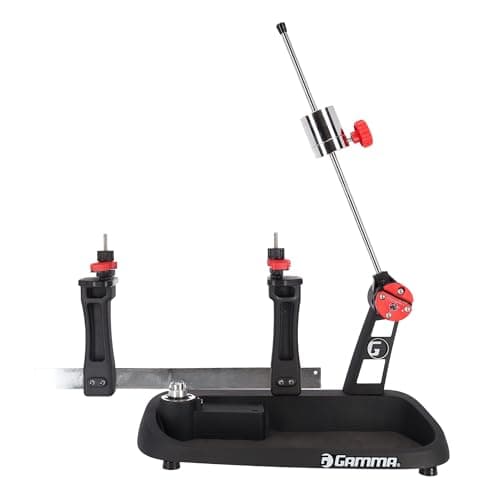
Drop weight. A weighted bar hangs off the tensioner and gravity does the pulling. There is nothing to calibrate, because gravity does not drift, and this is why a $200-class drop weight is as accurate as a machine costing five times more. What you give up is speed: expect well over an hour on your first few jobs, and perhaps forty minutes once you are practiced.
Crank / manual tensioner. A geared mechanism you turn until it locks at the set tension. Faster per pull than a drop weight and the thing most people actually want when they say they have outgrown their machine. Needs occasional calibration, because a spring does drift.
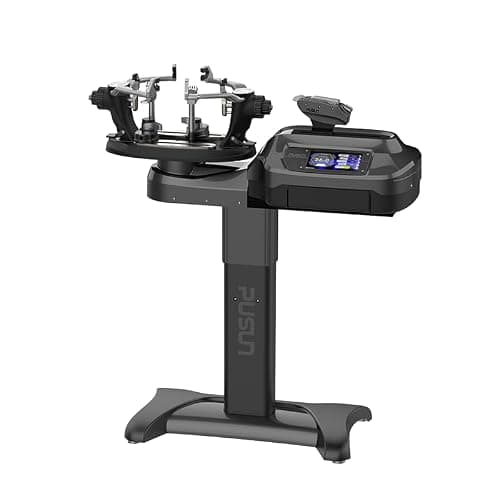
Electronic constant pull. A motor pulls to tension and then keeps pulling as the string relaxes under load. No manual machine does this: on a drop weight or a crank, the string creeps after you lock the clamp and the final tension is a little lower than the number you set. Constant pull is the only real performance difference in this whole category, and it matters to a stringer whose customers notice, not to a 4.0 playing Saturday doubles.
Two-point vs six-point mounting is the other axis, and it matters more than the tensioner for frame safety. Two points support the frame at head and throat; six spread the load. On your own racquet, two points with careful technique is fine — the Klippermate has been doing it for decades. On somebody else's $250 frame, buy six.
So which machine should you buy?
You string your own two frames and want the cheapest machine that is not a compromise → Klippermate. Drop weight, two-point, made in the US for decades, with tutorials and spares that all still exist. This is the answer for most people reading this page.
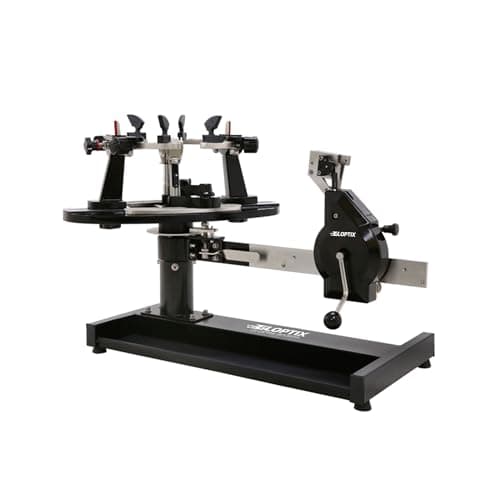
You string for a family, a high-school team or a junior program → GAMMA Momentum 2 or GLOPTIX GT-160. Six-point mounting and swivel clamps on the GAMMA; a complete tool kit in the box on the GLOPTIX. Both are the right shape for other people's frames.
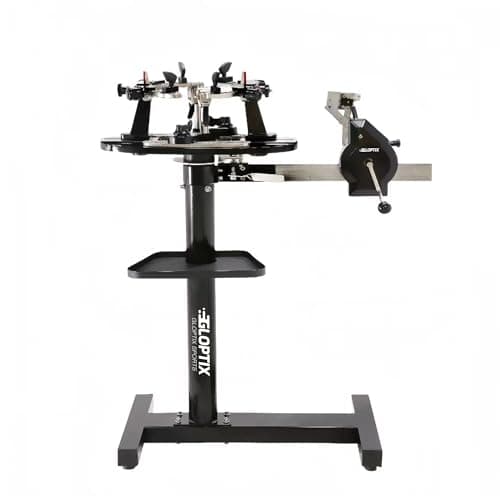
You will be standing at this machine for an hour at a time → GLOPTIX GT-210. A stand machine puts the racquet at chest height and rotates. It is the ergonomic upgrade people skip and then regret, and the reason every shop uses a stand.
You are going to charge for restringing → the PUSUN electronic. Constant pull plus digital tension entry removes the largest source of job-to-job variation, which is the person. Nothing about a club player's own game justifies it.
You restring twice a year → buy nothing. Read what restringing costs, pay the shop, and spend the money on string instead.
What else you need before the first restring
A machine is not a complete kit, and the cheapest route to a bad first experience is discovering that on the evening you planned to string. You need an awl, needle-nose pliers, a starting clamp and a pair of cutters. The GLOPTIX machines ship with a tool set; with a Klippermate, budget for the tools separately.
You also need string, and buying it by the reel rather than the set is where owning a machine actually saves money. A 200 m reel runs to roughly sixteen jobs, which turns the per-job string cost into a fraction of a retail set. Pick the string before the machine if you are unsure — how to choose tennis strings is the page for that, and the tension guide is the number you will dial into whichever machine you buy.
Finally: your first three restrings will be slow and at least one will be ugly. That is normal and it is not the machine's fault. Practice on a frame you do not care about — an old racquet from a garage, or your own beater — and read how to restring a tennis racket before you mount anything.