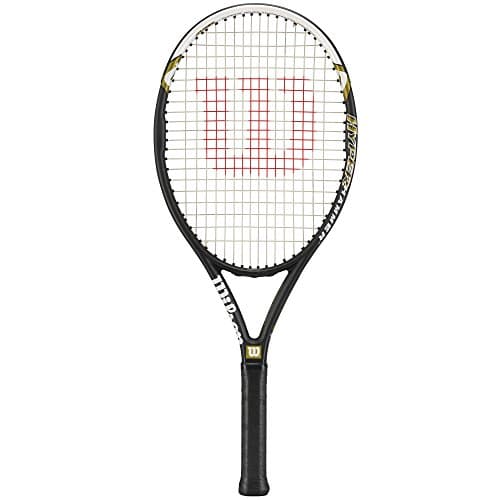
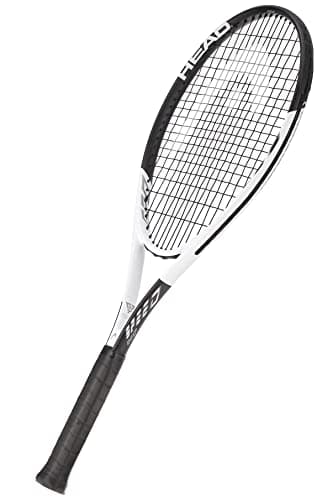
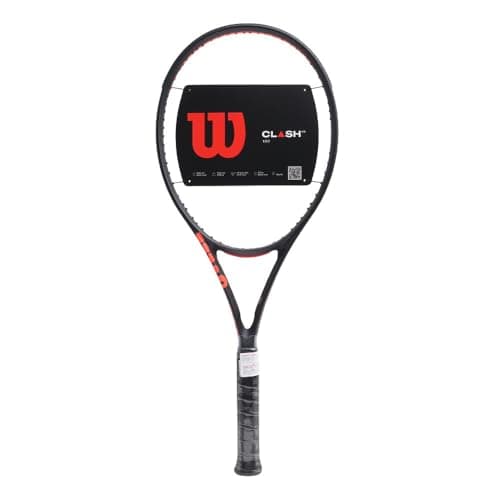
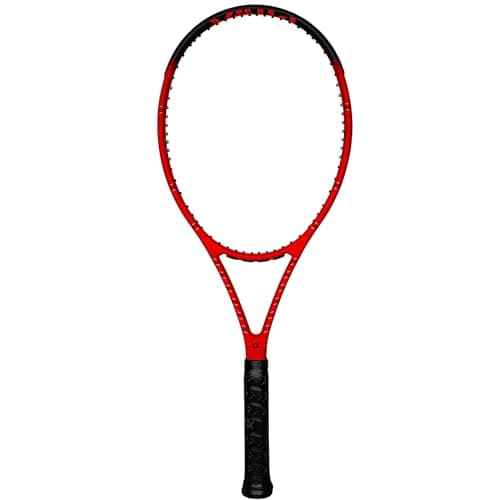
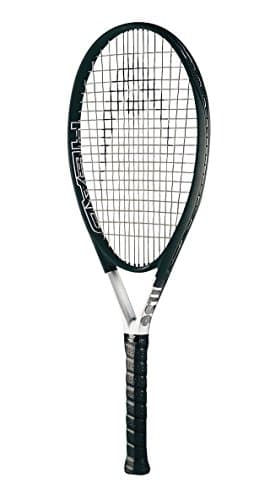
Buy the HEAD Ti S6. At 115 square inches and 8.9 oz strung it is the archetype of the frame an older player actually wants: a very light, very large, head-heavy racquet that supplies the depth your swing no longer has to. The Wilson Hyper Hammer 5.3 is the same idea at 110 square inches and 9.2 oz with an even more pronounced head-heavy balance, and the HEAD Geo Speed is the budget version. If your issue is your elbow rather than your swing speed, skip all three and buy the Wilson Clash 100 — at RA 54 it is the most flexible frame on this site, and flex is what protects an arm.
This page is written for a player in their sixties, seventies or eighties, or anyone whose hands have slowed, and that changes the whole ranking. A senior club player is usually not a beginner — the technique is often better than a 30-year-old's. What has changed is racquet head speed, and racquet head speed is the single input that decides which frame suits you.
Why slower swings need a different frame, not an easier one
A tennis racquet either supplies power or lets you supply it. A heavy, head-light, small-headed control frame assumes you will generate your own pace — it exists to stop a fast swing from spraying the ball. Point it at a slower swing and it does nothing but feel like a crowbar: the ball lands short, you reach for more, and your arm takes the strain.
The frame for a slower swing inverts all three variables.
Light overall weight. Under about 9.5 oz strung. You are accelerating this thing hundreds of times in two hours, and the weight you do not have to move is energy left for the third set. Both of the top two picks here are under 9.5 oz.
A large head. 105 to 115 square inches. A bigger stringbed is a bigger sweet spot, which is more free depth and less twisting on an off-center hit. A 115 sq in frame is not a beginner's compromise — it is an engineering answer to a slower swing.
Head-heavy balance. This is the counter-intuitive one, and it is the point most guides miss. A light frame with the mass in the head carries more momentum into the ball at the same swing speed than the same weight carried in the handle. That is exactly why the Hyper Hammer family was built head-heavy and why it has stayed on the market for decades. The cost is a slightly slower-feeling racquet in your hand on volleys and a bit less maneuverability at the net.
If the problem is your arm, flex beats weight
Light and head-heavy helps a slow swing. It does not, by itself, help a sore elbow — and for many older players the elbow is the actual constraint. The American Academy of Orthopaedic Surgeons describes tennis elbow as overuse causing "microtearing of the tendons that join the forearm muscles on the outside of the elbow," notes that most people who get it are between 30 and 50, and reports that "approximately 80 to 95% of patients have success with nonsurgical treatment."
For the frame, the number to look at is stiffness, published as an RA value. Lower is more flexible and more comfortable. The Wilson Clash 100 v3 is published at RA 54 with FORTYFIVE flex — exceptionally low for a modern 100 sq in frame, and the reason it is the arm-comfort pick on this page despite being heavier at 11.0 oz strung than the oversize frames above it. The Volkl Vostra V8 300 is the other comfort route, with REVA dampening and a RED Cell handle.
There is a genuine tension here, and it is worth naming rather than smoothing over: the lightest frames are usually the stiffest, because stiffness is how a light frame gets its power back. A very light, very stiff oversize racquet can be easier on your shoulder and your legs and harder on your elbow than a heavier flexible one. Which way to go depends on which part of you hurts:
Tired rather than sore → go light and head-heavy. HEAD Ti S6 or Hyper Hammer.
Sore elbow → go flexible, and accept a bit more weight. Wilson Clash 100 or Volkl Vostra V8. Pair it with a soft string — see best strings for tennis elbow — and look at a counterforce brace.
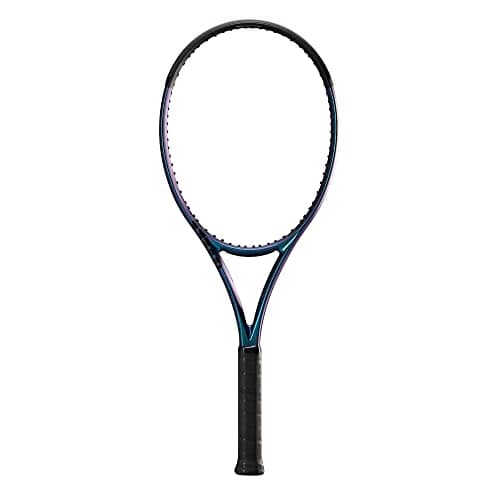
Both → Wilson Ultra 100UL at 9.5 oz unstrung is the compromise: a light frame in a mainstream 100 sq in performance line rather than an oversize recreational one.
Three changes that help more than the racquet
1. Lower your string tension, and use a softer string. This is cheaper than a racquet and often more effective. A multifilament at the lower end of your frame's range is meaningfully more comfortable than a polyester at the top of it, and for a slower swing it also adds depth. The tension guide has the ranges; how to choose tennis strings has the families.
2. Check your grip size. A handle that is too small makes you squeeze, and squeezing transmits more shock up the arm. Grip size is also the thing most likely to be wrong on a racquet you have owned for fifteen years, because hands change. The grip size guide has the measurement.
3. Use a softer ball. The most underrated intervention in senior tennis. A low-compression green-dot ball is full size on a full court at a published 75% of standard compression, which takes a quarter of the impact energy out of every shot — a larger change than any string or frame can offer, for under ten dollars. The softest tennis balls is the page.
What we are not going to tell you
We are not going to pretend there is a "senior" category of racquet, because there is not. The frames on this page are sold to beginners, to arm-conscious players and to anyone with a slower swing; what makes them right here is the combination of specs, not a label. Nor are we going to suggest that a lighter racquet will restore your racquet head speed — it will not. It will let you use the speed you have, which is a different and more honest claim.
And if you play USTA league tennis, your level is a published number rather than a guess. The USTA's NTRP guidelines define the levels, and NTRP ratings explained walks through them — useful because the right frame for a 3.5 with slow hands is on this page, and the right frame for a 4.5 with slow hands probably is not.
As everywhere on this site: we have not hit with these racquets. Every spec in the table is the manufacturer's published figure — head size, strung weight, balance, string pattern, stiffness — and the scores are judgments from that documentation against our rubric, weighted here toward low weight, large head and arm comfort rather than toward control.
If you arrived here searching by weight rather than by age, the lightweight racquets page ranks the same shelf purely on published strung weight, from 8.9 oz up. And if a light frame turns out to be too light and unstable against a hard hitter, you do not need a different racquet — adding a few grams at 3 and 9 o'clock fixes exactly that, reversibly.