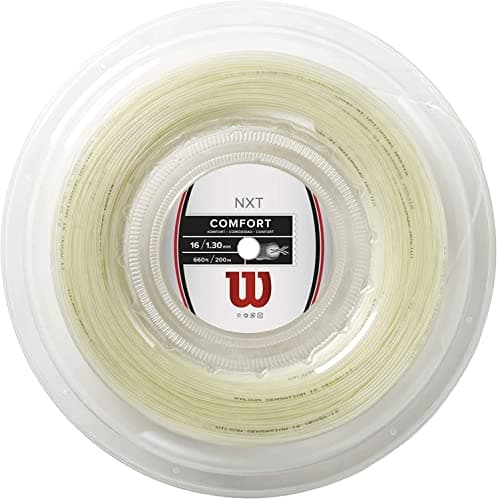
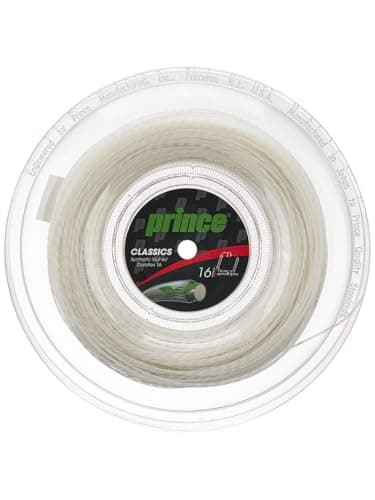
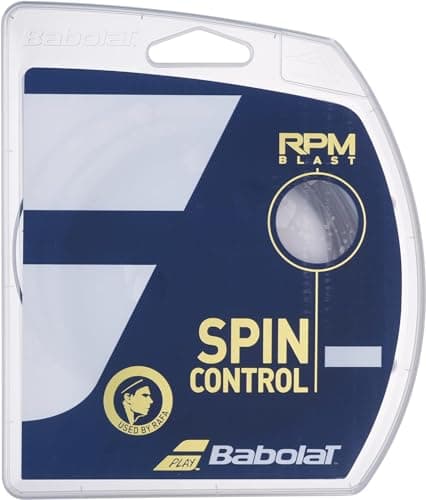
Use 16 gauge if you break strings; use 17 gauge if you do not. That is the honest one-sentence answer, and almost everything else about gauge is a second-order effect. Thicker 16 gauge string lasts longer and feels more controlled; thinner 17 gauge bites the ball more for spin and gives up some durability to do it. If you have never snapped a string in your life, go 17 and enjoy the extra bite — the Babolat RPM Blast at 1.25 mm is the default. If you break strings every few weeks, go 16 and stop paying your stringer — Wilson NXT at 1.30 mm if you want comfort, Prince Synthetic Gut Duraflex at 1.30 mm if you want it cheap by the reel.
One thing worth getting straight before anything else, because it is the actual source of the confusion: US gauge numbers run backwards. A higher number means a thinner string. 18 gauge is thinner than 17, which is thinner than 16. Nothing about the numbering tells you that, which is why this search exists at all.
The published conversion, and why the labels disagree
Gauge is a band, not a point. The published US-gauge chart puts 16 gauge at 1.26–1.34 mm, 16L at 1.22–1.30 mm and 17 gauge at 1.16–1.24 mm, with 18 gauge at 1.06–1.16 mm. The same reference notes that 15 and 16 gauge "come in ‘light’ or slightly thinner versions as denoted by 15L and 16L."
Now look at what that does in practice, using two strings from our own catalog. Luxilon publishes ALU Power at 1.25 mm, labeled 16L. Babolat publishes RPM Blast at 1.25 mm, labeled 17. Same diameter. Different number on the packet. Both labels are defensible, because 1.25 mm sits inside the 16L band and right at the top of the 17 band.
The practical conclusion: read the millimeters, not the gauge number. Every string in our registry publishes a mm figure, and the mm figure is the one that tells you what you are actually stringing. If a listing only gives you a gauge number, treat it as a rough band and expect a tenth of a millimeter of slop.
What gauge actually changes
Four effects, in descending order of how much you will notice them.
1. Durability — large and reliable. More material takes longer to saw through. The published rule of thumb is exactly that: "the heavier the gauge or thicker the string will be more durable and long-lasting," and "all else equal, thicker strings are more durable." A heavy topspin hitter who breaks 17 gauge polyester in two weeks will usually get three or four out of 16. This is the effect that decides the question for most people.
2. Spin — real, and smaller than the internet suggests. A thinner string has a smaller contact area and sits deeper into the ball, which the published guidance states as "the thinner the string, the more potential for spin, while the thicker the string, the less spin potential." Note the word potential. Gauge is worth something on spin; your swing path is worth far more, and so is the string's shape and slickness. A round 17 gauge nylon does not out-spin a shaped 16 gauge polyester.
3. Feel and power — real, and hard to predict. A thinner stringbed is generally a slightly softer, livelier one at the same tension, which most players read as more feel and a bit more free depth. "Generally" is doing work in that sentence.
4. Comfort — genuinely unresolved. This is where we part company with most of the category. The honest published position is that "when it comes to gauge and stringbed stiffness, which impacts comfort, studies have been inconclusive." So if you have tennis elbow, gauge is not your lever. Material and tension are. That is covered in arm-friendly strings and the tension guide.
Gauge matters much less than material
Worth saying bluntly, because gauge gets more attention than it deserves. Going from a stiff polyester to a multifilament changes how a racquet plays enormously. Going from 17 to 16 gauge in the same string changes it slightly. If you are trying to fix something — arm pain, no spin, no control — change the material first and the gauge second. Start at the types of tennis string and poly vs multifilament.
The exception is the string breaker. If your only problem is that strings keep snapping, gauge is the cheapest and most direct fix available, and it is worth doing before you change anything else.
So how do you choose your string gauge?
One question, answered honestly: when did you last break a string?
Never, or over a year ago → 17 gauge. You are leaving bite and feel on the table for durability you do not need. The published advice agrees: a player who does not break strings often has no reason to be in 1.30 mm or above.
Every few months → either works. Pick on material and stay at 16L or 1.25 mm, which is where most of the good co-polyesters live anyway.
Every few weeks → 16 gauge, and consider a shaped durability polyester by the reel. Tourna Big Hitter Black 7 is a 7-sided co-polyester sold by the reel for exactly this player.
Mid-match, more than once a season → 16 gauge polyester, and read how to restring a racquet yourself — at that rate you are paying a stringer more than a stringing machine costs.
Two notes that matter more than the gauge you pick. First, a hybrid is a legitimate answer: 16 gauge polyester in the mains, where strings break, and a thinner multifilament in the crosses, where they do not. Second, buying by the reel is cheaper per job than buying sets, and if you break strings often enough to care about gauge you break them often enough to care about that — see what restringing costs.
Gauge is one variable of four, and it is the one that matters least. If you are still deciding the string itself, take it by level: strings for intermediate players covers the soft polyesters and the poly-main hybrid for a 3.5 to 4.0 swing, and strings for advanced players covers what changes at 4.5 and above, where gauge finally becomes a durability decision rather than a feel one.