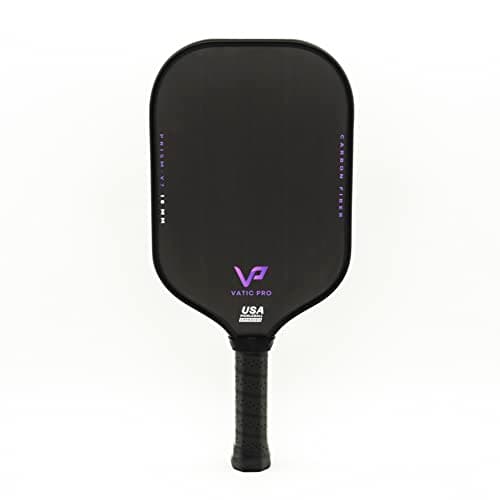
The Vatic Pro Prism is the paddle we point intermediate players toward when they ask why the enthusiast paddles cost $200. It carries the construction the expensive paddles are sold on — a raw carbon face, a 16mm core and foam-injected thermoformed walls — from a direct-to-consumer brand that does not pay for tour sponsorships.
What Vatic Pro is
Vatic Pro is one of a group of brands that built a following by selling paddles with enthusiast-grade construction at mid-market prices, mostly on reputation among improving players rather than on marketing. That is worth understanding before you buy, because it explains both the appeal and the risk: you are getting the construction without the brand infrastructure. Availability moves around more than it does for JOOLA or Selkirk, and the Amazon listing is where most buyers find it.
The construction, and what each part does
Raw carbon face. “Raw” means the carbon weave is left unpainted and unsealed, so the surface keeps its natural grit instead of being smoothed over by a finish coat. Grit is what bites the ball and generates spin. The trade-off is that raw faces wear: the grit that makes them spin is a consumable, and a heavily used raw face generates less spin at eighteen months than it did new. Our paddle cleaning guide covers how to slow that down.
16mm core. A thicker core generally means a softer, deader response — the ball sinks into the face slightly longer, which gives you more control on a dink and takes some pop off a drive. 16mm is the mainstream enthusiast choice for exactly that reason; our 14mm vs 16mm comparison sets out both sides.
Foam-injected walls and thermoforming. Thermoforming is a manufacturing method where the paddle is formed as one unibody piece under heat rather than assembled around an edge guard, and foam injected into the perimeter walls stiffens the frame. The claimed effect is a larger usable sweet spot and more power off the edges of the face, because the whole structure flexes as one piece rather than going dead outside the middle. This is the construction that defined the last few years of paddle development, and finding it below the premium price tier is the entire reason this paddle has a following.
Who it is for
This is an intermediate paddle in the truest sense. If you can already keep a rally going, you are starting to shape shots, and you have noticed that your fiberglass starter paddle does not do what you ask on a topspin dink, this is the class of paddle that will feel like an upgrade rather than an expensive lateral move.
It also suits singles players well, which is why it sits second on our best paddles for singles list — the stiffer thermoformed build and gritty face let you drive with topspin, which is how singles points get constructed.
Who should skip it
Genuine beginners. A stiff, spin-oriented paddle gives you nothing if you are still learning where the middle of the face is, and it costs several times what a first paddle should. Start with our beginner picks and upgrade when you can name what you want the new paddle to do.
Anyone with elbow trouble. Stiff, thermoformed paddles transmit more shock to the arm than a softer, more flexible build. If you have had tennis elbow, this is not the direction to go — see our tennis elbow picks instead.
Players who want a brand-name resale market. Enthusiast-brand paddles hold less resale value than the mainstream names, and warranty service is a smaller operation.
What we can and cannot tell you
We have not physically tested this paddle, and we are not going to imply otherwise. Everything above is drawn from the manufacturer-published construction on the live listing, read against the same rubric we apply to every paddle on this site, weighted for the intermediate tier. What that means in practice: we can tell you what a raw carbon face and a foam-injected 16mm thermoformed body are designed to do and who that design suits, and we can score it consistently against the alternatives. We cannot tell you how it sounds, how the swing weight feels in your hand, or how the grit holds up after a year of outdoor play, because those require hitting with it and we have not.
The specific thing we would want to check in person is balance. Thermoformed paddles are often head-heavy, and head weight is the difference between a paddle that feels powerful and a paddle that feels slow in a hands battle. The listing does not publish a swing weight, so treat that as an open question rather than a settled one.
How it compares
Against the JOOLA Ben Johns Hyperion, you are giving up the elongated shape and the brand support, and saving real money. Against the Franklin Ben Johns, you are paying more for a stiffer, grittier, more modern construction — worth it if you have the technique to use spin, not worth it if you do not. Against a fiberglass starter paddle, it is a different category of equipment entirely.
Against the Luzz line, the two brands are doing the same thing from different directions: Vatic sits lower on price, while Luzz publishes fuller performance numbers — including a swing weight, which this listing does not.
If you are cross-shopping the whole tier, our best carbon fiber paddles roundup ranks it against the rest of the carbon-faced field, and best paddles for intermediate players puts it in the context of the level it is built for.