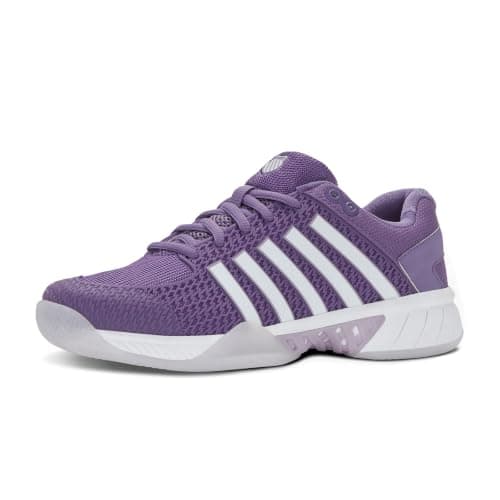
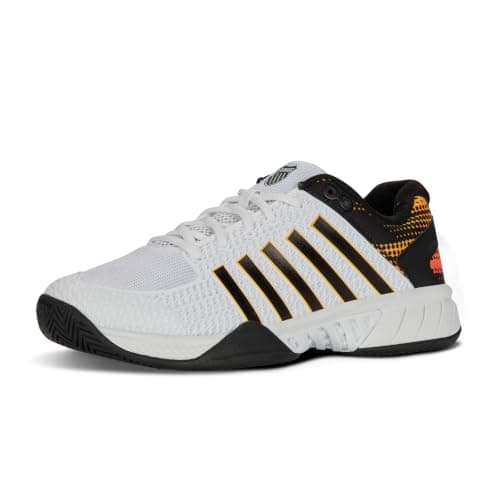
The K-Swiss Express Light is the default court shoe on this site because it does the one thing that matters — a real court outsole with lateral support — in a light, purpose-built package at a price the brand's rivals do not match. It is not the most cushioned shoe we rank, it runs slightly narrow through the heel, and there is now a second version. This review lays out what is published, what is reported, and who should look elsewhere.
What it is
K-Swiss has made court shoes for over half a century, and the Express Light Pickleball is the model it built when the sport got big enough to deserve its own shoe rather than a rebadged tennis one. K-Swiss describes it as “a lightweight, breathable shoe built for players of all levels,” with “a K-EVA midsole and 180-degree Plantar Support Chassis” for stability and “the Aosta rubber outsole with DragGuard” for durability. The listed construction is a synthetic leather upper, a textile collar lining, a molded rubber outsole, a CMEVA midsole, a die-cut Ortholite x40 sock liner and a lace closure.
The men's listing we link to is the original Express Light Pickleball; the women's listing carries the same name and one of the same colorways K-Swiss lists for the original. Both were re-verified as live listings on the day this review was published.
The published spec sheet
| Spec | Published figure | Source |
|---|
| Weight | 12.7 oz (men's) | Pickleball Central spec sheet |
| Midsole | K-EVA / CMEVA with 180-degree Plantar Support Chassis | K-Swiss |
| Outsole | Aosta rubber, DragGuard at toe and heel, modified herringbone, non-marking | K-Swiss; Pickleball Central |
| Upper | Synthetic leather with Durawrap toe protection | K-Swiss; Pickleball Central |
| Sock liner | Die-cut Ortholite x40 | K-Swiss |
| Fit measurements | Heel slightly narrow (68mm); midsole slightly narrow (77mm); toe box standard (97mm) | Pickleball Central |
| Widths | Medium; a 2E wide version is listed by K-Swiss | K-Swiss catalog |
| Outsole guarantee | None | Pickleball Central |
Two things worth noticing. K-Swiss itself does not publish a weight; the 12.7-ounce figure is the retailer's, and an April 2026 write-up at The Pickleball Gang gives the same number for a men's 10.5. And the shoe carries no outsole durability guarantee, which several tennis-shoe rivals offer — a small point, but a real one for a player who drags a toe.
Who it is for
The player who wants one shoe that is unarguably right for the court and does not want to overthink it. That describes most of the readers who arrive at our beginner shoe picks, which is why this shoe leads them. It is light enough for quick lateral steps, the toe is reinforced against the drag that shreds running shoes, and the Plantar Support Chassis is a stability feature most shoes at this price do not publish. The review themes Pickleball Central summarizes — comfortable, lightweight, excellent traction, good lateral support, little break-in — match the reasons we rank it.
Who should skip it
- Players who want plush cushioning.A court shoe is deliberately firmer and lower than a running shoe, and this one scores a 7 on cushioning against a 9 for the ASICS Gel-RENMA 2 and the Skechers Viper Court Pro 2.0. “Very stiff shoe, my feet hurt after just two hours of play” is a representative complaint in the retailer's reviews.
- Wide feet, unless you buy the 2E. The published heel and midsole widths are slightly narrow. Our wide-feet picks lead with the New Balance FuelCell for a reason.
- Anyone between sizes.“Shoes were too short” recurs in the reviews, and the Pickleball Gang piece reports community feedback that it “can run a half-size small.” Sizing up is the safer error.
- Players chasing style. It is a functional shoe with a pickleball logo. That is not a criticism from us, but it is one from some buyers.
What the Express Light 2 changes
K-Swiss now sells an Express Light Pickleball 2 at the same list price as the original. The brand's description says it “builds on the legacy of the original, delivering the same trusted step-in comfort and playability,” and is “upgraded with a redesigned upper and enhanced durability in high-wear zones on both the upper and outsole.” The listed construction drops to a synthetic upper, molded rubber outsole and CMEVA midsole; the Plantar Support Chassis, Aosta and DragGuard names do not appear on the version 2 page, and no weight is published for it. We link to the original because it is the listing we can verify and price live; if you find the 2 at a similar price, the published changes are all in the direction of durability.
What we cannot tell you
We have not worn either version on a court. How the K-EVA feels after two hours, how long the herringbone keeps its bite outdoors, whether the slightly narrow heel is a problem for your foot — those are questions only wear answers, and the attributed reports above are the closest we can get. The scores on this page are judgments from published specifications, per the rubric on our methodology page.
Men's vs women's
Both listings are the Express Light Pickleball; the women's is built on a women's last rather than being a downsized men's shoe. Prices differ, and at recent checks the men's listing has carried a discount from list while the women's has not — the buttons show today's numbers.
How it compares
Against the ASICS Gel-RENMA 2, the K-Swiss is lighter and cheaper at recent checks; the ASICS is more cushioned and scores higher on support. Against the Wilson Rush Pro 4.5, a tennis shoe that crosses over, the K-Swiss is the lighter, pickleball-specific choice and the Wilson the more durable, often-discounted one. Against the Skechers Viper Court Pro 2.0, the K-Swiss is firmer and more connected, the Skechers softer and more forgiving. Our full shoe ranking puts all of them side by side.
Making it last
Court shoes die from the midsole inward, not the outsole outward. Rotate two pairs if you play more than three times a week, keep them for the court rather than the errands, and replace them when the cushioning packs down — our shoe lifespan guide covers the signs.