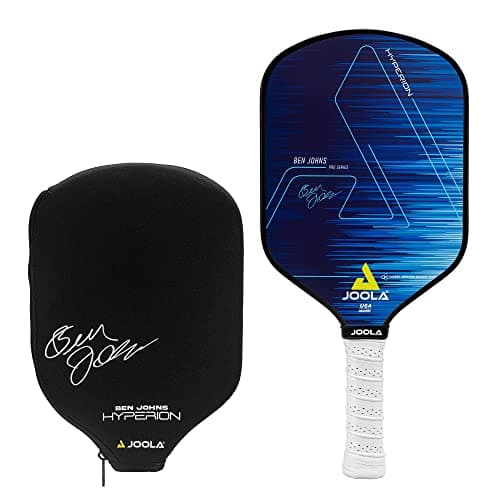
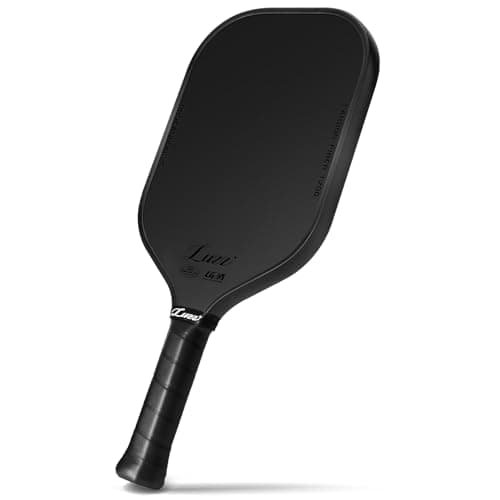
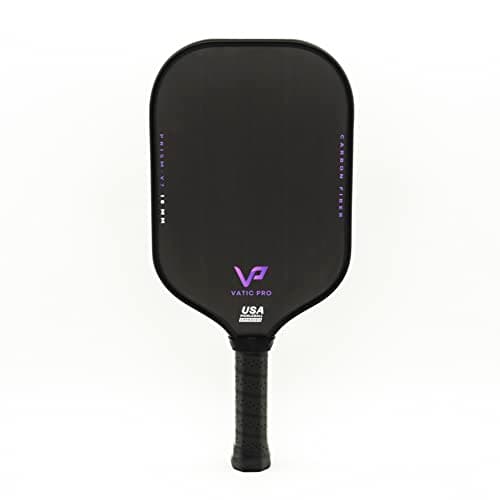
For most players the Vatic Pro Prism is the better buy: it matches the Hyperion's published outline and core thickness, scores higher on control, and costs meaningfully less at every price check we have run. Buy the JOOLA Ben Johns Hyperion if maximum spin is the whole point, if you want the longer 5.5-inch handle for a two-handed backhand, or if the name matters to you. If you like the Prism's price but want a full thermoform, the Luzz Cannon is the third option.
Why these two get compared
Google suggests this comparison for both brands, and the reason is on the spec sheets. JOOLA publishes the Hyperion CFS 16 at 16.5 inches long by 7.5 inches wide with a 16mm reactive polymer honeycomb core. Vatic Pro publishes the Prism V7 at 16.5 by 7.5 with a 16mm honeycomb core. Both have carbon faces built for spin, both are elongated, both sell as USA Pickleball approved. On paper they are the same paddle; on the price tag they are not. The question is what the difference buys.
Spec for spec
Everything in the table is a published figure from the manufacturer or its retailer spec sheet, linked in the sources. Nothing was measured by us.
| Spec | JOOLA Ben Johns Hyperion CFS 16 | Vatic Pro Prism V7 16mm |
|---|
| Face | Carbon Friction Surface (Carbon-Flex5 texture) | Raw TORAY T700 carbon with heat-compressed texturing |
| Core | 16mm reactive polymer honeycomb | 16mm C7 polymer honeycomb (also sold in 14mm) |
| Length x width | 16.5 x 7.5 in | 16.5 x 7.5 in |
| Handle length | 5.5 in | 5.3 in standard or 5.75 in long handle |
| Grip circumference | 4.25 in (JOOLA notes it may vary) | 4.125 in |
| Weight | 8.4 oz average (8.2–8.6 oz range) | Not published as a fixed figure; custom weight requests accommodated, not guaranteed |
| Edge | Edge guard, 1/4 in overlapping the face | Unibody foam-injected walls, anti-abrasion TPU edge guard |
| Construction | Traditional layup with edge guard | Unibody with foam walls; positioned by Vatic Pro between thermoformed and Gen-1 |
| Approval | USAP approved; PBCoR .43 certified (JOOLA) | Sold as USAP approved |
| Our scores (control / power / spin / forgiveness / value) | 8 / 8 / 10 / 6 / 7 | 9 / 8 / 9 / 6 / 8 |
Where the Hyperion wins
Spin. The Hyperion is the only paddle in our registry scoring a 10, and the Carbon Friction Surface is the reason: it is the grittiest face JOOLA makes in this line and the one hands-on reviewers, quoted in our Hyperion review, consistently single out. Handle.5.5 inches as standard, against the Prism's 5.3 — though Vatic Pro sells a 5.75-inch long-handle version that reverses this. Published weight. JOOLA gives a range; Vatic Pro says exact weights are not guaranteed. If you care about matching two paddles, that matters. The name. This is the original Ben Johns signature paddle, and for some buyers that is the purchase.
Where the Prism wins
Price.At every check we have run the Prism has been the cheaper paddle by a clear margin; the buttons show today's numbers. Control.The Prism scores a 9 to the Hyperion's 8, and Vatic Pro's own description — foam walls and polyurethane grip inserts pitched at reset and placement — is the description of a control paddle that spins, rather than a spin paddle that controls. Edge.Foam-injected unibody walls are the construction the more expensive paddles in the category use, and the Hyperion's traditional edge guard is one of the things our review lists against it. Grip. 4.125 inches is small enough to build up with an overgrip; 4.25 is already large for smaller hands.
What neither of them is
Forgiving. Both score a 6, both are elongated, and both reward clean contact. A beginner buying either one is buying reach and spin they cannot use yet and a sweet spot that punishes the mishits they are still making. If that is you, our beginner picks are the better money, and the elongated vs standard guide explains what the shape costs.
Nor is either one a Gen-1 paddle in the current sense. The Hyperion CFS 16 is the original Hyperion; JOOLA has built several newer generations under the Ben Johns name since, which the review covers. The Prism is Vatic Pro's answer to players who found full thermoforms too powerful — which is also a way of saying it is not the most powerful paddle Vatic Pro makes.
The verdict, by player
Intermediate moving to carbon for the first time: Prism. The price gap is money you have not proven you need to spend, and the control score is the higher one. Spin-first player with a two-handed backhand: Hyperion, or the Prism in the long-handle configuration if you are price-sensitive. Singles player who wants reach and drive: either; the outlines are identical, and our singles picks rank the Hyperion first for the extra spin on a dipping drive. Player with any arm history: Prism, for the polyurethane grip inserts Vatic Pro says are there to reduce shock, and read our tennis elbow picks before either.
The third option: Luzz Cannon
If the Prism's price is right but you actually want a full thermoform — stiffer, more powerful, pressed as one piece — the Luzz Cannon publishes a T700 face, a 16mm core, a 16.54 x 7.5-inch elongated body and a 5.52-inch handle, and sits between the two on price at the last check. It is the highest-scoring paddle in our under-$150 ranking and the subject of the Luzz review. The trade is stiffness: it is the least forgiving of the three on an off-center hit.
What we cannot tell you
We have not hit with either paddle. What the sweet spot feels like on a mishit, how quickly each face loses its grit, whether the Hyperion's edge guard lifts after a season of ground contact — those are questions only play answers, and the hands-on reports we quote in each review are the closest we can get. Every score on this page is a judgment from published specs, per the rubric on our methodology page.