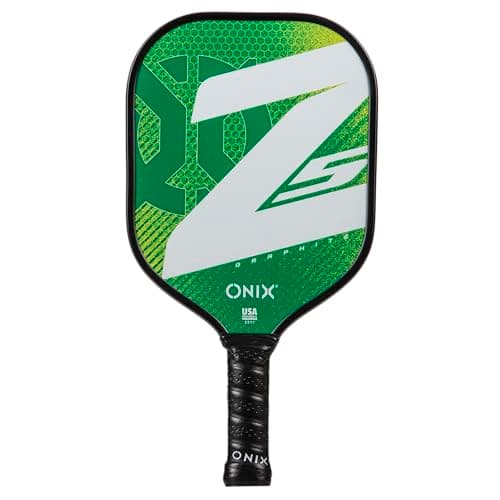
The Onix Z5 is a wide-body, medium-weight paddle with a graphite face over a Nomex honeycomb core, and it earns its place on our lists for one reason: an 8-1/8-inch-wide face that gives a developing player the most forgiving sweet spot in our registry. It is the paddle we rank first for seniors and lead with for intermediate players. It is also a design that predates textured carbon faces and thick polymer cores, and this review is honest about what that costs.
What it is, and which one you are buying
Onix currently sells three paddles under the Z5 name: the Z5 Graphite, the Z5 Mod Series Graphite and the Z5 Mod V2 Graphite. We read all three product pages, and Onix publishes the same description for each, word for word apart from the name: “the most popular pickleball paddle in the Onix line because of its outstanding touch and ball control,” a “graphite face and nomex core,” a “total paddle weight of 7.5–8.2 ounces,” and a “Widebody shape” that is “great for beginner through advanced level players with its large sweet spot.” Onix does not say anywhere what “Mod” means, and neither does its parent company's catalog. The visible difference in the published material is the colorways: the Mod V2 page lists seven, the Mod page pink and blue, the Graphite page blue.
So when you read a review of “the Z5,” you are reading about one construction in several paint jobs, as far as anything Onix publishes can tell you. The listing we link to is the Graphite Mod Z5 on Amazon (ASIN B0D6MN4STP), which we re-verified as a live, in-stock listing on the day this review was published. Amazon carries at least eight Z5 listings under slightly different titles, and at our check their prices differed by more than double for what Onix describes as the same paddle — so compare the listings before you buy, and use our live price as the reference for the one we link.
The published spec sheet
| Spec | Published figure | Source |
|---|
| Face | Graphite (woven, screen-printed Z) | Onix; Escalade; Pickleball Central |
| Core | Nomex paper honeycomb | Onix; Escalade |
| Weight | 7.5–8.2 oz range; 7.9 oz average | Onix (range); Pickleball Central (average) |
| Length x width | 15-1/2 x 8-1/8 in (Escalade lists 15.5 x 8.3 in) | Pickleball Central; Escalade |
| Handle length | 5 in | Pickleball Central |
| Grip circumference | 4-1/4 in (may vary up to 1/8 in); perforated cushion grip | Escalade; Pickleball Central |
| Edge guard | 1/4 in overlapping the face | Pickleball Central |
| Approval | Not stated on Onix's product pages; check the approved list before sanctioned play | USA Pickleball approved paddle list |
Two things to notice. The retailers disagree on the width by about a fifth of an inch, which is the kind of spread you see when one measures the face and the other the edge guard; either way this is the widest paddle we rank. And nothing Onix publishes gives a core thickness — Escalade's 1.5-inch “height” is the packaging dimension, not the core — so the 14mm-vs-16mm conversation that dominates our core thickness guide does not really apply here. This is a paddle from before that conversation.
What Nomex means for the feel
Almost every paddle in our registry uses a polypropylene (polymer) honeycomb core. The Z5 uses Nomex, a resin-impregnated paper honeycomb that is stiffer and harder than polymer. Onix describes the result as “superior feel of the ball” and “outstanding ball control,” and the independent review we read agrees that control is one of its biggest strengths. The other side of a hard core is documented in the retailer's own customer reviews, where “excessive noise” is a recurring complaint: Nomex paddles are loud, with a sharper crack on contact than a polymer paddle's thud. If you play somewhere with noise-sensitive neighbors, that is a real consideration, not a nitpick.
A hard core also returns more of the ball's energy, which is why the Z5 feels lively off the face and why a soft dink asks more of your hands than it would on a thick polymer paddle. Players describe the same paddle as “solid” and as having “great feel,” and both are true; what neither means is “soft.”
Who it is for
The player whose contact is still settling. A face 8-1/8 inches wide puts more of the paddle behind an off-center hit than any standard or elongated shape can, and that is the whole case for the Z5: it turns mishits into playable balls while you learn where the middle is. That describes most beginners, most social intermediates and a great many older players, which is why it leads our seniorspicks — forgiveness and a medium weight matter more there than spin. It also suits a doubles player who wants a big blocking surface at the kitchen, and anyone moving up from a set paddle who wants a recognizable name at a mid-tier price rather than a leap to raw carbon.
Four reasons to skip it
- Spin is limited.A smooth graphite face does not grip the ball the way a textured carbon face does; the Dink Sink review names “limited spin compared to textured paddles” as its first weakness, and our own graphite vs carbon fiber guide explains why. If shaping shots is where your game is going, look at our spin-and-control picks instead.
- The wide body is slower. Width costs reach and hand speed. Our elongated vs standard guide covers the trade; in a fast hands battle at the net a wide body turns more slowly than a standard shape, and in singles it gives up the reach an elongated paddle buys.
- It is loud, and it is hard. Nomex is the reason for both. Players with any elbow history should read our tennis elbow picks first, none of which use a Nomex core.
- Durability complaints exist.Among 765 reviews on the retailer's page, the recurring negatives are the grip deteriorating within a month and the graphite face splintering at the edge. We cannot verify how common either is, but they are the complaints that repeat. An overgrip fixes the first cheaply; the second is what the edge guard is for, and our paddle lifespan guide covers what edge damage means.
A correction to our own product card
While researching this review we found that our product card for the Z5 had described its face as carbon fiber and credited a “carbon face” with adding bite over an earlier version. Onix publishes a graphiteface and a Nomex core for every Z5 it sells, and Escalade and Pickleball Central say the same; the Amazon listing title uses both words. Graphite is a carbon material, but on this site “carbon fiber face” means a textured raw-carbon surface built for spin, and the Z5 is not that. We corrected the card on September 20, 2026: the spec chips now read graphite face and Nomex honeycomb core, and the pro that credited a carbon face was replaced with what Onix actually claims for the Nomex construction. The paddle's scores and its position on every list are unchanged — its spin score was already a 7, not a carbon-paddle 9. Two roundup pages still describe the Z5 as carbon-faced in their prose; those are flagged for correction rather than rewritten here.
How it compares
Against the HEAD Radical Elite— the comparison Google suggests most — the Z5 is the wider, harder paddle: graphite over Nomex against fiberglass over a polymer honeycomb. The HEAD is quieter, softer and cheaper at our checks; the Z5 is more forgiving across the face and more connected. Both score a 5–7 on spin, so neither is the answer if spin is the question. Against the Franklin Signature Series Pro, the paddle that tops our flagship ranking, the Z5 gives up spin (the Franklin's MaxGrit coating scores an 8 to the Z5's 7), matches it on control, and wins only on forgiveness; the Franklin also costs a little less at our checks, which is why it outranks the Z5 for almost every player except the one who needs the width. Against the GAMMA Conqueror, the other graphite-composite face in our registry, the Z5 is the more established paddle with the bigger face; the GAMMA is the cheaper alternative from another racket-sports brand, with a modest face texture of its own.
The honest summary: in 2026 the Z5 is a forgiveness specialist. Ten years ago its combination of graphite and Nomex was the performance choice; today the performance choices are textured carbon over thick polymer, and the Z5's remaining argument is the one it has always had. For the player who needs that argument it is still the right paddle.
Which listing to buy
Because Onix publishes the same construction for the Graphite, Mod and Mod V2, the sensible way to choose is price and color: pick the colorway you like from whichever listing is cheapest that day. The live button on this page reflects the listing we verified; if you go to Amazon directly, compare the Z5 listings side by side, because at our check the same paddle appeared at prices more than double one another. If a listing's title says “composite” rather than “graphite,” that is a different face material — Onix's current catalog is graphite-only, and a composite listing is old stock.
Grip size
The published 4-1/4-inch grip with up to 1/8 inch of variance sits in the middle of the registry. Our grip size guide shows how to measure your hand; if you are between sizes, this is a paddle to size down on and build up with an overgrip, because the stock cushion grip is also the part reviewers say wears first.
Is it approved for tournaments?
Onix's product pages do not state USA Pickleball approval, and the approved paddle list is searchable by brand and model but not readable by our tools. If you plan to play sanctioned events, search the list for the exact model name on your listing before you buy. The equipment standards it is tested against are linked in the sources.
Alternatives by reason
If you want the forgiveness but with spin, the Franklin Signature Series Pro is the next step and costs about the same. If you want a quieter, softer beginner paddle, the HEAD Radical Elite or the niupipo on our beginner list. If you have outgrown the need for a wide body, the Vatic Pro Prism is where we send intermediates who are ready for raw carbon. And if you are choosing a paddle for someone else, the Z5 is on our intermediate gift guide for the same reason it is here.
What we cannot tell you
We have not hit a ball with any Z5. How loud it really is on your court, whether your grip wears in a month or a year, what the difference between the Mod and the Mod V2 feels like in the hand if there is one — those are questions only play answers. What we did was read the three Onix product pages, the parent company's catalog page, a specialty retailer's spec sheet and its customer review themes, and one independent review, and score the result against the rubric on our methodology page. Every number above is theirs, and the scores are our judgment of it.