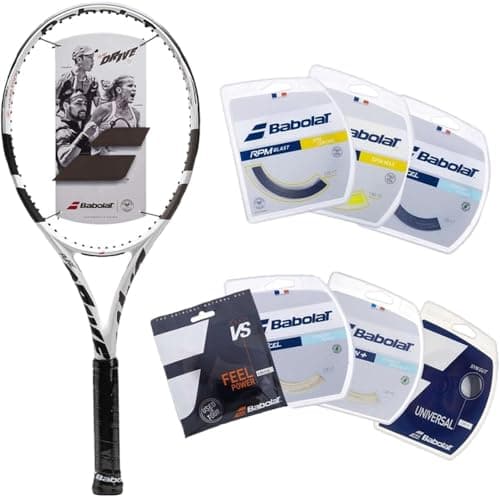
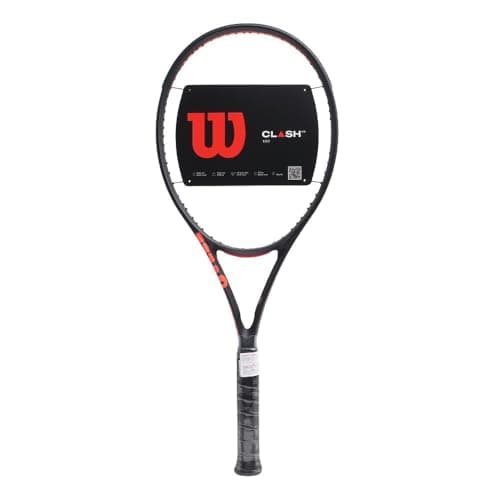
Buy the Wilson Clash 100 v3 if you want control and comfort and your arm has ever complained. Buy the Babolat Pure Drive if you want free depth and your arm is bombproof. That is the whole decision, and it rests on one published spec: Tennis Warehouse lists the Clash at RA 54 and the Pure Drive at RA 69.
Why these two get cross-shopped
Because on a spec sheet they look like the same racquet. Both are 100 square inches. Both run a 16x19 string pattern. Both are 27 inches. The Clash is published at 11.0 oz strung, the Pure Drive at 11.2 oz — a difference of about six grams, which nobody can feel.
They are also the two default recommendations for an intermediate player, from two of the three biggest brands in tennis, at a similar price. If you walk into a shop as a 3.5 looking to upgrade, these are the two frames you will be handed.
The spec that separates them
| Spec | Wilson Clash 100 v3 | Babolat Pure Drive |
|---|
| Head size | 100 sq in | 100 sq in |
| Strung weight | 11.0 oz / 312 g | 11.2 oz / 318 g |
| String pattern | 16x19 | 16x19 |
| Balance | 7 pts head-light | 4 pts head-light |
| Swingweight | 308 | 317 |
| Stiffness (RA) | 54 | 69 |
Fifteen RA points is not a nuance. It is close to the full width of the mainstream range: RA 54 is among the softest performance frames anyone sells, and RA 69 is firmly at the stiff end. Everything you will feel on court traces back to that row.
What RA 54 feels like
The Clash bends. The ball sits on the string bed fractionally longer, which gives you more information about what you just did and more ability to shape the shot. Touch volleys and drop shots are noticeably easier. Shock through the wrist and elbow is reduced, which is why it is the standard recommendation for players with arm history.
The cost is free depth. Against a pusher who gives you nothing, you supply all the pace yourself, and on a tired evening that shows.
What RA 69 feels like
The Pure Drive does not bend, so almost all the energy goes back into the ball. Depth is effortless. The 4-point head-light balance and 317 swingweight put more mass behind the ball than the Clash's 7 points and 308, which is why it feels like it hits a heavier ball even though it weighs six grams more.
The cost is shock, and a less informative feel. You know the ball left; you know less about how.
Which one, by player
| If you… | Buy |
|---|
| Have had tennis elbow, or feel anything after a long match | Clash 100 v3 |
| Want to string with a full polyester bed | Clash 100 v3 |
| Play a lot of doubles and want touch at the net | Clash 100 v3 |
| Struggle to get depth and hit short | Pure Drive |
| Have a compact swing and need the frame to help | Pure Drive |
| Are a flat hitter who wants a heavy ball | Pure Drive |
The string decision changes with the frame
This is the part most comparisons skip, and it matters more than the frame choice.
In the Clash, a polyester is a reasonable default. The frame's flex absorbs enough shock that a full poly bed is comfortable for most players, and the added control pairs well with a soft frame. Solinco Hyper-G Soft or Yonex Poly Tour Pro are good starting points.
In the Pure Drive, a full stiff poly is the combination to avoid. Stiff frame plus stiff string is the classic injury pathway. Either hybrid it (poly mains, multifilament crosses) or string a multifilament like Wilson NXT throughout, and go toward the lower end of the 46–55 lb published range.
Full detail on both options is in the strings hub, and the comfort-specific version is at strings for tennis elbow.
What about the Wimbledon edition?
The Pure Drive we link to is the Wimbledon 11th Gen limited edition, which is the same frame in a different cosmetic at a limited-edition price. If the colourway does not matter to you, the standard Pure Drive is the identical racquet for less money — worth checking current availability before you commit. And if you are cross-shopping inside the Babolat range rather than across brands, the other comparison that matters is Pure Drive vs Pure Aero.
If neither is right
These two define the ends of a spectrum, and there are frames in the middle. The HEAD Boom MP sits between them on feel and ships strung, which makes it the easiest to actually buy. The Yonex EZONE 100 is the frame that genuinely refuses the trade: real power with handle dampening, at a higher price. Both are on our intermediate racquets list.
The honest summary
These are both excellent racquets and the Pure Drive has outsold almost everything in tennis for two decades for good reasons. The Clash wins our pick not because it is a better frame but because the failure mode is kinder: a player who buys the Clash and wanted more power is mildly disappointed, and a player who buys the Pure Drive, strings it with poly and develops tennis elbow loses a season.
How we picked
We have not physically tested this gear
Everyone in this category says they tested twenty racquets. We have not tested any — and we say so. What we did instead: compiled the manufacturer-published specifications (head size, strung weight, string pattern, stiffness, outsole compound), normalized them, and scored each product against a published rubric weighted for the NTRP tier this page serves. The scores are judgments from documented research, not measurements we took, because we do not have a lab and are not going to pretend we do.